Author Archives: Johna Till Johnson

Christmas in February

By Johna Till Johnson

IMGP0001 cropped small

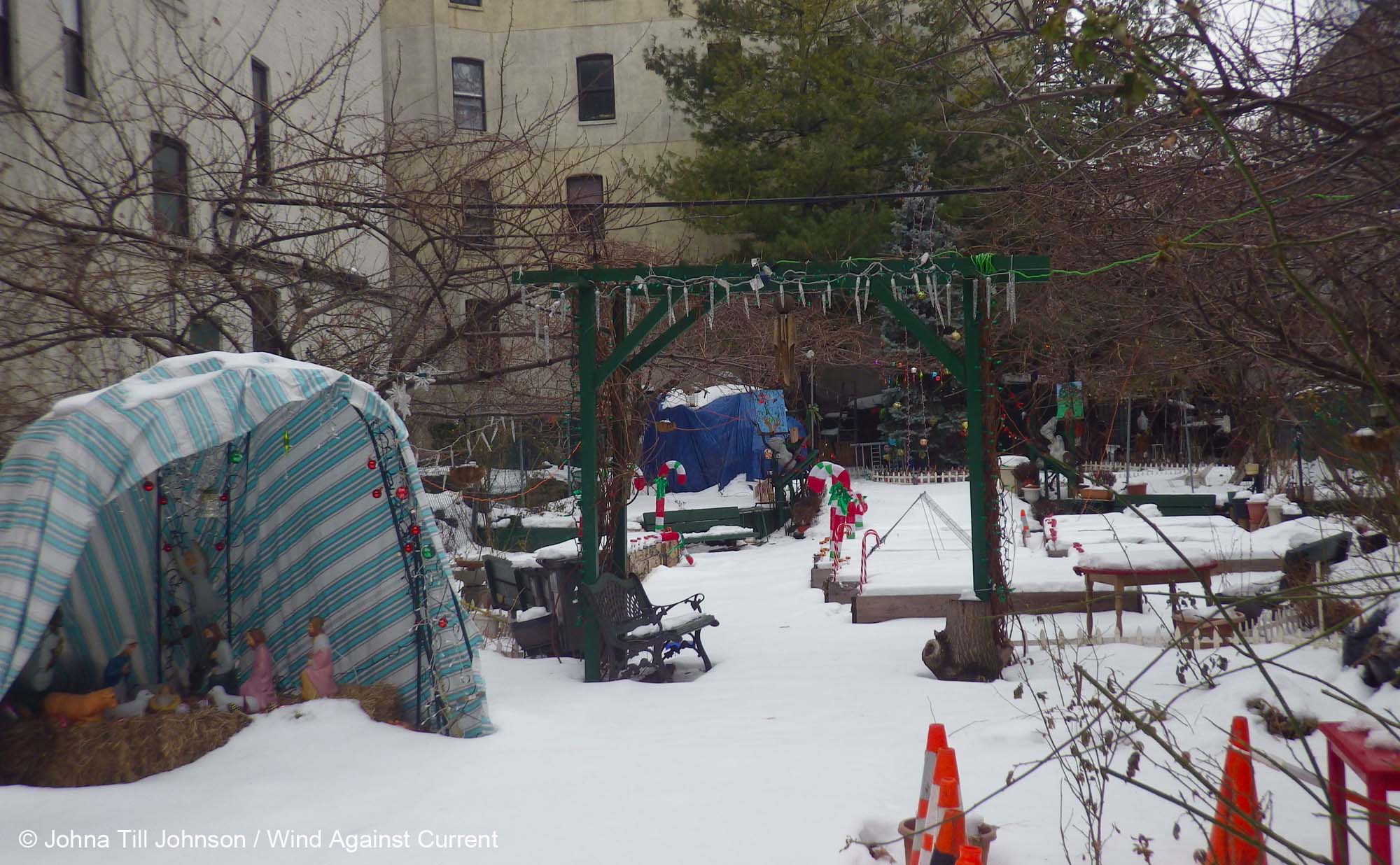
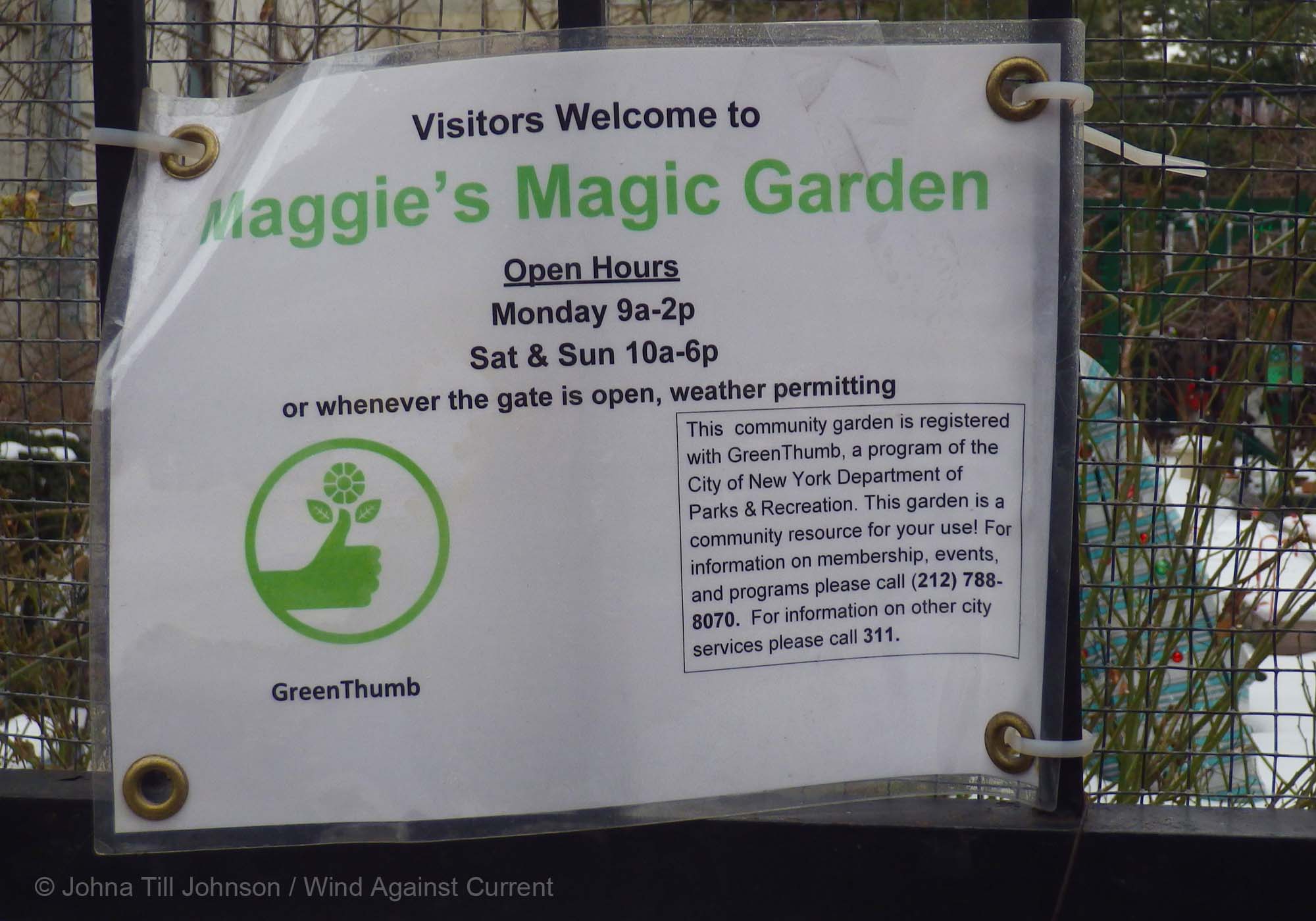
Maggie’s Magic Garden

Last week I did something I’ve been meaning to do for a while: I went to Maggie’s Magic Garden to take a few photos.

Vlad and I had passed this space many times. It’s a community garden, a small, open plot of land surrounded by buildings. As the seasons changed, it provided a lovely glimpse of nature amidst the urban setting.

So I was curious to see what I’d find in midwinter, after the first few snowfalls of the year. I don’t know what  I expected, but it wasn’t what I found: Christmas in February!

IMGP0005 cropped small

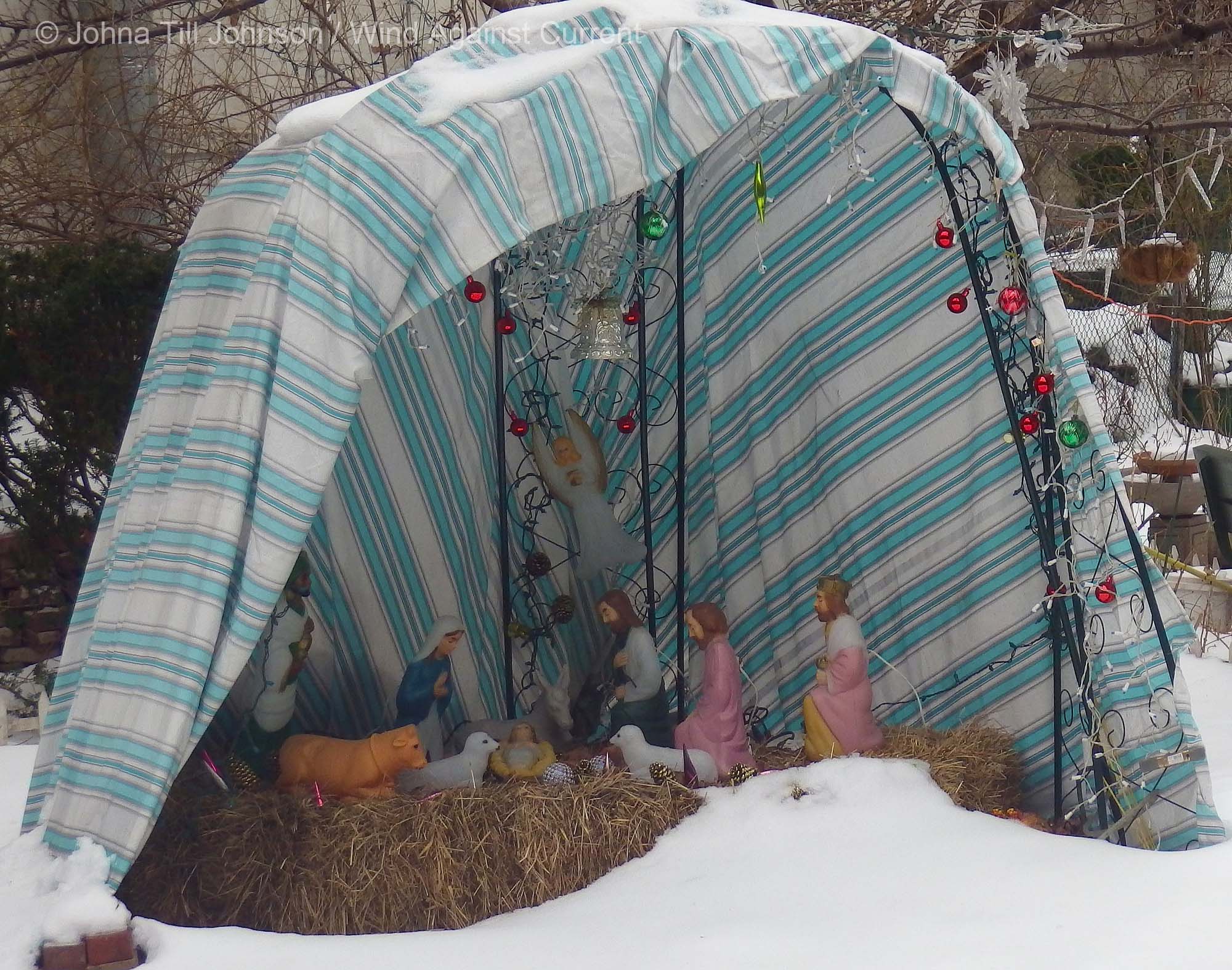
Christmas in February

My favorite part of the Christmas decorations was the homemade creche, with what looked like a bedsheet draping over the figurines. (Also note the angled angel over the manger.)

IMGP0004 cropped small

Homemade creche

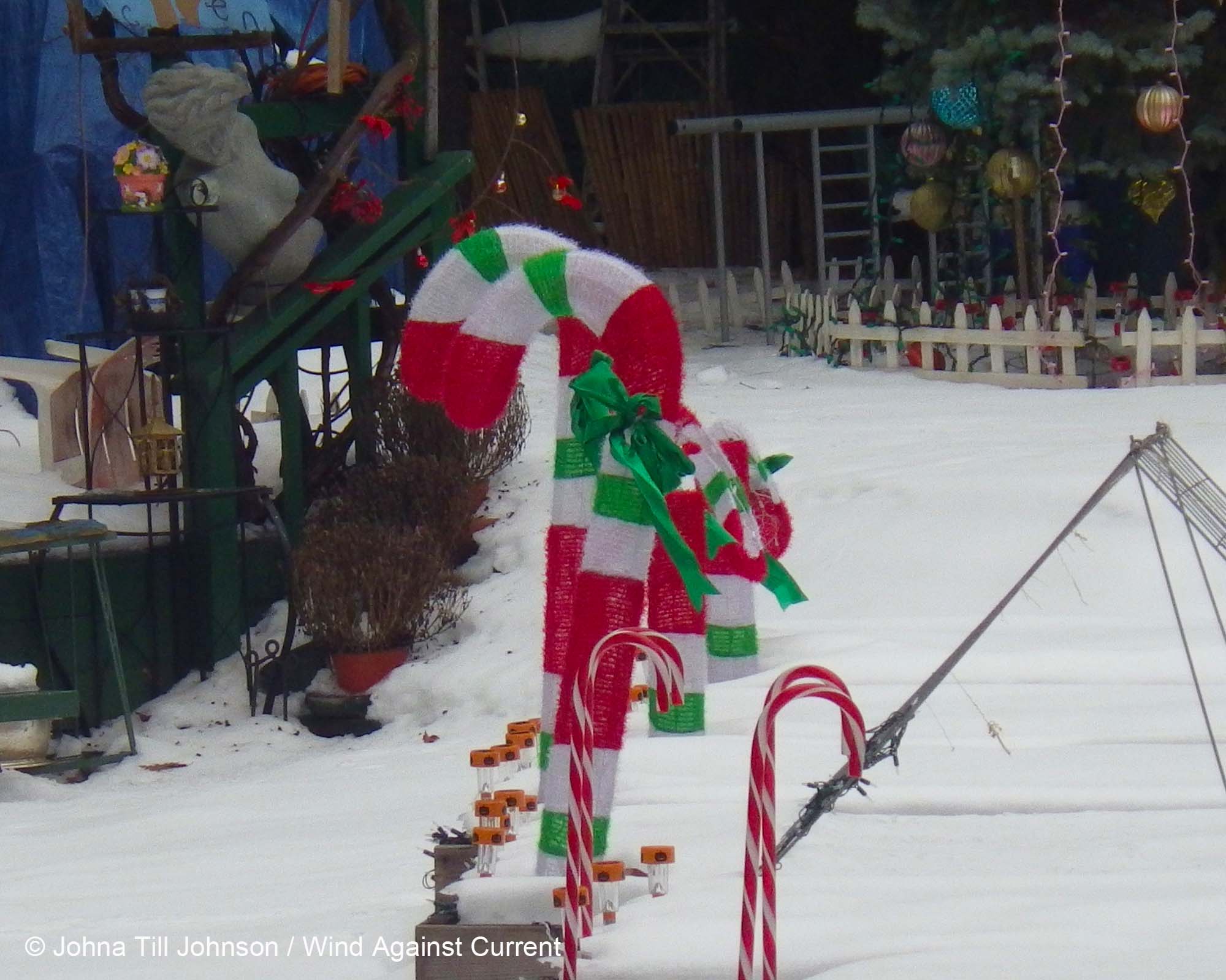
And there were more secular decorations as well…

IMGP0008 cropped small

Bright candy canes

Alas, I wasn’t able to get into the garden to explore—despite the sign, it was closed when I visited. But it clearly lives up to its description: Magical indeed. I’ll be back there in the spring, to see what magic is afoot then!

NYC’s Magical Snow Day

By Johna Till Johnson
Photos by Johna Till Johnson and Vladimir Brezina

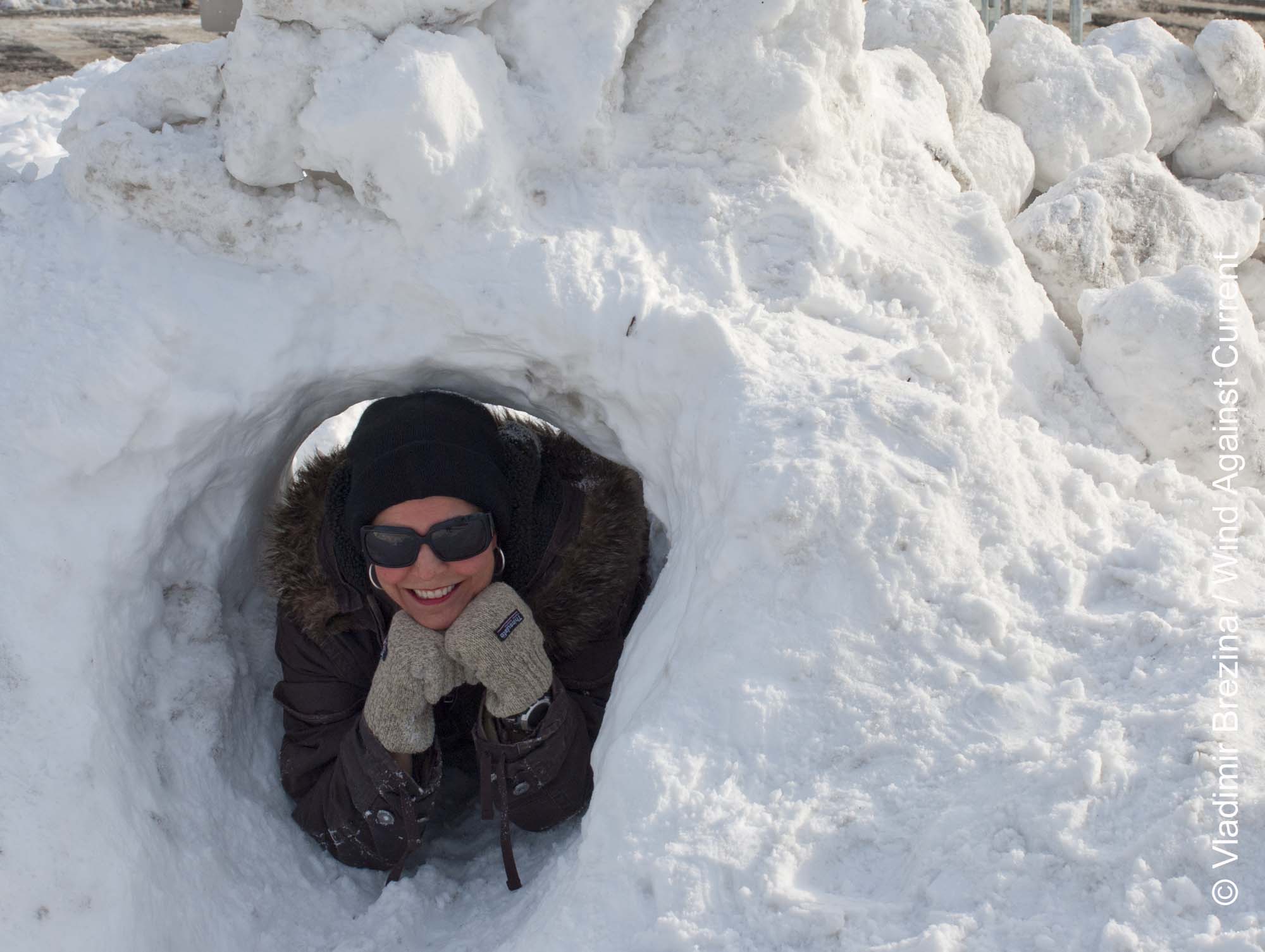
Johna exploring a snow fort in Central Park (photo by Vlad)

By rights, New York City should still be digging out from the blizzard that was to be “historic, catastrophic”—except that it wasn’t.

The storm was predicted to bury New York in up to thirty inches of snow. In anticipation, the Mayor and the Governor declared a state of emergency, shut down the subway system, and banned all vehicles (including taxis and delivery bicycles) on the grounds that stalled vehicles would impede emergency efforts.

And then the blizzard didn’t happen. True, Long Island got a couple of feet of snow. And coastal New England, including Boston, got hammered.

But here in New York, we awoke to a mere eight inches of snow in Central Park… and a government-mandated, universally observed, snow day.

It was great!

Continue reading

The Sunspot Story

By Johna Till Johnson

Suspended lion face
Spilling at the centre
Of an unfurnished sky
How still you stand,
And how unaided
Single stalkless flower
You pour unrecompensed.

The eye sees you
Simplified by distance
Into an origin,
Your petalled head of flames
Continuously exploding. …

—Philip Larkin, Solar

.
What’s the longest-running scientific experiment in history?

I bet you didn’t think of monitoring sunspots.

Sunspots

Sunspots (photo by NASA)

And I can’t definitively say it’s the longest-running experiment —there may be others I haven’t heard of yet. But the first recorded systematic observation of sunspots in the West was by astronomers Thomas Harriot, Johannes and David Fabricius  in 1610 (Chinese astronomers observed them as far back as 300 BC). Scientists have been monitoring sunspots ever since—which means that sunspots have been monitored for the past 405 years!

Continue reading

Christmas, 2014

By Johna Till Johnson
Photos by Vladimir Brezina and Johna Till Johnson

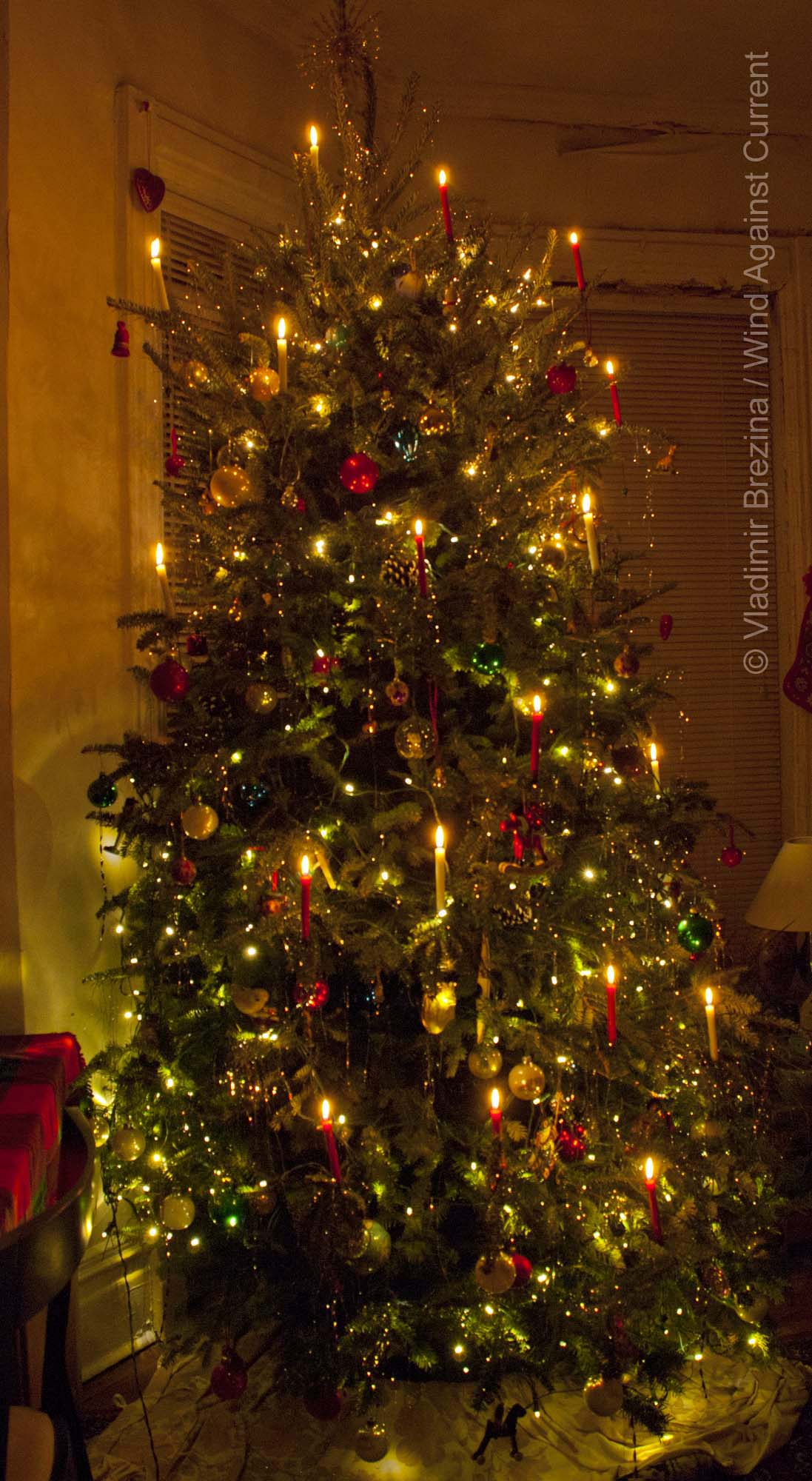
Our 2014 Christmas treeMaybe it’s because we spent last Christmas on the waters of the Florida Everglades. Or maybe it’s because this year has held more than the usual vicissitudes. For whatever reason, this year we found ourselves focused intently on the traditional trappings and rituals: A live tree, with real candles. A wreath, with ribbons and a bell. Roast goose, mashed potatoes, and cabbage. Christmas carols.

And they were wonderful: As the sun set on Christmas Eve, the apartment filled with the scent of roasting goose (overpowering the fresh fragrance of pine). Dinner that night was magical, with light glittering everywhere, and the sound of Christmas carols on the air.

Johna's favorite ornamentChristmas Day, we slept late, then spent a splendid several hours opening gifts. Okay, more like a few minutes doing the actual opening—but since most of the gifts were books (and most of the remainder was food), we spent a lazy afternoon listening to music, reading, and nibbling cookies. On Boxing Day, we did the official tree-candle lighting (complete with obligatory stand-by bucket of water and fire extinguisher).

All the trappings were there, and the rituals were most satisfactorily observed.  But even more than the trappings and decorations, what resonated most with us was the meaning of Christmas: light in darkness, hope for better times to come.

Continue reading

It’s All About the Ideas

By Johna Till Johnson

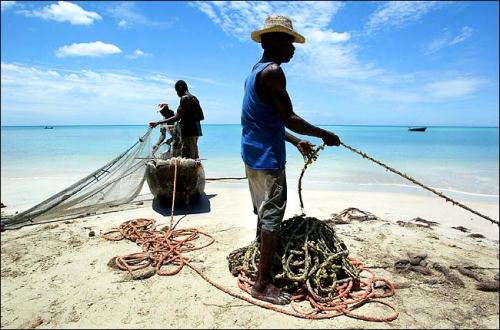
Haitian fishermen (photo Ruth Fremson/The New York Times)

“Ya gotta have ideas,” the cab driver said, followed by an uproarious belly-laugh. “Money’s not worth nothing unless you have ideas.”

I laughed along with him. It was impossible not to: the man had the most contagious laughter I’d ever heard. And he had ideas. Boy, did he have ideas.

He wasn’t what I expected when I got into the cab on that overcast, dreary December day a few days before Christmas. All I could see of him was a dark face, beard streaked with a bit of gray. He was eating a late lunch when I got in, and didn’t return my greeting.

So I figured I wasn’t going to hear much from him—and that was fine. I had errands to get done, and worries on my mind. After I told him the destination, I figured that was the last exchange we’d have. Wrong!

Continue reading

Guest Post: The Art of Art

A few days ago we posted “Thanksgiving Musings: We’re Grateful for that Still, Small Voice…,” in which we referred to a wonderful essay by writer and adventurer Willis Eschenbach. He generously gave us permission to reprint the essay in full on our blog. Here it is. We hope you enjoy it as much as we did!

Guest Post by Willis Eschenbach

With Thanksgiving coming up, I thought I’d write about something other than science. A few weekends ago, I went by kayak across Tomales Bay from Marshall to Lairds Landing, where I lived for nine months or so when I was about twenty-five with a wonderful friend and his lady and their son. It had been fifteen years since I was last there, I’d gone for the wake not long after my friend died. I went on this trip with a long-time shipmate of mine, a gifted artist, builder, and blacksmith.

Now, there are lots of words for the gradations of friendship—friends, acquaintances, work-mates, BFFs, room-mates, colleagues, and the like. “Shipmate” means more than any of those to me. It means someone who I’ve been through some storms with at sea.

Continue reading

Thanksgiving Musings: We’re Grateful for that Still, Small Voice…

By Johna Till Johnson
Photos by Vladimir Brezina

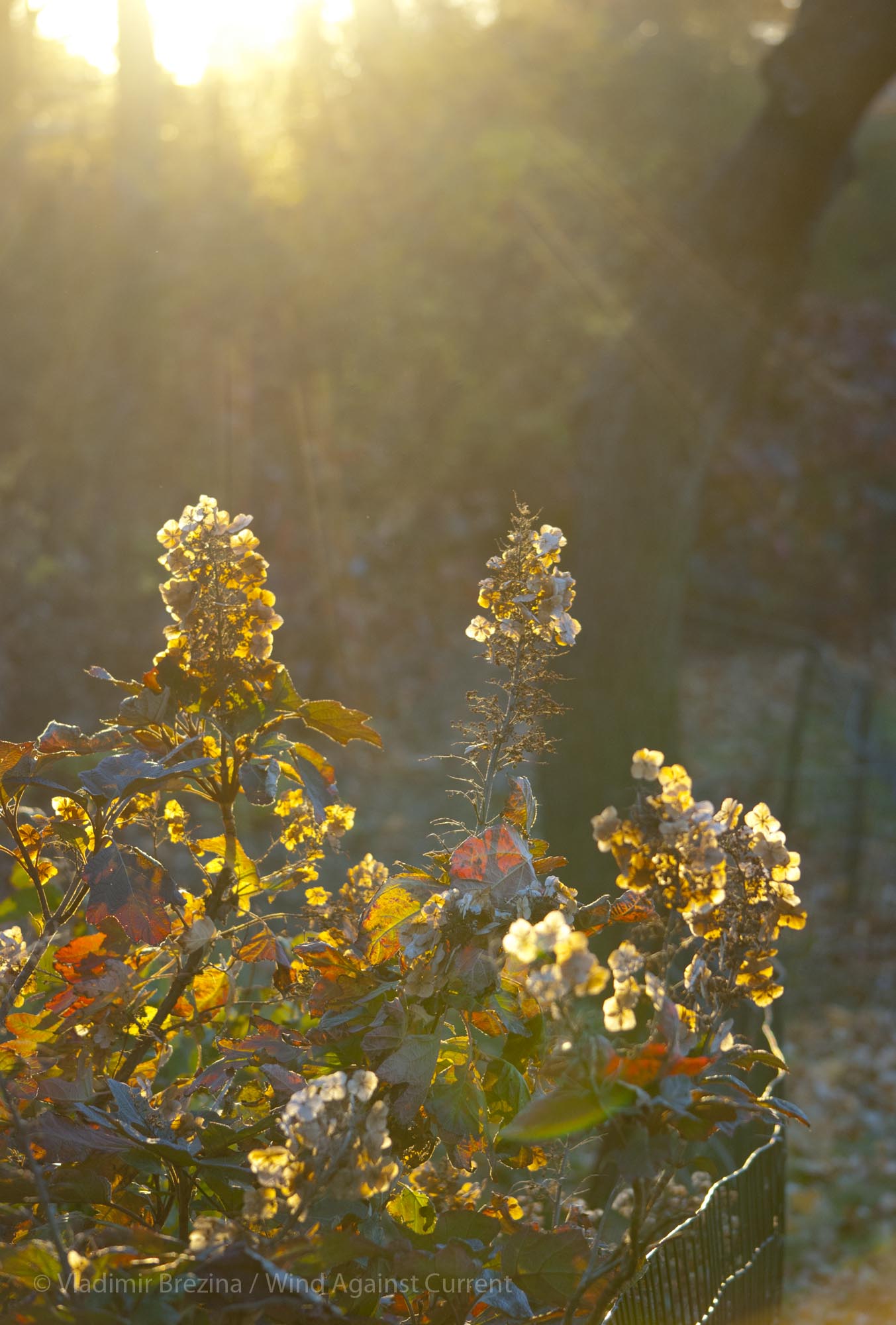
Backlit

This is the time of year to stop, take a pause, and think of all the things we’re grateful for. For most of us, that’s family, friends, a warm hearth when it’s cold outside…

And we’re grateful for those, very much so. Particularly our friends, who have held us close recently, and whose warmth and support have reminded us of the very best that human nature can offer.

We’re also grateful for something that’s a bit harder to articulate. It’s the common theme uniting art, poetry, adventure, and the love of nature. It’s that small voice that calls to you: “Pay attention! This thought, or image, or moment, or destination is important!”

Artists know this voice. They live by it. And scientists hear its call, too. As do adventurers. It’s the call that pulls you off the beaten path, onto a new path you didn’t expect to follow, away from all your carefully constructed, sensible plans: We were going to stop and camp here, but… what’s around that next bend? We need to make it to the next waypoint, but… look, there’s a double rainbow! Time to wrap up the experiment, but… what’s going on over here?

You could say it’s the call of the unexpected, or unusual, or unusually beautiful. You could call it, as Vlad sometimes does, an esthetic sense. Or you could just note that sometimes the world, in all its strangeness and beauty, sometimes just reaches out to tap you on the shoulder and say, “Hey! Slow down! There’s something here to appreciate!”

Whatever it is, we’re grateful for that voice, and for the ability to hear it.

We were recently reminded of it in an essay about an American artist, Clayton Lewis, who was also a woodworker and sculptor, and who, by all accounts, lived by this call. Writer and adventurer Willis Eschenbach, who knew him personally, encapsulates that worldview like this:

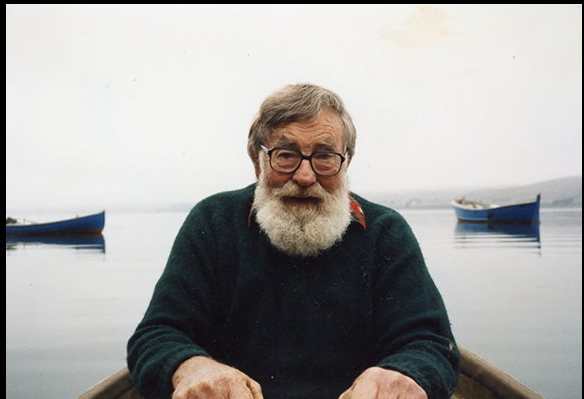
“Clayton was an artist, and a jeweler, and a boatbuilder, and a fisherman, and a crusty old bugger. He owned three boats, all of them with beautiful lines. I was going to buy a boat once, because it was cheap, even though it was ugly. ‘Don’t buy it,’ he warned, ‘owning an ugly boat is bad for a man’s spirit.’ ” —Willis Eschenbach, November 2014

Clayton Lewis

American artist Clayton Lewis (from Clayton Lewis’ website)

You can read more about Clayton Lewis, and see photos of his work, including the beautiful seaside studio he constructed, at his website. (One interesting note: He’s one of the very few artists whose bed is now in a museum!)

That voice often calls to Vlad in his photography. Here are a few examples—

(click on any photo to start slideshow)

Mom, We Did It!

By Johna Till Johnson

Occasionally a news story really resonates with me. This is one: An Indian spacecraft called Mars Orbiter Mission (MOM) has just reached orbit around the planet Mars.

And the achievement is astonishing on many fronts: It’s the first time in history that any country’s spacecraft has made it on the first attempt. At $74 million, the effort cost less than making the movie “Gravity”—and almost 10 times less than the US’s NASA Mars mission.

Scientists and engineers cheer as MOM reaches Mars orbit (Photo: Reuters)

Scientists and engineers cheer as MOM reaches Mars orbit (Photo: Reuters)

And, as with the NASA effort, some of the top scientists and engineers involved are women. There’s something symbolic in “Mother India”—which is linguistically, culturally, and even genetically the ancestor of many of us of European descent—sending a spacecraft called MOM to Mars.

I’m really proud of our Indian sisters and brothers for pulling this off. And I’m psyched to see so many saris involved in the celebration.

MOM, we did it!

Two MacArthur Geniuses

By Johna Till Johnson

I don’t normally pay a lot of attention to the MacArthur Genius awards. The name alone annoys me, because it’s simultaneously elitist and undefined.  What makes artist X a “genius” while her peers are merely “talented”? And how can we be sure that out of all the talented people in the universe, the committee has miraculously selected the 12, or 20, that are talented enough to be considered geniuses?

But I do like the notion of awarding creative people a big chunk of change—this year, it was $625,000 over a period of five years—with no constraints. And I also think it’s cool that the awards are so broad-ranging. They go to poets, activists, artists, musicians… and even the occasional scientist, mathematician, or engineer.

Which brings me to this year’s awards. I was overjoyed to see the award given to two people in particular.  One was Craig Gentry, a cryptography researcher at IBM’s T. J. Watson research center, who’s done groundbreaking work in the area of homomorphic encryption.

Craig Gentry

Craig Gentry

Homomorphic encryption is, in some respects, the holy grail of encryption, because it enables machines to process encrypted data without ever decrypting it. That doesn’t sound like much, but consider: Today, if your email is stored on Google’s servers, it’s fully accessible to Google (which has been known to turn it over to the NSA).

It’s fully accessible because you need Google to do useful things for you (like sort the mail into folders). With homomorphic encryption, you could keep your mail entirely encrypted without giving up any of the functionality (such as folder-sorting). But Google would have no idea what you named your folders, or what was in your email—and the NSA couldn’t read it, either.

Now imagine that instead of ordinary email, we’re talking about medical or financial records—and you can see the benefit.

The issue at the moment is that the computational horsepower required to make homomorphic encryption is immense, so only starting to become practical in real-world applications. But Craig was among the first to show it was theoretically possible. And he did it incredibly elegantly, using a Zeno’s-paradox-like approach that started with “somewhat homomorphic” encryption that iteratively refined itself to become “fully homomorphic”.

And there’s one other thing I like about Craig: He writes really, really well. His Stanford University PhD thesis, which you can find here, is a joy to read. I don’t mind ploughing through dense scientific papers—but I really appreciate it when someone writes gracefully and well.

Yitang Zhang

Yitang Zhang

Another one of this year’s “geniuses” is Yitang Zhang, who is a number theorist at the University of New Hampshire in Durham. Yitang (who I’ve read goes by “Tom”) recently proved the “bounded gaps” conjecture about prime numbers.

Slate’s Jordan Ellenberg (who’s a mathematics professor at the University of Wisconsin) does a much better job explaining what this is and why it matters than I could do. I urge you to read his writeup here.

Suffice it to say that Tom cracked a really, really hard problem in one of the most demanding areas of mathematics. And he’s apparently a really nice, funny, down-to-earth guy, as described in this University of New Hampshire Magazine article.

But that’s not all: Tom is 57—and has done much of his most creative work in the past 10 years (ie from his late 40s onwards).

Mathematics is a field as notorious as gymnastics or ballet for having a youthful peak–the joke among mathematicians is that anyone over 30 is washed up. Gauss, one of the most famous mathematicians ever, did his most significant work by the age of 22—a fact pointed out by my overly gleeful number theory professor when I was 21 or so.

So it’s great to see someone not only doing great things, but doing them at the relatively “advanced” age of 57.

I’m sure the other 19 MacArthur Fellows have done equally great work in their fields. But seeing the awards go to these two made me happy—and I wanted to share my joy with you!

New England On the Edge of Fall

By Johna Till Johnson

Fall is arriving early this year.

Last weekend I was up in coastal Connecticut helping my mother settle into a new apartment. The retirement community where she lives is lovely, surrounded by hills, trees, and not-too-manicured fields of wildflowers. And on this mid-September day, with still more than a week to go before autumn officially starts… the trees are turning.

Fortunately I had several errands that involved walking around the community in the golden afternoon sunshine. I took as many photos as I could to capture the essence of the day: Brilliant blue skies, sun-dappled trees, wildflowers dancing in the light breeze.

Nobody knows what the winter will bring. But if autumn continues the way it’s begun… it will be beautiful!

(click on any photo to start slideshow)