Category Archives: New York City

Screams and Surprises

The iconic “Scream”… but what’s that off in the distance?

By Johna Till Johnson

Last night, some friends and I went to go see the Munch Exhibit at the Met. I’ve been a fan of Edvard Munch since I first saw his work as a teenager in Norway. So when one of my friends mentioned he had never seen the iconic “Scream” in real life, I was delighted to accompany him, his wife, and another friend to the exhibit.

Munch made many versions of his most famous work, including “Scream”, some as wood cuts, others in oil. So although we weren’t lucky enough to see a color version of the piece, we did get to see a black-and-white woodcut.

But while looking through images in preparation for the visit, I noticed something I’d never noticed before.

See if you can see it in the image above… Look towards the horizon… on the water…

Do you see them?

The paddleboarders?

Yes! Quite clearly those are proto-paddleboarders in the background,  braving the cold Norwegian waters. All the way back in 1900! Norwegians have always been avant-guard, and Munch was famous for his innovative eye. Apparently he could see into the future!

I pointed this out to my friends when we saw the wood cut. And we all agreed. For sure, those were paddleboarders. Somehow Munch had managed to place a sport that did not yet exist in the center of his most iconic image.

It wasn’t until we compared the image with a photo of the same area that we had to acknowledge they were the masts of small sailboats. But we still preferred our interpretation.

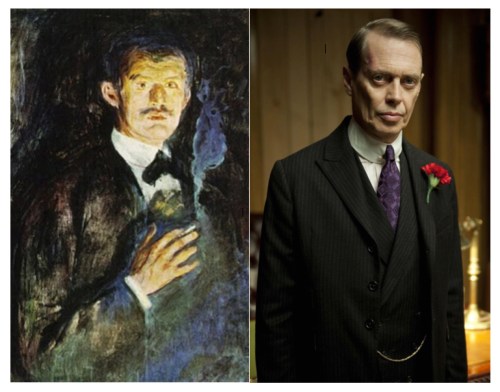
But that wasn’t the end of the surprises that evening. While inspecting Munch’s many self-portraits, I kept having a nagging feeling of familiarity, and  not just because I’d seen them before. Hmmm…

Separated at birth?

Yes, indeed! The resemblance was remarkable! Edvard Munch and Steve Buscemi share not only features but the same intense, haunted stare.

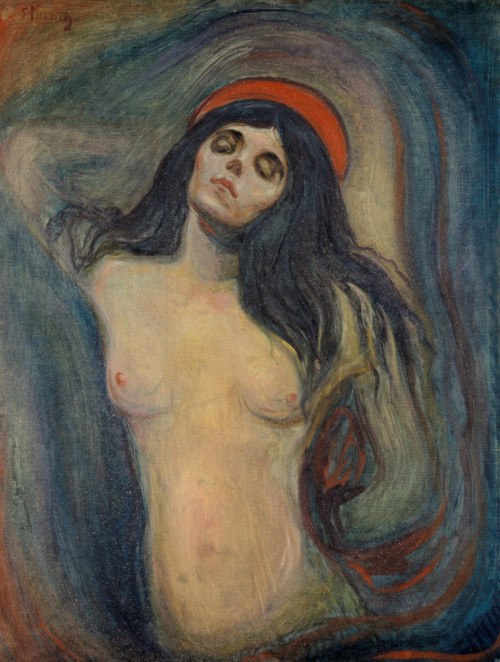
Finally, just because I love it so much, here’s Munch’s Madonna, which is my favorite work of his. Enjoy!

Madonna, by Edvard Munch

All men shall be sailors…

Sailing and freedom

By Johna Till Johnson
Photo by Vladimir Brezina

“All men shall be sailors then
Until the sea shall free them…” — Leonard Cohen, “Suzanne”

I’ve been listening to a lot of the singer-songwriter Leonard Cohen lately. I’m not alone in this; he’s experiencing an (in my mind deserved) groundswell of popularity in the 14 months since he died.

His themes are universal and serious: the inevitability of loss, imperfectability of human nature, the ephemeral transcendence of love.

His fundamental stance is religious, but while it’s rooted in his native Jewish tradition (he remained devout all his life), it draws from a broad set of perspectives, with a pragmatic bent. He once told the New Yorker:  “Anything, Roman Catholicism, Buddhism, LSD, I’m for anything that works.”

He wasn’t joking. Over the years, he studied Scientology, became an ordained Buddhist monk, and studied at an Indian ashram—along with pursuing various intoxicants (from acid to alcohol) and ascetic practices (particularly fasting). His goal was less the abstract pursuit of enlightenment than to ameliorate the bouts of depression that struck him throughout much of his life.

Sylvie Simmons wrote a wonderful biography of Cohen in 2012, “I’m Your Man,” One of the interesting paradoxes of Cohen’s life is that although he was deeply embedded in the contemporary cultural matrix  to a degree that’s almost Zelig-like, his essential formality was fundamentally out of step with the “anything goes” ethos of the times.

The Jewish magazine Forward has an insightful obituary that highlights this: “The “absence of the casual” may well be one of the singular characteristics setting Cohen’s work apart from his so-called contemporaries,” writes Seth Rogovoy.

And it paid off in the long run—Cohen is one of the rare artists who pursued his craft with intensity and diligence all his life, and  peaked as a performer in his 70s.

In a surprising twist that serves as a hopeful beacon to us late bloomers, after his business manager embezzled his money and left him broke early in the 2000s, he decided to go on tour to support his ex-wife and children. Although he had previously hated performing, he put together a stellar backup band and collaborated with them to develop innovative arrangements of his work.

The result was almost a decade of some of the best live performances in popular music history (you can find many of them in YouTube). Cohen not only accomplished his goal of earning back a fortune, he left a shining legacy that touches millions.

That “absence of the casual” is perhaps the most appropriate response to the inevitable tragedies of life, which may be one of the reasons Cohen’s work is experiencing a renaissance.

The lines above (“until the sea shall free them”) particularly resonated with me because the sea has always been associated in my mind with freedom. Towards the end of his life, my father (who was a naval officer)  turned to me and said, “The open ocean is closer than they led us to believe.”

He was referring, of course, to his imminent death, but what struck me was that he associated it with the open ocean—and freedom.


Tappan Zee Redux!

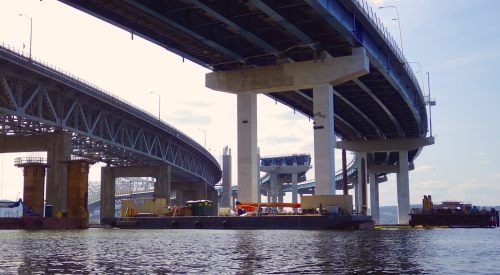
Unfinished span of the new Tappan Zee

By Johna Till Johnson
Photo composition by Brian Fulton-Howard

Four years ago this month, I wrote about the “New bridge over the Hudson” that was to replace the Tappan Zee. At the time, it was hard to believe the bridge would really be built; the project had been in discussions since 1999. At  $3.9 billion, the new construction would represent one of the largest infrastructure investments in New York this century. And it would be the first new bridge to be constructed since the Verrazano-Narrows in 1964.

A daunting prospect; skepticism was warranted.

Guess what? It’s here! And astonishingly, it was completed on time and on budget, as governor Andrew Cuomo was quick to point out.  The grand opening of the new bridge was last summer (though one span remains to be completed in 2018).

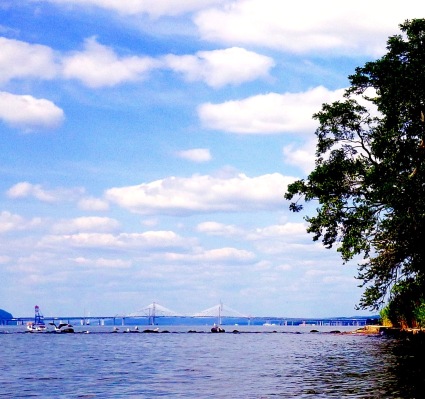
Right after it opened, on a bright summer day, Brian and I paddled up to see it. As we bounced over the slight waves, the twin peaks of the bridge’s profile (a cable-stayed design) slowly emerged from a dusting of clouds.

It looked strangely familiar…

The profile of the bridge emerges…

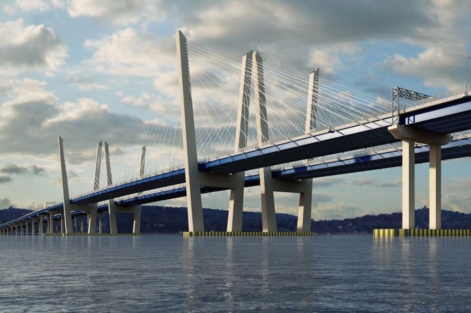
… Of course!  It was remarkably similar to the original artist’s rendering, below:

Artist’s rendering (New York Times)

I think the actual bridge is even prettier than the original conception, but it’s hard to say, as it’s still surrounded by the original Tappan Zee, which won’t be torn down until sometime this year.

As Brian and I paddled closer to the bridge, we were struck by the sight of the unfinished span that appeared in cross-section in the middle of the combined infrastructure.

It’s not every day you get to literally see the guts of a bridge as it’s being built, so we struggled to stay stable in the strong flood current as I took shot after shot. Brian finally figured out the exact location from which the unfinished span was framed perfectly (see photo above).


You’ll notice I’ve referred throughout to “the new Tappan Zee” and “the bridge”. The official name of the bridge, as of late last year, is the “Mario Cuomo bridge”, named after the three-term governor (and the current governor’s father). However, there’s a petition circulating to keep the original name.

As the petitioners explain, it’s nothing against Mario Cuomo, who “may be deserving of having something named after him.” (Don’t you love that “may be”?)

The problem is simply esthetic, petitioners assert. It sounds cool to say, ‘I’m taking the Tappan Zee,” the petition reads. “It does not sound cool to say, ‘I’m taking the Cuomo.”

I have to give them the point—”the Tappan Zee” sounds way cooler.  I doubt the petition will succeed, but I’m not sure the official name will stick, either. New Yorkers can be stubborn, and  even Google Maps still refers (confusingly to out-of-towners) to the Triboro Bridge rather than its official name of  RFK Bridge.

In any event, with my Tiderace now living happily at the Yonkers Paddling and Rowing Club, I look forward to many more trips to the, ahem, Tappan Zee.

Meantime, here’s a photo of Brian in the sunshine, just to remind everyone that summer will indeed return!

Brian in the sunshine (view looking north)

.


Snowfall by the River

East River in snow

By Johna Till Johnson

I’ve always loved the East River.

She’s not really a river at all, but rather a connector between Long Island Sound and New York Harbor.  That topography accounts for her rapid currents, which are slightly out of sync with those of the Hudson (a tidal estuary). And it also accounts for much of her charm. To me, the East River has always been beautiful, mysterious, and slightly dangerous, with an allure that’s impossible to resist.

Before I learned to kayak, I’d walk along the river and think, “Wouldn’t it be lovely to go into the water?” Crazy thought! In addition to the swift currents, the East River was known in decades past for pollution and the occasional dead body. (These days, the water is much cleaner. There are even dolphins!)

After I took up paddling, I ended up actually in the East River more than once, usually by design (practicing capsizing in current) but one memorable time entirely by accident. And I’ve paddled its length many more times than that—my best count is that I’ve circumnavigated Manhattan around 40 times, and I’ve paddled out to Long Island Sound a handful of times as well.

But as is the case with most true loves, knowing the East River better only increases her allure.

It was natural, then, when a blizzard rolled in, for me to make time to go down to the East River and see what she looked like in snow.  I’m biased, but isn’t she gorgeous?

Happy New Year!

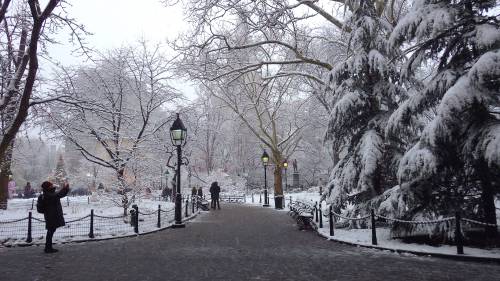
Snowfall in Washington Square Park

By Johna Till Johnson

The new year has begun, and with it, winter.

Somehow I’m never completely expecting the seasons when they finally arrive. On a sweaty day in July I truly can’t believe the ground will ever be covered in snow again… and yet, predictably, it is.

The beauty is no less delightful for its predictability. In fact, quite the opposite: each new snowfall is both like and unlike all other snowfalls.

Vlad used to say he never got bored, even paddling the same route over and over again. I believe this is partially what he meant: On a familiar route, you can appreciate both the familiar and the new.

May 2018 be full of both anticipated and unanticipated beauty. And may we appreciate it all!

Daily Post: Compass

Compass on deck.. and a chart in the case!

By Johna Till Johnson

Today’s daily post is “Compass”.

I almost always paddle with one, even when there’s almost no chance of getting lost. (Hint: If you’re going south on the Hudson River, Manhattan is to your left!).

A compass can be useful in many ways. You can practice guessing the directions, and checking your guess against the compass: “The sun is behind me, and it’s an afternoon in the winter, so the sun is in the southwest which means I’m pointing… Northeast? Yes!”

You can also use one to precisely locate objects, particularly when paddling with a friend:  “See that bird on our left? About 90 degrees?”

And believe it or not, a compass often comes in handy when you least expect it. I’ve had fog so thick that I couldn’t see the Manhattan side of the Hudson from New Jersey—I was happy to have a compass then!

Because I have several boats, I have a compass that clips on to the deck lines, so I take it from boat to boat. (Actually, I have two compasses; I inherited one from Vlad). Many paddlers have the compass physically attached to their boats, so they don’t have to worry about traveling with one.

And, oh yeah, here’s a tip: Don’t put your compass on top of the deck bag in which you also have your car keys. The metal and electronics in the key will mess up the compass… and, as happened to me on a recent trip, you’ll wonder why the compass always tells you you’re pointing north!

A Winter Nighttime Paddle on the Hudson

By Johna Till Johnson
Photos by Johna Till Johnson and Brian Fulton-Howard (see note)

George Washington Bridge from the north

December 3, 2017

It was to be Brian’s first winter paddle. That is, even though it wasn’t quite winter yet, the air and water temperatures told us it was time to don drysuits—something Brian had never done before.

The conditions were perfect: the forecast was for a misty overcast day, with air temperatures in the 50s and water temperatures in the 40s, with virtually no wind.

And thanks to the “supermoon”—a larger-than-usual moon due to the moon’s close orbit to Earth—we’d have king tides, bringing currents of between 2 and 3 knots in the Hudson. That meant an easy paddle in both directions, if we kept with the current. (Currents that strong and stronger are common in the East River, but more typically in the Hudson they range from 1 to 2 knots).

There was just one catch.

To travel with the current in both directions, we had two choices for our launch from Yonkers: A predawn launch heading north to the Tappan Zee bridge, or a midafternoon launch heading south to the George Washington.

Realistically, I couldn’t picture getting up early enough for a pre-dawn launch.

But if we took the latter option, we’d be spending most of the trip in darkness.

Was that really wise?

One of my good friends and coaches, Taino, likes to illustrate kayaking risks with a slot machine metaphor: Each risk may be acceptable individually… but if enough of them line up—disaster.

So what were these risks? Well, it was Brian’s first time paddling in a drysuit. And it was winter paddling (paddling in cold water is always riskier than in warm). And paddling in the dark.

But countering that were the near-perfect conditions (particularly the lack of wind). There was fact that we were two paddlers (two are always better off than one). Also, Brian is a strong paddler, with a level head and good judgment. And we both felt healthy, with no injuries or ailments.

The deciding factor was esthetic: The morning was predicted to be cloudy, with little chance of a beautiful sunrise. But if we opted for the evening paddle, there was at least the chance the clouds would part and we’d get to see the supermoon as it rose.

The evening paddle it was!

Brian arrived at my apartment around 2, and we prepared to pack. Hot, sweet tea: Check. Plenty of chocolate (Brian’s contribution): check. All the usual cold-weather gear: hats, gloves, “space blankets”: check.

Except for one thing…

As Brian pulled on his drysuit (discovering in the process that it fit perfectly), I asked, “So you brought your neoprene booties, right?”

Ahhh… nope!

Brian hadn’t realized drysuits need shoes (or some kind of foot covering) to avoid getting punctured. (Drysuits basically consist of GoreTex, zippers, and gaskets—you need to wear insulating clothing underneath, and put on some kind of foot covering.)

But Brian is nothing if not resourceful. “Got any duct tape?” he asked. I did, along with the cardboard and Sharpie he requested. And in a few minutes, he’d made himself a pair of cardboard-and-duct-tape “sandals”—not super fancy, but enough to protect the soles of his drysuit from damage.

That problem solved, we proceeded to Yonkers, where we managed to launch around 3:30 PM. Manhattan was visible in a haze of pink as the last hour of daylight slowly faded into dusk.

Manhattan in a haze of pink

We paddled south with the current (which was roughly 2 kt at that point). We stopped to have a look at the Riverdale Yacht Club, a beautiful structure on the eastern shore of the Hudson. Brian explained it had formerly been the Riverdale train station on the Metro-North line. (Apparently, there’s even a book about the Riverdale Yacht Club!)

Riverdale Yacht Club

We paddled on, and arrived at the Spuyten Duyvil swing bridge  guarding the Harlem River just around sunset. We’d previously discussed taking a gander down the Harlem, so in we went. The current was with us, and growing stronger as we went forward.

We had our radios on, as a standard precautionary measure. Suddenly there was a crackle as a tugboat—the Kenny G—announced it wanted to bring a barge through the bridge.

We paddled closer to the southern shore of the Harlem, and I radioed back a message to the captain: “Securité, securité, two kayaks in the Harlem river, we know you’re there and we’re staying close to shore until you pass.”

The captain acknowledged, and we continued down the Harlem with an accelerating current.

Sure enough, the tug and barge soon passed, steaming by at 12-15 kt, or maybe even more.

We paddled on for a few more minutes, but decided that the accelerating current was just a bit too risky. So we crossed over to the north side and paddled back to the bridge, helped along by a healthy back-eddy.

We stopped at the mouth of Harlem, inside the bridge in a protected, mostly still patch of water, to have chocolate and rest. By then it was full dark, but with the lights of Manhattan all around, we could see fairly well. We turned on our deck lights and I donned a headlamp (Brian would do so later on).

When we exited the Harlem, I glanced back over my shoulder, and gasped. “Look, Brian!” I shouted. The clouds had cleared, and the supermoon was rising over the Bronx.

Supermoon rising over the Bronx

I took as many photos as I could, and then we continued south to the George Washington. Rather arbitrarily, we’d chosen the little red lighthouse as our turnaround point.

We arrived at the lighthouse right around 6:30, which was by our calculations right at slack. After several tries, I succeeded in getting a shot of the lighthouse flashing, though I couldn’t convince Brian to get in the picture.

Little Red Lighthouse (and little red kayak)

We paddled back in full darkness, glad of the extra visibility provided by our headlamps. True to prediction, the current increased slowly: 0.8 kt, 1.0 kt, 1.2 kt, 1.8 kt.

A conga line of tug-and-barges heading south on our left took us a bit by surprise, as we’d initially thought they were anchored (though there no danger as we were well out of their way). And the moon, by now high in the sky, was visible for most of the way.

We arrived back in Yonkers just past 8 PM, meaning we’d spent about 4.5 hours on the water. We’d paddled 18 statute miles (15.5 nautical miles) at an average pace of 4 mph, or 3.5 kt. –including the time we’d spent enjoying chocolate. The power of the king tides!

All in all… a very successful first winter paddle for Brian. Here’s to many more!

(Note: Regular readers of this blog may be forgiven for wondering who this mysterious “Brian” is. He was formerly one of Vlad’s grad students, and is now a post-doctoral researcher in his own right. He and I have paddled several times this year, though this is the first time I’ve been able to do a writeup. He, his wife Tyna, and I have become quite good friends.)

See slideshow below for more photos. Click on the arrows to move back or forward!

This slideshow requires JavaScript.

 

Trip 16: Hudson River, Manhattan to Ossining

By Vladimir Brezina

Winter waves (same time of year, some years later)

Saturday, 8 April 2000

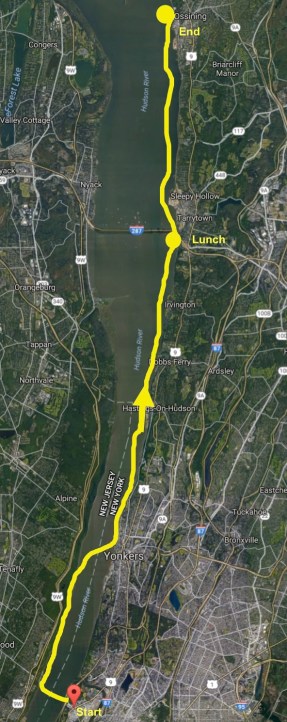
Launched at Dyckman St. just after 8 a.m. Sunny day, with some haze at first. Current still ebbing, so paddled across the river and north along the Palisades. Warm spring weather; later, air temperature in the 60s, even 70s away from the water.

First day not wearing drysuit, although water temperature (in the high 40s, perhaps around 50 in places) still marginal. First butterfly over the river. Some trees on the Palisades already putting out the first light green leaves, others still bare. Completely windless at first (although small craft advisory) but then wind progressively picking up from the south. By Irvington tail wind of about 15 knots, 1-ft following seas; smaller than otherwise with this wind as current now flooding strongly.

Lunch on the little promontory cut off by the railway just south of the Tappan Zee Bridge. Then continued through the Tappan Zee. Wind and waves building. By Ossining wind up to 20 knots with higher gusts (and forecast to get stronger still as the promised front came in) following seas 2-2 ½ feet, covered in whitecaps. Very impressive glittering against the sun.

Good practice; some difficulty keeping boat from broaching. Need much more practice with automatic braces. Around 2 p.m., rode up to the Ossining boat ramp on large, steep following waves. As conditions likely to get worse, train back to New York.

Note: To non-kayakers, this may seem like a matter-of-fact trip report. But hidden in those last few sentences—both by Vlad’s laconic delivery and his choice of nautical terms—is some real excitement. “Some difficulty keeping boat from broaching” translates to “I was about to capsize multiple times”. Vlad was using the sailing definition of broaching, which is, “”to slew around on a wave front…so as to present the ship’s side to oncoming large waves [and]… capsize and enter a “death roll”. Not exactly what you want to have happen when you’re alone on 40-degree water in a gathering storm!

And “need much more practice with automatic braces” says, in effect, “My skill level was not up to keeping the boat upright”. “Bracing” is a way that kayakers hold the paddle to prevent capsize in, among other things, high waves; as the kayaker becomes more skilled, he or she gets better at bracing automatically, to keep the boat upright.

The giveaway here is the word “much”—Vlad clearly felt the conditions were at or beyond his skill level. So, in effect, Vlad is saying here that he ran into what was for him at the time (and likely for most paddlers at any time) conditions beyond what he could paddle. He doesn’t say, but it appears from his last sentence that he’d intended to go farther than Ossining, but pulled out due to conditions (a show of good judgment I’m always happy to see).

Finally, spring is the most dangerous time for paddlers; the combination of cold water and temptingly warm air leads to underdressing, which can be fatal in the event of a capsize. And in the Hudson, there’s often snowmelt, which increases the current (though that didn’t apply here, as the current was flooding, or heading upriver).

I suspect Vlad subsequently realized he had been underdressed for the conditions; in any event, by the time we paddled together, he would not have gone out without a drysuit on a warm day in spring, as made clear in this story. Needless to say, his automatic bracing—and other paddling techniques–had also improved considerably by then!

Trip 15: Hudson River, Manhattan-Piermont-Ellis Island

By Vladimir Brezina

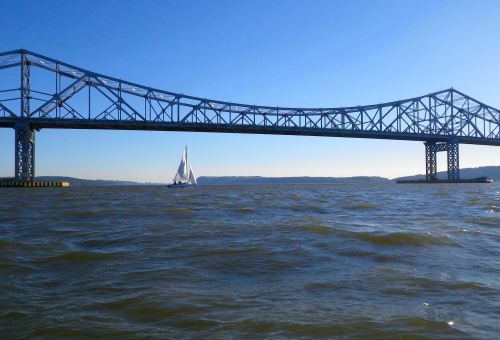
The (old) Tappan Zee bridge

Saturday, 1 April 2000

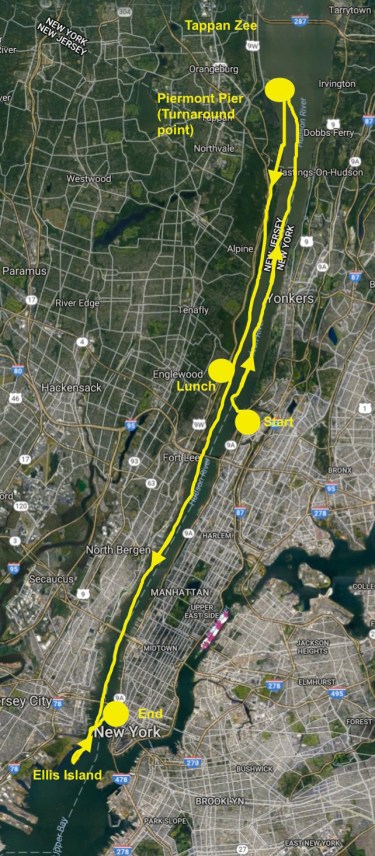
Launched at Dyckman St. around 6:30 a.m. Half-hour after sunrise; sun lighting up Palisades. Sunny all day, with some high clouds. Air and water warming up now, but both still cold enough for drysuit. Paddled north with flood current, crossing over to west side of the river, past Alpine, Italian Gardens, up to Piermont Pier.

Turned around with the current and paddled back south along the Palisades. Wind now picking up from the south. Lunch, around 11:30 a.m., just south of Englewood. Then continued south along the New Jersey shore. South wind 10-15 knots, whitecaps in main channel.

Opposite the last few miles of Manhattan, great view, but many delays for ferries.  At least four or five ferry landing points; NY Waterways ferries and Ellis Island/Liberty boats very active, though still few other boats. Ellis Island around 2 p.m. Still significant wind from the south.

Met two kayakers from the Boathouse, going to the Statue. Current, at least around the back of Ellis Island, already turning against me, so went with the wind back along the New Jersey Shore to the level of the Holland Tunnel ventilator. Then crossed over to the Manhattan side. Waves in the main channel fun: already longer, 2-3 ft, some breaking.

Whole scene in this section of the river always exhilarating, full of energy: great views of the skyscrapers of downtown Manhattan and opening south into the harbor; waves and wind; boats of all kinds criss-crossing the river.

Took out at the public dock on Pier 24. Paddling time around 8 hours; 36 nm.

(Note: Once again, this is an unusual route, one that most Manhattan-area kayakers would not have thought of paddling. Usually on the Hudson one either goes North (towards the Tappan Zee, now Mario Cuomo) or South (toward the Statue of Liberty). Doing both on the same trip is distinctively “Vlad”. 

Also, once again he is making excellent time. Covering 36 nm in 8 hours is an average of 4.5 knots, or 5.2 miles per hour—significantly more than a typical paddler. A good bit of this is his conscious decision to paddle with the current, which can be up to 2 knots in the Hudson.)

Trip 14: Combined Circumnavigation of Manhattan and City Island

By Vladimir Brezina

The iconic Manhattan view

Saturday, 25 March, 2000

(Note: The prosaic title does not do this trip justice! City Island is a small island in Long Island Sound; just getting there and back from Manhattan is considered an achievement by most New York-area paddlers. A Manhattan circumnavigation is a little more common—most of us have done quite a few—but still a non-trivial paddle.

But combining them both…? I wonder, from this vantage point of almost 20 years, what inspired Vlad to take this trip, after the previous runs up and down the Hudson. If I were able to go back in time and ask him, how would he have answered?) 

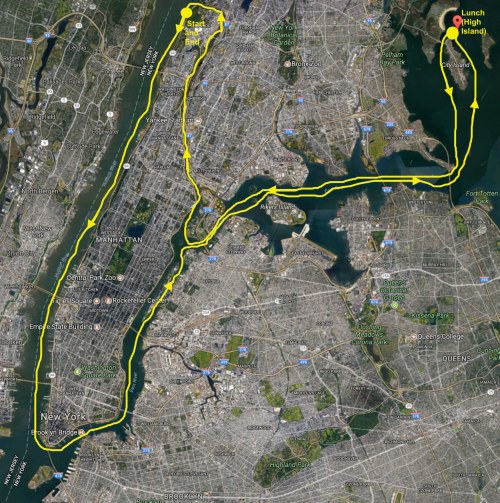
Combined Manhattan and City Island circumnavigation

Launched at Dyckman St. around 6:45 a.m. Low tide: wading through horrible mud, careful launch between pilings under pier. Sunshine already lighting up Palisades, but sun dimmed periodically by thin clouds. Quite warm: later, high around 60° F.

Paddled south with ebb current, against slight head wind from the southwest. Under George Washington Bridge, past 79th St. Boat Basin, Chelsea Piers; Downtown Boathouse in about 1 1/2 hours. (Note: This is very fast). Very few boats. Round the Battery; tourists already waiting for Statue of Liberty and Ellis Island boats; in a few minutes saw three of them emerging from their dock in East River.

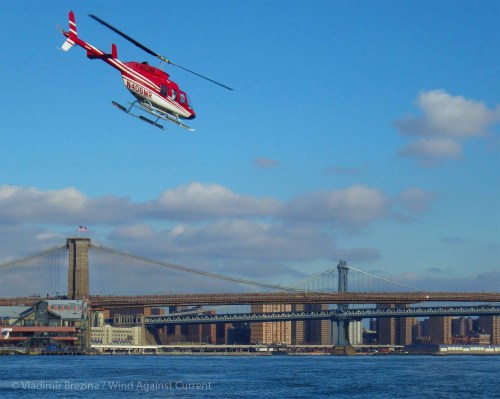
Up the East River; waves from two of the tourist boats and a tug bounced around and built to about 3 ft. in the triable between the Brooklyn and Manhattan Bridges. Under the Williamsburg Bridge; hazy sunshine. Now going with the wind and strong current. Out of the muddy Hudson, water now very clear. Just south of the United Nations narrowly avoided seaplane taking off, and later, almost at Roosevelt Island, landing. (Note: That seaplane will appear later in our writeups; nearly two decades on, I still encounter it regularly on the East River!)

Air traffic in the East River

Took the east channel past Roosevelt Island. Current dramatically speeding up. Through Hell Gate: water quite flat (no boat wakes) but heavy swirls. Still with the current and wind, past Rikers Island, under the Bronx-Whitestone Bridge and the Throgs Neck Bridge. Reached Throgs Neck at around 11:15 a.m.: 4 1/2 hours for about 25 (?) nm. (Note: That’s a blistering pace, 5.6 knots, or 6.4 miles per hour!)

Past Throgs Neck lost favorable current, in fact now some contrary current. Good view of Stepping Stones lighthouse. Crossed Eastchester Bay over to City Island and around the east side. Water beautifully clear, blue and green. Some intermittent sun, but increasing clouds. Strong contrary current flowing south between islands. Lunch on small island with tall transmitter just off City Island. Two huge white swans looking at me suspiciously. Beach littered with oyster shells. Inviting view east among the islands, past the Execution Rocks lighthouse, out on to the open Long Island Sound.

After lunch, round the northern tip of City Island, under bridge connecting it to mainland, and south through Eastchester Bay. Now paddling with some tail current, but opposed by head wind, now building up to 10-15 knots. Whitecaps everywhere in main channel. Slow going. Back to Throgs Neck again at about 2 p. m. Turning toward manhattan, beam to the wind. Severe weathercocking: boat not balanced. Crossed over to the south shore and landed to take on water ballast (not much, but perhaps some, effect). Starting to rain; misty views of Manhattan. Back under Bronx-Whitestone Bridge, past LaGuardia and Rikers Island. Still slow going, partly against, and still weathercockng into, the wind. Speeding up with favorable current toward Hell Gate. Sun coming out again. Through Hell Gate easily around 4 p.m.

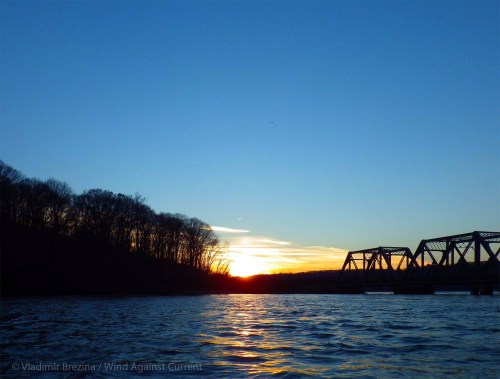
Orange sun setting into Palisades

Through Harlem River, sun low in the sky, wind dying down, water smooth. Rapid smooth progress with good tail current. Emerged into Hudson again just as the orange sun was disappearing behind Palisades. Hudson hazy and calm. Back at Dyckman St. just after 6 p.m.

Paddling time around 11 hours; about 50 nm.

(Vlad’s humorous, gentle sensibility emerges so clearly from this entry: The “huge” swans look at him “suspiciously”; the “inviting view” looking out across Long Island Sound; and the “orange sun disappearing behind the Palisades”.

Perhaps I’ve answered my own question: Vlad was forever in search of new beauty to delight his eye and heart.)