Tag Archives: Kayaking

Tappan Zee Redux!

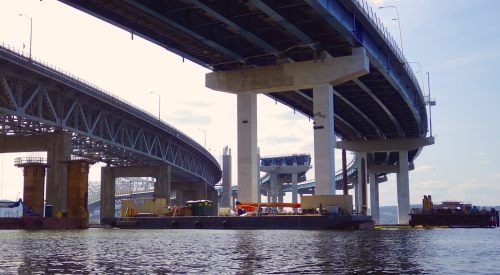
Unfinished span of the new Tappan Zee

By Johna Till Johnson
Photo composition by Brian Fulton-Howard

Four years ago this month, I wrote about the “New bridge over the Hudson” that was to replace the Tappan Zee. At the time, it was hard to believe the bridge would really be built; the project had been in discussions since 1999. At  $3.9 billion, the new construction would represent one of the largest infrastructure investments in New York this century. And it would be the first new bridge to be constructed since the Verrazano-Narrows in 1964.

A daunting prospect; skepticism was warranted.

Guess what? It’s here! And astonishingly, it was completed on time and on budget, as governor Andrew Cuomo was quick to point out.  The grand opening of the new bridge was last summer (though one span remains to be completed in 2018).

Right after it opened, on a bright summer day, Brian and I paddled up to see it. As we bounced over the slight waves, the twin peaks of the bridge’s profile (a cable-stayed design) slowly emerged from a dusting of clouds.

It looked strangely familiar…
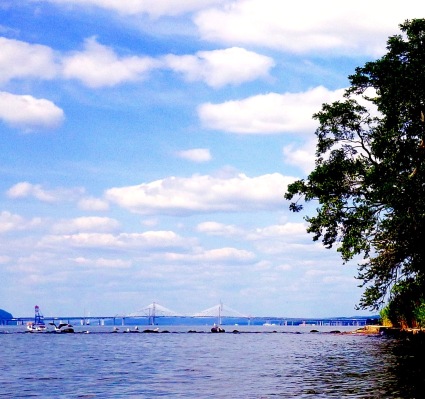
The profile of the bridge emerges…

… Of course!  It was remarkably similar to the original artist’s rendering, below:
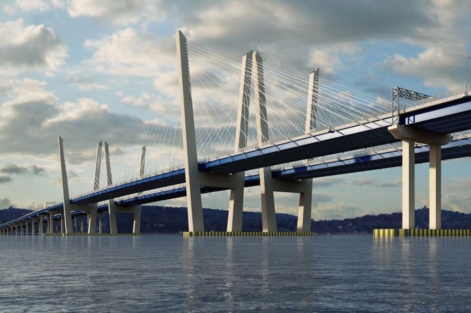
Artist’s rendering (New York Times)

I think the actual bridge is even prettier than the original conception, but it’s hard to say, as it’s still surrounded by the original Tappan Zee, which won’t be torn down until sometime this year.

As Brian and I paddled closer to the bridge, we were struck by the sight of the unfinished span that appeared in cross-section in the middle of the combined infrastructure.

It’s not every day you get to literally see the guts of a bridge as it’s being built, so we struggled to stay stable in the strong flood current as I took shot after shot. Brian finally figured out the exact location from which the unfinished span was framed perfectly (see photo above).


You’ll notice I’ve referred throughout to “the new Tappan Zee” and “the bridge”. The official name of the bridge, as of late last year, is the “Mario Cuomo bridge”, named after the three-term governor (and the current governor’s father). However, there’s a petition circulating to keep the original name.

As the petitioners explain, it’s nothing against Mario Cuomo, who “may be deserving of having something named after him.” (Don’t you love that “may be”?)

The problem is simply esthetic, petitioners assert. It sounds cool to say, ‘I’m taking the Tappan Zee,” the petition reads. “It does not sound cool to say, ‘I’m taking the Cuomo.”

I have to give them the point—”the Tappan Zee” sounds way cooler.  I doubt the petition will succeed, but I’m not sure the official name will stick, either. New Yorkers can be stubborn, and  even Google Maps still refers (confusingly to out-of-towners) to the Triboro Bridge rather than its official name of  RFK Bridge.

In any event, with my Tiderace now living happily at the Yonkers Paddling and Rowing Club, I look forward to many more trips to the, ahem, Tappan Zee.

Meantime, here’s a photo of Brian in the sunshine, just to remind everyone that summer will indeed return!

Brian in the sunshine (view looking north)

.


Snowfall by the River

East River in snow

By Johna Till Johnson

I’ve always loved the East River.

She’s not really a river at all, but rather a connector between Long Island Sound and New York Harbor.  That topography accounts for her rapid currents, which are slightly out of sync with those of the Hudson (a tidal estuary). And it also accounts for much of her charm. To me, the East River has always been beautiful, mysterious, and slightly dangerous, with an allure that’s impossible to resist.

Before I learned to kayak, I’d walk along the river and think, “Wouldn’t it be lovely to go into the water?” Crazy thought! In addition to the swift currents, the East River was known in decades past for pollution and the occasional dead body. (These days, the water is much cleaner. There are even dolphins!)

After I took up paddling, I ended up actually in the East River more than once, usually by design (practicing capsizing in current) but one memorable time entirely by accident. And I’ve paddled its length many more times than that—my best count is that I’ve circumnavigated Manhattan around 40 times, and I’ve paddled out to Long Island Sound a handful of times as well.

But as is the case with most true loves, knowing the East River better only increases her allure.

It was natural, then, when a blizzard rolled in, for me to make time to go down to the East River and see what she looked like in snow.  I’m biased, but isn’t she gorgeous?

Daily Post: Compass

Compass on deck.. and a chart in the case!

By Johna Till Johnson

Today’s daily post is “Compass”.

I almost always paddle with one, even when there’s almost no chance of getting lost. (Hint: If you’re going south on the Hudson River, Manhattan is to your left!).

A compass can be useful in many ways. You can practice guessing the directions, and checking your guess against the compass: “The sun is behind me, and it’s an afternoon in the winter, so the sun is in the southwest which means I’m pointing… Northeast? Yes!”

You can also use one to precisely locate objects, particularly when paddling with a friend:  “See that bird on our left? About 90 degrees?”

And believe it or not, a compass often comes in handy when you least expect it. I’ve had fog so thick that I couldn’t see the Manhattan side of the Hudson from New Jersey—I was happy to have a compass then!

Because I have several boats, I have a compass that clips on to the deck lines, so I take it from boat to boat. (Actually, I have two compasses; I inherited one from Vlad). Many paddlers have the compass physically attached to their boats, so they don’t have to worry about traveling with one.

And, oh yeah, here’s a tip: Don’t put your compass on top of the deck bag in which you also have your car keys. The metal and electronics in the key will mess up the compass… and, as happened to me on a recent trip, you’ll wonder why the compass always tells you you’re pointing north!

An Autumn Paddle in New England

The source: Osprey Sea Kayak Adventures

By Johna Till Johnson

October 7, 2017

To me, Rhode Island is New England’s quirky little brother.

In the New England family, Massachusetts is the corporate CEO:  rich, polished, well-connected, and casually dominant.

Connecticut is the suburban matron with pearl stud earrings, perfectly pressed khakis, 2.5 blond kids and a white picket fence.

Vermont is the crunchy-granola hippie sister, with flowing locks and skirts and beads.

New Hampshire is the gruff older brother with flannel shirts, pickup truck with a gun rack, and the “live free or die” bumpersticker.

Maine… that’s the far-off cousin I’ve never properly met, distant, mysterious, and cold.

But Rhode Island is the bright, tattooed little brother with grommet earrings who’s working as a barista while waiting for his band to hit the big time.

The person I’d naturally gravitate to at Thanksgiving dinner, in other words, because he’s likely to have the most interesting stories and unusual perspectives.

So when the email arrived notifying me that the paddles I’d ordered had arrived at Osprey Sea Kayak Adventures, it was a no-brainer for me  to decide to drive up and pick them up. My weekend had come unexpectedly free, with an unusually warm and sunny Saturday forecast. A visit to Rhode Island seemed like a brilliant idea.

Technically, Osprey Sea Kayak isn’t in Rhode Island. It’s in southern Massachusetts, on the banks of the eastern fork of the Westport River.  But the owners, Carl and Samantha Ladd, live in Rhode Island, and it’s always seemed like a Rhode Island institution to me.

I’d never paddled the Westport before. Whenever I’d headed up to Rhode Island for past trips, the whole point had been to play in ocean surf. In fact, I’d barely noticed that the tiny “creek” behind the kayak shop was actually a river.

But it is, and like Rhode Island itself, it’s an under-appreciated gem. See for yourself: Click on any of the photos below to see the vistas from that day. And you can read about my timely discovery of the boat named “Sea Hare” here.

This slideshow requires JavaScript.

Trip 16: Hudson River, Manhattan to Ossining

By Vladimir Brezina

Winter waves (same time of year, some years later)

Saturday, 8 April 2000

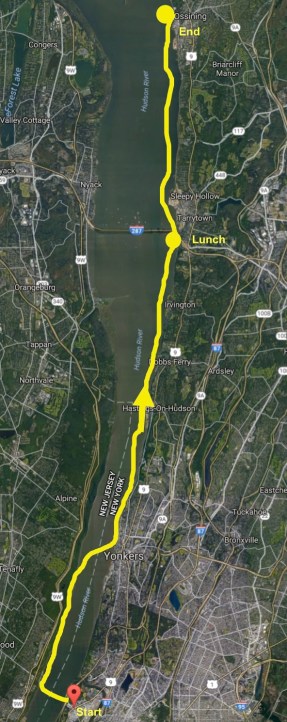
Launched at Dyckman St. just after 8 a.m. Sunny day, with some haze at first. Current still ebbing, so paddled across the river and north along the Palisades. Warm spring weather; later, air temperature in the 60s, even 70s away from the water.

First day not wearing drysuit, although water temperature (in the high 40s, perhaps around 50 in places) still marginal. First butterfly over the river. Some trees on the Palisades already putting out the first light green leaves, others still bare. Completely windless at first (although small craft advisory) but then wind progressively picking up from the south. By Irvington tail wind of about 15 knots, 1-ft following seas; smaller than otherwise with this wind as current now flooding strongly.

Lunch on the little promontory cut off by the railway just south of the Tappan Zee Bridge. Then continued through the Tappan Zee. Wind and waves building. By Ossining wind up to 20 knots with higher gusts (and forecast to get stronger still as the promised front came in) following seas 2-2 ½ feet, covered in whitecaps. Very impressive glittering against the sun.

Good practice; some difficulty keeping boat from broaching. Need much more practice with automatic braces. Around 2 p.m., rode up to the Ossining boat ramp on large, steep following waves. As conditions likely to get worse, train back to New York.

Note: To non-kayakers, this may seem like a matter-of-fact trip report. But hidden in those last few sentences—both by Vlad’s laconic delivery and his choice of nautical terms—is some real excitement. “Some difficulty keeping boat from broaching” translates to “I was about to capsize multiple times”. Vlad was using the sailing definition of broaching, which is, “”to slew around on a wave front…so as to present the ship’s side to oncoming large waves [and]… capsize and enter a “death roll”. Not exactly what you want to have happen when you’re alone on 40-degree water in a gathering storm!

And “need much more practice with automatic braces” says, in effect, “My skill level was not up to keeping the boat upright”. “Bracing” is a way that kayakers hold the paddle to prevent capsize in, among other things, high waves; as the kayaker becomes more skilled, he or she gets better at bracing automatically, to keep the boat upright.

The giveaway here is the word “much”—Vlad clearly felt the conditions were at or beyond his skill level. So, in effect, Vlad is saying here that he ran into what was for him at the time (and likely for most paddlers at any time) conditions beyond what he could paddle. He doesn’t say, but it appears from his last sentence that he’d intended to go farther than Ossining, but pulled out due to conditions (a show of good judgment I’m always happy to see).

Finally, spring is the most dangerous time for paddlers; the combination of cold water and temptingly warm air leads to underdressing, which can be fatal in the event of a capsize. And in the Hudson, there’s often snowmelt, which increases the current (though that didn’t apply here, as the current was flooding, or heading upriver).

I suspect Vlad subsequently realized he had been underdressed for the conditions; in any event, by the time we paddled together, he would not have gone out without a drysuit on a warm day in spring, as made clear in this story. Needless to say, his automatic bracing—and other paddling techniques–had also improved considerably by then!

Trip 15: Hudson River, Manhattan-Piermont-Ellis Island

By Vladimir Brezina

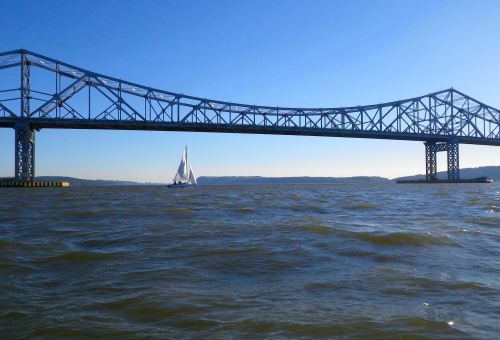
The (old) Tappan Zee bridge

Saturday, 1 April 2000

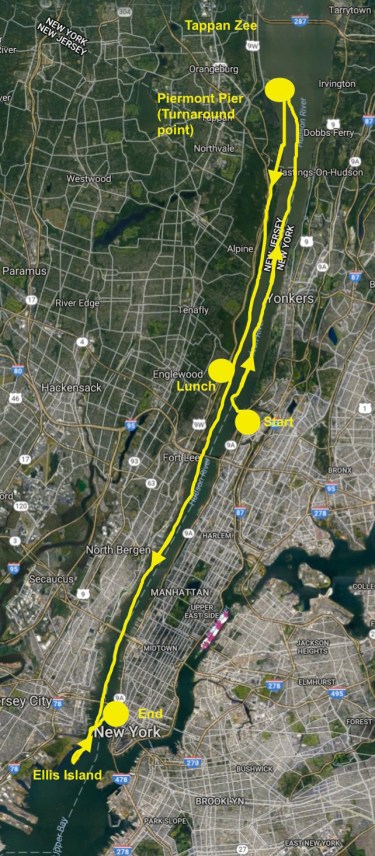
Launched at Dyckman St. around 6:30 a.m. Half-hour after sunrise; sun lighting up Palisades. Sunny all day, with some high clouds. Air and water warming up now, but both still cold enough for drysuit. Paddled north with flood current, crossing over to west side of the river, past Alpine, Italian Gardens, up to Piermont Pier.

Turned around with the current and paddled back south along the Palisades. Wind now picking up from the south. Lunch, around 11:30 a.m., just south of Englewood. Then continued south along the New Jersey shore. South wind 10-15 knots, whitecaps in main channel.

Opposite the last few miles of Manhattan, great view, but many delays for ferries.  At least four or five ferry landing points; NY Waterways ferries and Ellis Island/Liberty boats very active, though still few other boats. Ellis Island around 2 p.m. Still significant wind from the south.

Met two kayakers from the Boathouse, going to the Statue. Current, at least around the back of Ellis Island, already turning against me, so went with the wind back along the New Jersey Shore to the level of the Holland Tunnel ventilator. Then crossed over to the Manhattan side. Waves in the main channel fun: already longer, 2-3 ft, some breaking.

Whole scene in this section of the river always exhilarating, full of energy: great views of the skyscrapers of downtown Manhattan and opening south into the harbor; waves and wind; boats of all kinds criss-crossing the river.

Took out at the public dock on Pier 24. Paddling time around 8 hours; 36 nm.

(Note: Once again, this is an unusual route, one that most Manhattan-area kayakers would not have thought of paddling. Usually on the Hudson one either goes North (towards the Tappan Zee, now Mario Cuomo) or South (toward the Statue of Liberty). Doing both on the same trip is distinctively “Vlad”. 

Also, once again he is making excellent time. Covering 36 nm in 8 hours is an average of 4.5 knots, or 5.2 miles per hour—significantly more than a typical paddler. A good bit of this is his conscious decision to paddle with the current, which can be up to 2 knots in the Hudson.)

Trip 13: Peekskill to Manhattan Redux

By Vladimir Brezina

Bright sky beyond bare branches..

Saturday, 18 March 2000

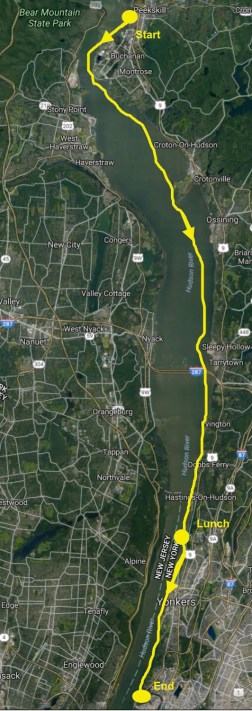
7:43 a.m. Metro-North train to Peekskill. Sunny all day, no clouds at all (got sunburned), but chilly. Temperatures in the 30s, possibly just making it into the 40s. Some snow on the ground around Peekskill; puddles and shallow water spilling over into the parking lot frozen overnight.

Launched by 10:00 a.m. Paddled south against the current into Haverstraw Bay, then along eastern shore and across to Croton Point. 10-kt tail wind and 1-ft following seas (whitecaps in main channel), both increasing significantly alongside Croton Point and south into the Tappan Zee. Some icing on the boat from freezing spray.
Croton Point around noon. Followed eastern shore of Tappan Zee; wind and waves gradually diminishing. Lunch on north-facing beach at Philipse Manor, vey cold standing wet in the wind. Now good ebb current (close to spring tides today). South of the Tappan Zee wind completely calm; water mirror-smooth though still some residual ripples. Still very few boats (saw only three or four boats all day, mostly commercial, tugs and barges) but planes and helicopters flying over the river seemingly every couple of minutes.

Spent some time photographing around Yonkers. Wind then picked up from the south; head wind but not too strong. Reached Dyckman St. around 4:30 p.m. Paddling time around 6 hours; about 28 nm.

(Note: Vlad’s pale Eastern European skin was prone to sunburn, and he suffered badly from it—he would even get feverish at night.

Beyond that, the Vlad I met is emerging clearly from the page: casual familiarity with the tides (spring and neap), currents, and wind speeds. And completing a 28 nm trip in 6 hours is a characteristically blistering pace: 4.6 knots, or 5.4 miles per hour, some of it against the current!

Finally, it gratifies me that he found Yonkers, where I now keep one of my boats, pleasing enough to photograph. I’ve fallen a little bit in love with the place myself.)


Trip 11: Hudson River, Manhattan

By Vladimir Brezina

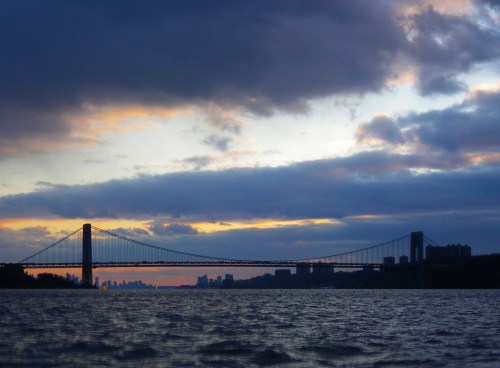
George Washington Bridge on a winter day

Sunday, 27 February 2000

Launched at Dyckman Street around 10 a.m. First paddle since ice gone. Relatively mild winter day, but foggy, despite forecast, essentially all day. Brighter spots through the clouds now and then, but rather grey, and so a little cold, most of the time.

Paddled south under George Washington Bridge and along the Manhattan shoreline, with ebb current. Slight head wind (10 knots) and so some whitecaps. Later wind calmed down; in the afternoon completely calm.

Reached Downtown Boathouse around 11:30 a.m. Turned round and returned, dodging between the piers, against the current. Just south of Chelsea Piers sopke with paddler from there, Rufus, with all-new red Khatsalano and full high-tech equipment. Gave him my phone number: may go out with him and his group of Feathercrafters in future.

Lunch on the water in empty marina immediately adjacent to driving range at Chelsea Piers. Then continued north along Manhattan shoreline to 79th Street. now should have been strong flood current, but still slight ebb. Some weak flood current only much later, at peak of astronomical cycle, and in retrospect ebb current in the morning was much stronger than it should have been: presumably runoff and ice melting up the river.

From 79th Street crossed river and went up along New Jersey side. Under George Washington Bridge and back across to Dyckman Street. Started packing up the boat around 4 p.m.; now, of course, sun finally coming out, weakly.

(Note: Here we see more of the essential Vlad. First his characterization of a 10-kt wind as “slight”; most paddlers consider that substantial! Second is his joy in connecting with kindred spirits, along with his teasing characterization of the “high-tech equipment”. And finally, there’s his thoughtful analysis of the current; indeed in springtime (which was rapidly approaching) the runoff often cancels the flood entirely in the Hudson.)

Trip 10: Hudson River, Manhattan to Peekskill

By Vladimir Brezina

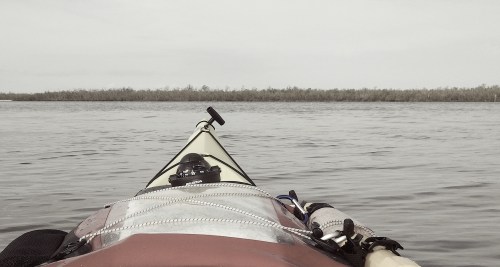
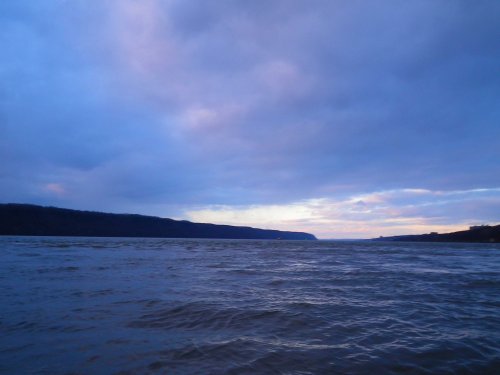
Looking North on the Hudson on a winter’s day

Sunday, 9 January 2000
Launched at Dyckman St just before 9 a.m. Mild winter day. Partly sunny all day, with very little wind: tail winds around 5 knots all day (measured with new wind-meter). River calm. Air temperature climbing to around 50°F in the afternoon. But water temperature (from the Web) in the mid- to upper 30s; wore drysuit for the first time this winter.

Paddled north with good flood current. Reached Croton Point around 12:30 p.m.: 18 1/2 nm in 3 1/2 hours, my best ever so far over this stretch. Lunch. Continued north around 1 p.m. Current now turning against me, but not really felt until past Verplanck.

Reached Peekskill around 3:30 p.m. Relieved to see no ice in Peekskill Bay. Lazed about on the water until sunset (at 4:40 p.m. or so): colorful, interesting cloud formations but not as spectacular as I hoped. Talked with old couple out for a walk that I talked with here last year. Confirmed no ice here yet this winter. Took 5:19 p.m. train back to New York City.

About 26(?) nm, 6 hours paddling time.

(Note: This is one of my favorite logs. It conveys the Vlad that I met in a few succinct words. His power and endurance: Covering 26 nm in 6 hours is an impressive feat, even given the assistance of the wind and current: a sustained pace of 4.3 knots, or almost 5 miles per hour. I also delight in his joy in the “new wind-meter”, and his methodical approach to tracking conditions—both hallmarks of his scientific mind.

But best of all is the throwaway line, “Talked with old couple out for a walk that I talked with here last year.” Pure Vlad! Only he would take time in a terse writeup to note that they were “out for a walk”. And who remembers an encounter with strangers from a year before? Someone who truly sees and connects with people, that’s who. 

All in all, an auspicious way to start the New Year… a year that, as we’ll see, will usher in some of Vlad’s legendary long trips.)


Trip 9: Hudson River, Beacon to Peekskill

Text and photo by Vladimir Brezina

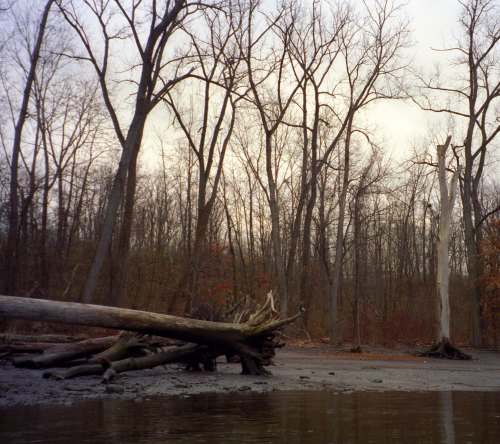
Winter riverbank

Saturday, 18 December 1999

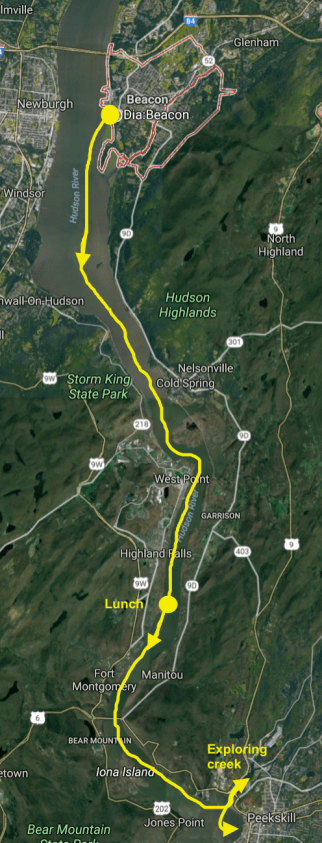
7:43 a.m. Metro-North train to Beacon. Launched by 10 a.m. Winter weather: temperature in the 30s all day, cold wind from the north. Partly overcast at first, then mostly sunny; pale blue winter sky, sun low down on the horizon.

Water temperature probably in the upper 40s. All trees bare by now. Paddled south with the ebb current and wind. Past Denning Point, Bannerman’s Island, Cold Spring, West Point. Lunch on Con Hook, cold in the wind (wearing only wetsuit, not yet drysuit), but warm enough out of the wind in the sun. Paddled further south to Peekskill; arrived in Peekskill Bay around 1:30 p.m. Explored the beginning of Annsville Creek; not very interesting now in the winter; shallow and muddy. Not enough daylight to continue to Ossining, so 3:19 p.m. train back to New York City.

(Note: We’re seeing the shape of the Vlad-to-come emerge in these few short sentences. He always particularly enjoyed winter paddling, which is a truly different experience from paddling on a warm summer’s day. In later years he will not be daunted by the onset of night, although paddling alone at night in winter certainly increases the risk.)