
By Johna Till Johnson
Photos by Vladimir Brezina
“This will be your best circumnav ever,” said Randy, smiling.
I smiled back, a bit dubiously.
Randy’s a friend and the owner of the New York Kayak Company. I’d just bought a new kayak from him—a red-and-black-and-white Tiderace Xplore-S Carbon Pro, a long, lean, lightweight boat designed for expedition sea kayaking.

Solstice
I loved the new boat—which I promptly named Solstice—but I was feeling a bit squeamish about taking her for a maiden voyage on a Manhattan circumnavigation. It’s always a bit tricky paddling a new boat, particularly one that handles considerably differently than your previous one.
Solstice is a good 15 inches longer than Photon, my old Valley Avocet, and an inch or two narrower. That design makes for a boat that’s faster and more powerful, but also potentially harder to control. And although circumnavigating Manhattan isn’t an inherently challenging proposition, there are some tricky bits, even in calm conditions.
The swirling eddies at Hell Gate can almost always be counted on to provide some excitement, for instance, as can the ferries at the Battery (and their wakes). Being unable to handle your boat in such situations is not a good thing—even less so in winter, when a capsize can lead to hypothermia, even if the rescue or self-rescue is effective. So taking a brand-new boat out for a 6-hour trip seemed, under the circumstances, slightly risky.
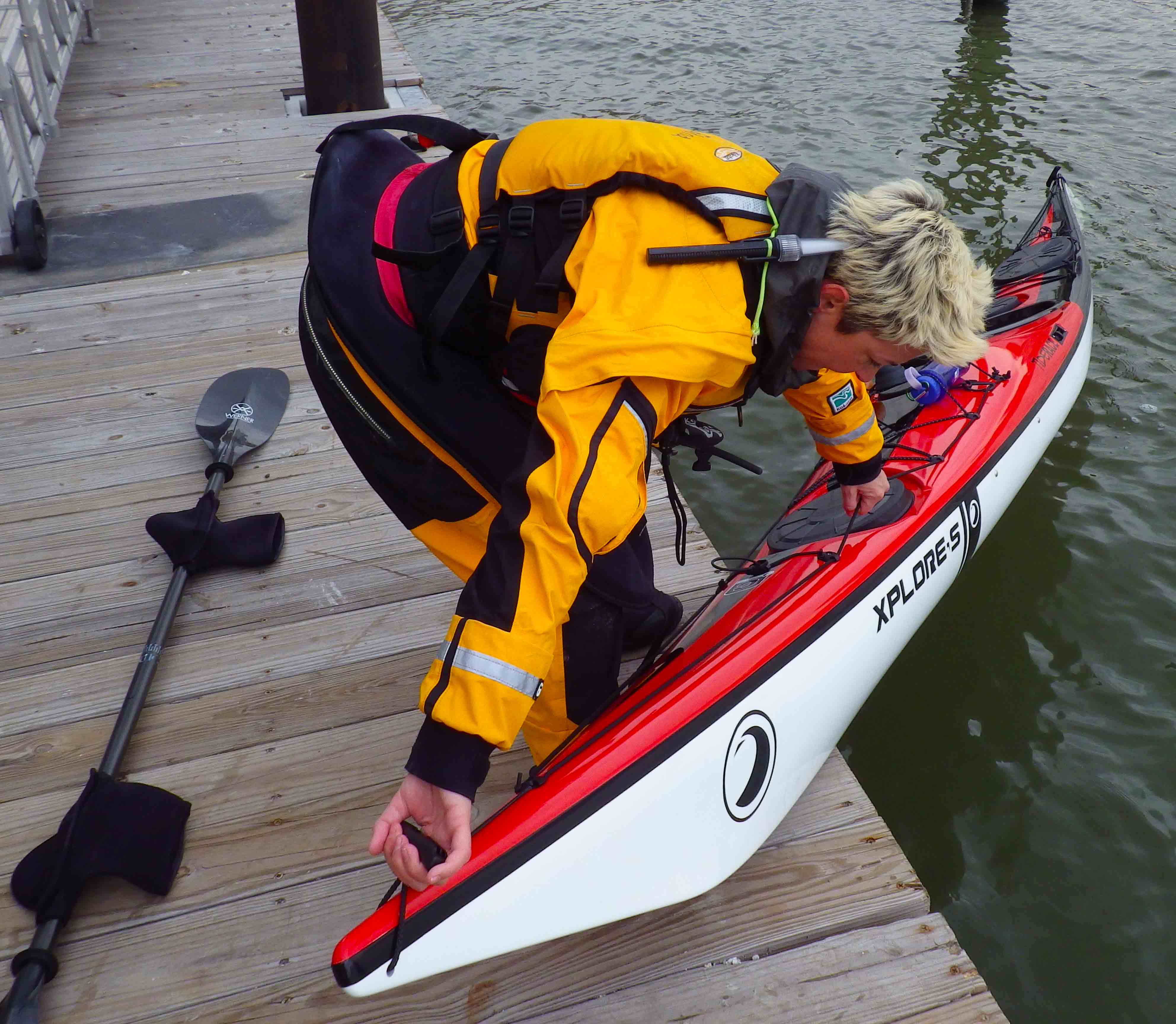
In the water for the first time!

A longer, narrower boat…
But Randy’s confidence was contagious, and I tried my best to shelve the worries. And as Vlad and I launched a bit later that day, we were both looking forward to the outing, our first longer paddle in the NYC area since before Hurricane Sandy. I hoped Randy was right.
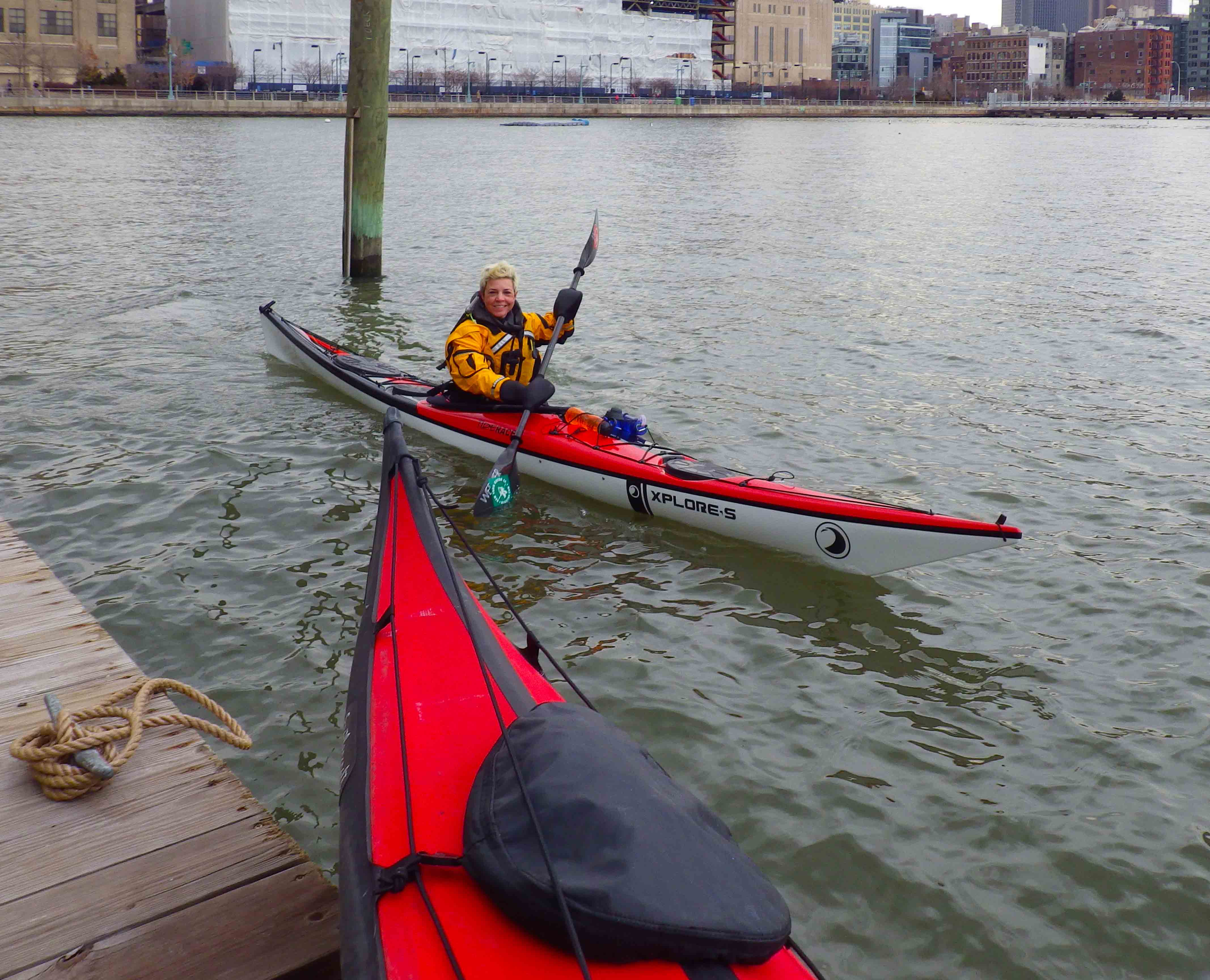
First strokes
I had no idea how right he’d turn out to be. The trip was… well, “magical” is the best way I can describe it. Or maybe “enchanted”…
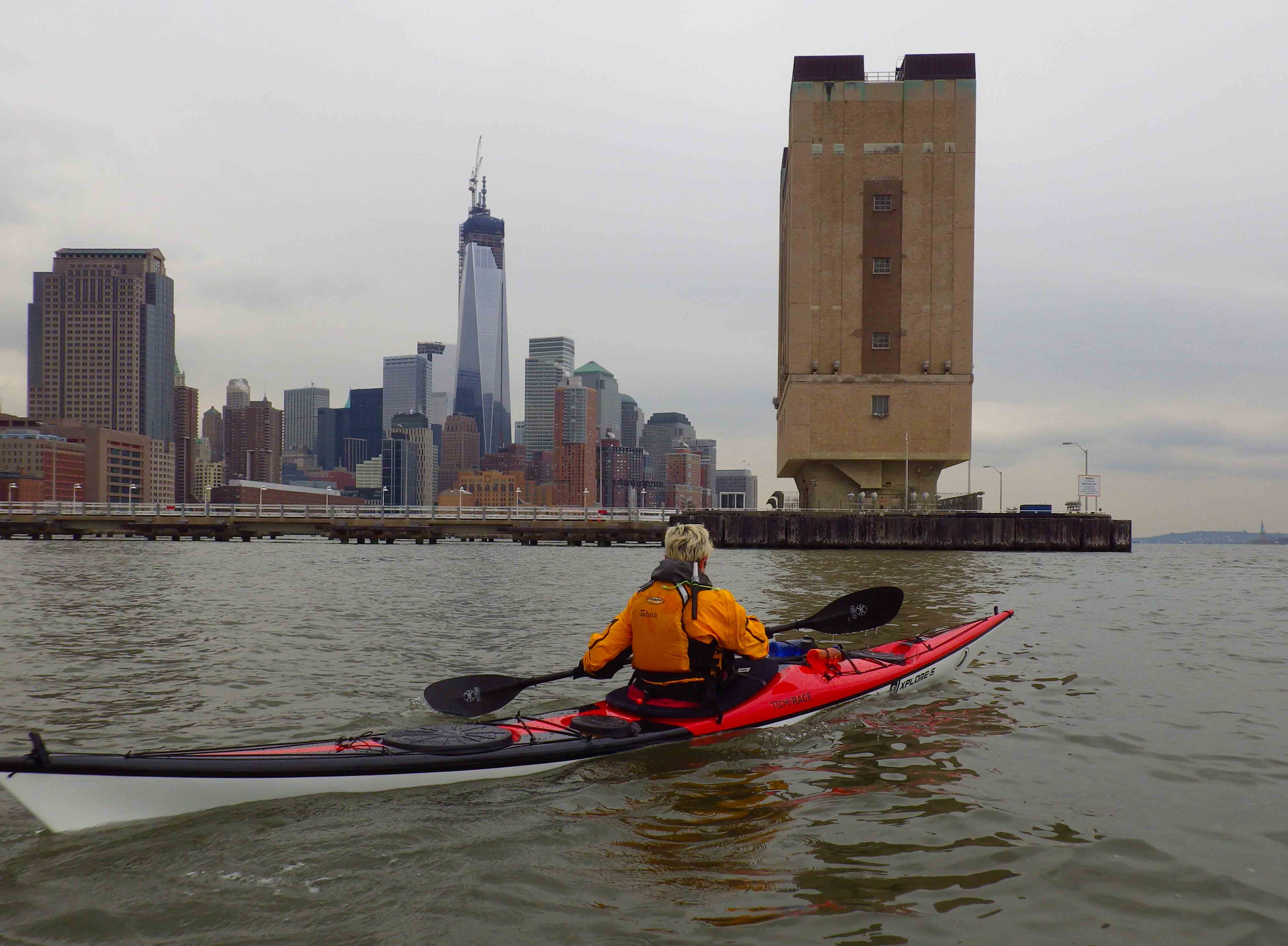
We head out of the embayment into the Hudson
First, there was the snow. It had been spattering down on and off all morning, but as we set off into the Hudson, the fitful flurries morphed into a real, end-of-winter snowstorm, falling hard and softening and blurring the edges of the Manhattan skyline. Paddling in snow is always exciting, and this was the first time in a while that we’d been out in a snowstorm. It seemed a good omen… one of many, as things turned out.

At the Battery, we paddle round the just-docked Staten Island Ferry…
.
.
.
.
After we rounded the Battery (carefully avoiding the ferries) and made our way up towards the Brooklyn Bridge…

… and into the East River
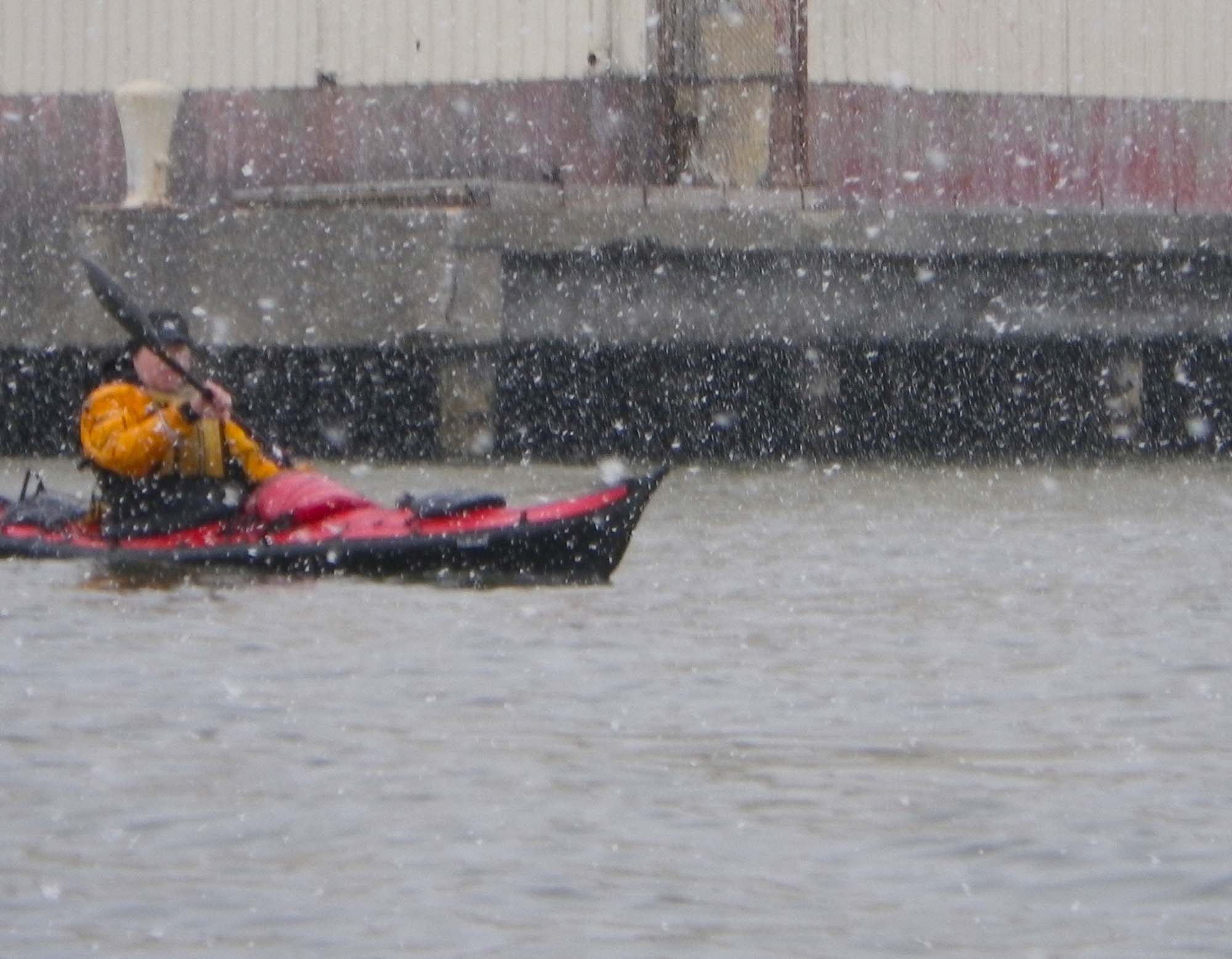
The snow is really coming down now (photo by Johna)
… the flakes fell soft and fluffy, hitting our faces like cold fairy kisses.
There was almost no wind, and the water was glassy. If you looked closely at it, you had the optical illusion that the snowflakes were falling up, coming from inside the river towards the surface..
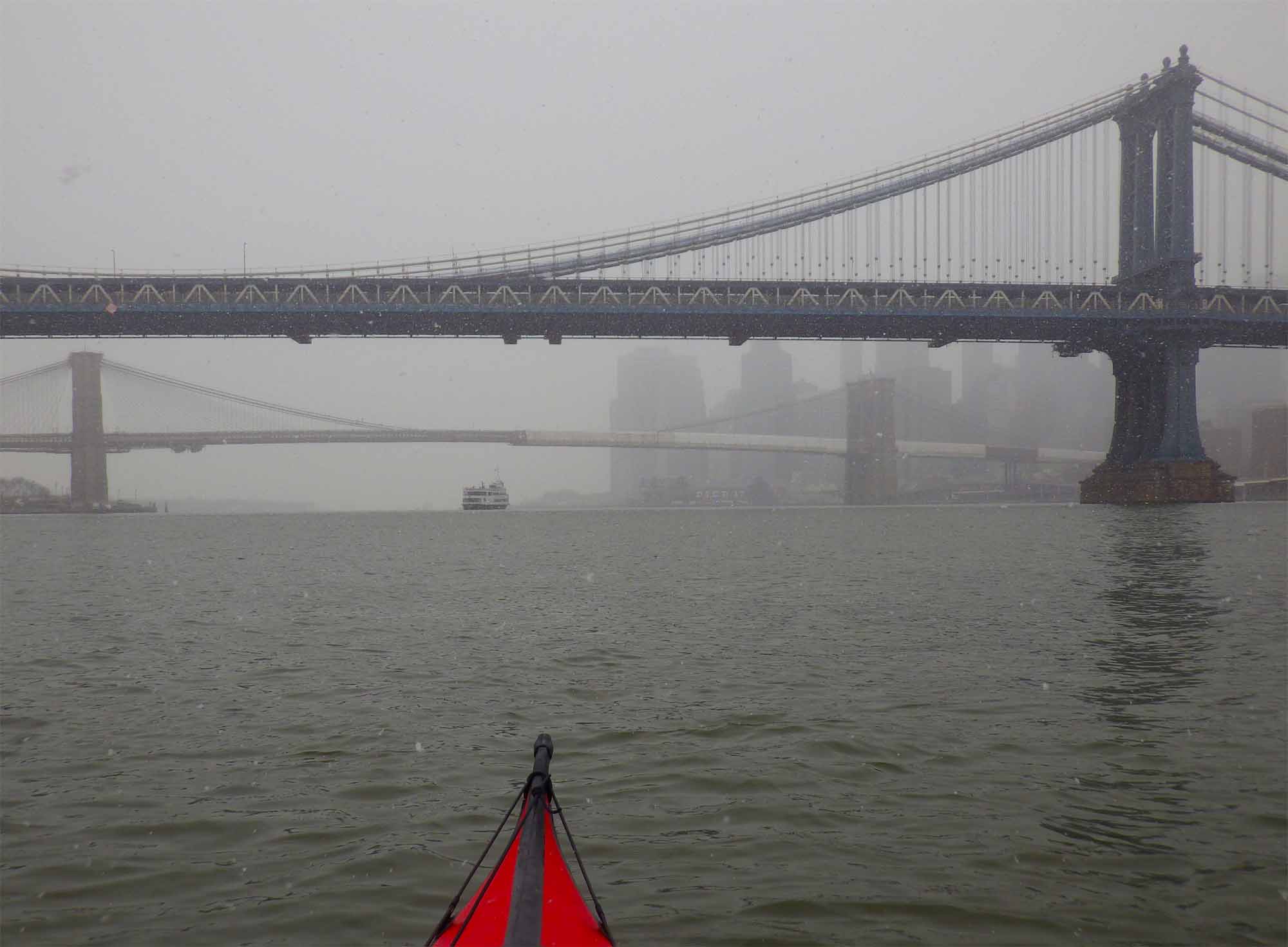
Looking back, downtown Manhattan vanishes in the swirling snow
There was almost no sound, except for the occasional cackle of the ship-captains on the radio, which I kept tuned to channel 13 to keep abreast of commercial traffic..
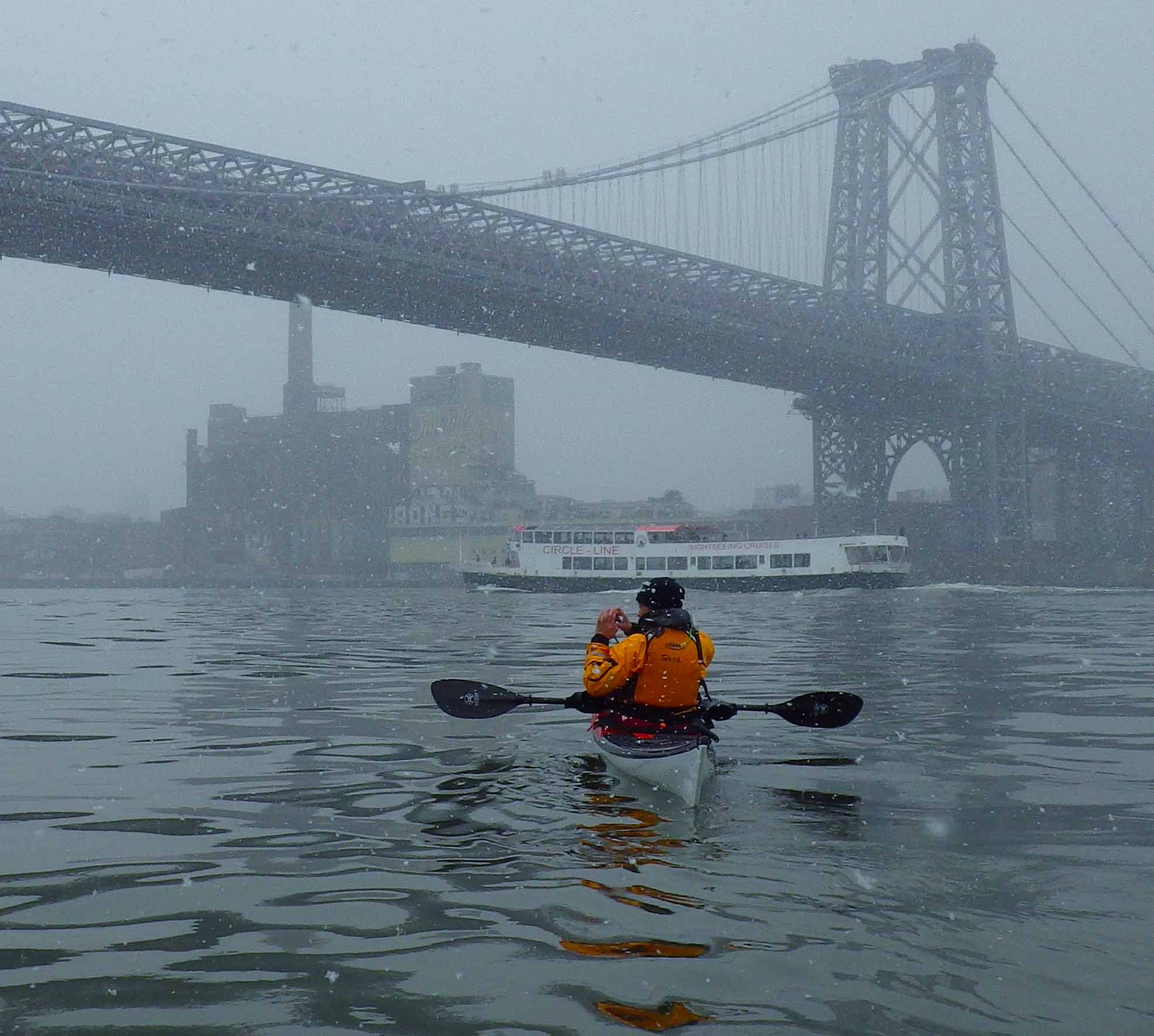
The romance of paddling on the East River in the snow…
(click on any photo to start slideshow)


.
We’d left late, and we knew the current would turn against us in the East River, either at Roosevelt Island or even before. But for now we still had some current with us, and it swept us northward on the East River. When I wasn’t admiring the snowflakes and the romantic snow-blurred skyline, I was feeling out the new boat.
I’d been disappointed by the relative lack of reviews of Tiderace’s Xplore series, particularly as compared to the Xcite, the flagship model. Xcite is a wonderfully snappy, maneuverable boat, ideal for paddlers who particularly enjoy rock-gardening and playing in the waves. It was introduced to quite a fanfare of reviews, and most paddlers who own a Tiderace have an Xcite.
Xplore, in contrast, had a more muted impact, and I hadn’t been able to find out that much about it, other than that it’s Tiderace’s conception of an expedition boat. It’s a bit similar to the Valley Nordkapp, a boat I (and many others) have a love-hate relationship with. The Nordkapp is fast and responsive, but it can be tippy. I was curious to check out the Xplore’s stability, so I was zigging and sagging Solstice, just a few yards outside of the East River channel.
As I was happily edging and turning the new boat, a ferry churned past on our left, southbound.
It was safely far away, so I was a bit surprised to hear Vlad shout, “Look! There’s the East River Dolphin!” At first I was confused: Did the East River ferry company have a boat called the Dolphin? Or was Vlad making a joke about dolphins in the East River?
Then I realized he was neither confused nor kidding: He meant a dolphin—a real dolphin.
I squinted and looked ahead, where he was pointing. Nothing. Just the silvery sheen of water like liquid mercury.
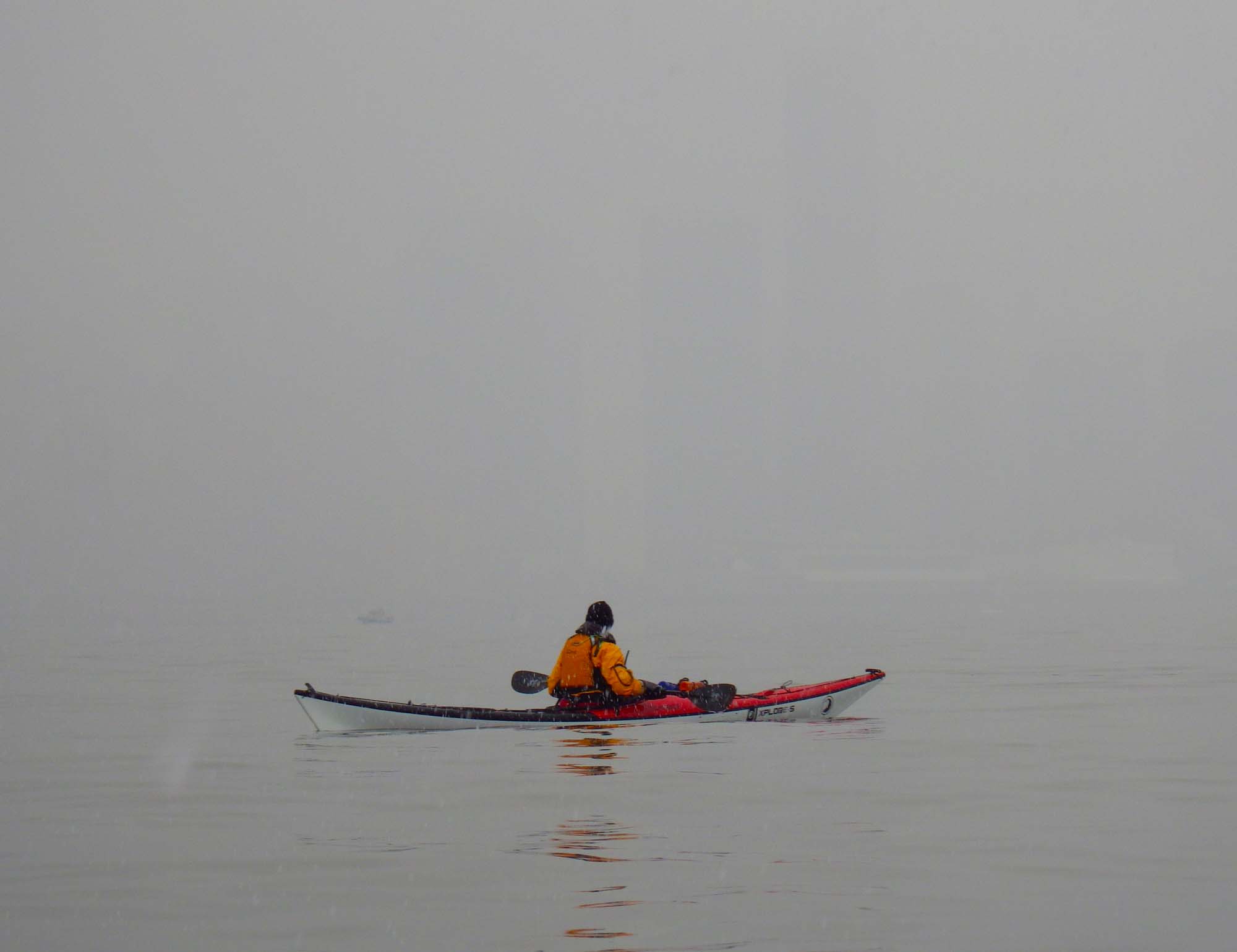
Johna scans for the dolphin
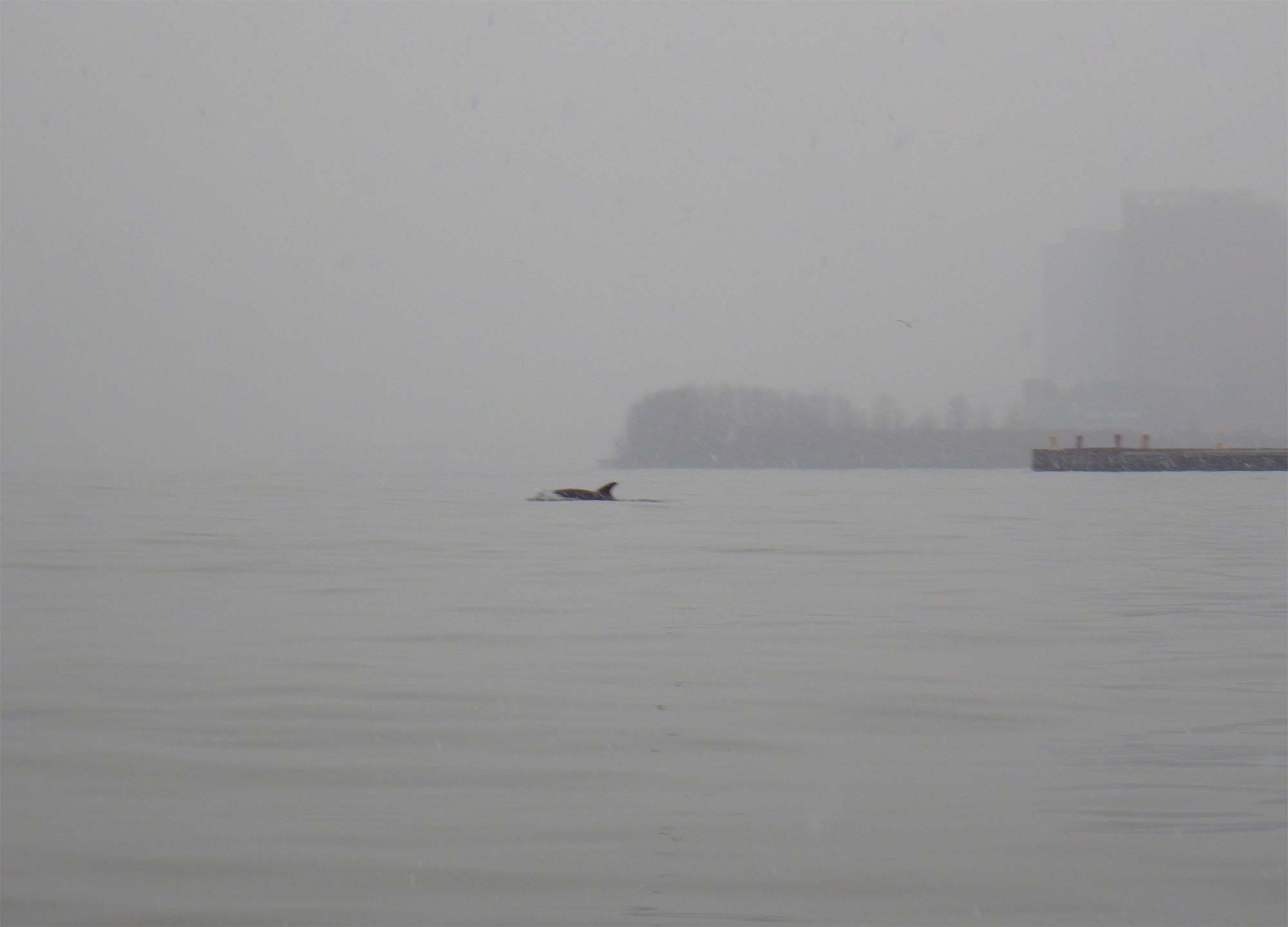
There it is!!
Then I saw it! A sharp fin sliced the air, and a gray-and-white body arced out. A real dolphin! In the East River!
And a big one, too. We guessed it was at least twelve feet long. You could mark its position by the flock of seagulls that circled overhead, cawing and waiting for the dolphin to drive fish to the surface.
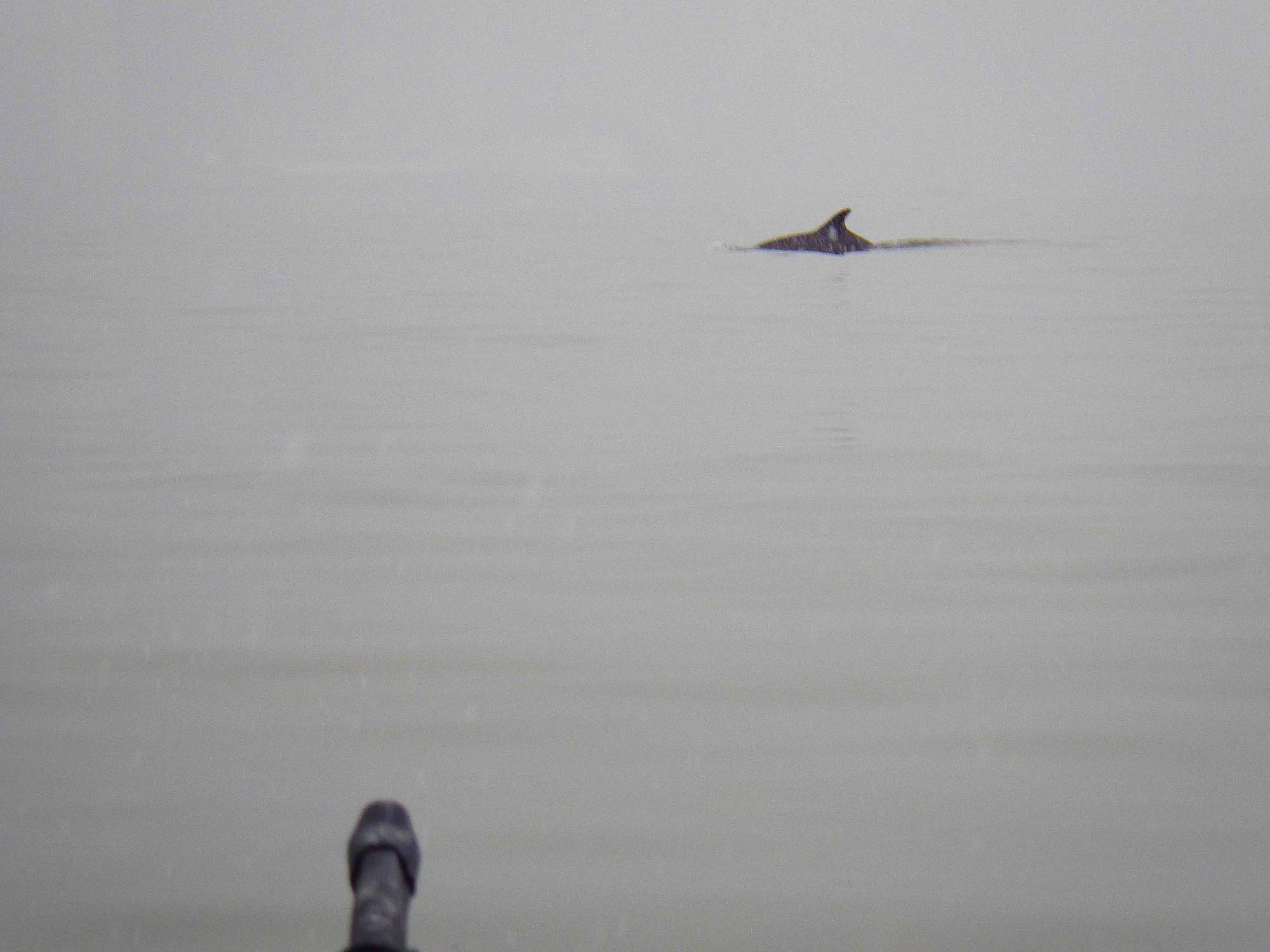
East River Dolphin dead ahead!
We paddled as close as we could get, with Vlad taking pictures and me barely daring to breathe. The dolphin dove and surfaced, surfaced and dove, in what felt like a circle around us, followed by the flock of seagulls, which seemed to regard the dolphin as their property.

We are joined on our dolphin watch by a green canoe
Suddenly a green canoe appeared from the mist of snow, paddled by a couple of guys who introduced themselves as Willis Elkins and Fung Lim.
“Did you see it?” they asked. It turned out they’d seen the dolphin earlier that day, and had taken close-up photos and a great video:
We chatted a bit but mostly just smiled at each other, still stunned by the unexpected magic.
I remember many years ago—when the pollution of the New York waterways was at its peak and the cleanup had only just begun—hearing someone joke about the day when there would be “dolphins in the East River”.
I still remember the image that sprang to mind: fins arcing against the skyline of Manhattan.
And I remember thinking, “Not in my lifetime—if ever!” It just didn’t seem possible that the ecological damage could be undone to that extent. Cleaned up passably—maybe. But dolphins? Happy, healthy, and cavorting?
Yet here they were (we found out later there was at least one other in the East River that day). That image that I’d thought was a dream—fins against the skyline of Manhattan—I’d seen in real life. I couldn’t believe such a promising omen on Solstice‘s maiden voyage!
After we’d said our goodbyes and paddled away from the canoeists, I said to Vlad, “Now I’ve seen it all! What’s next? Rainbows, dancing unicorns, and choirs of angels singing encouragement?”
Well, we never did see the dancing unicorns, but as for the rest…
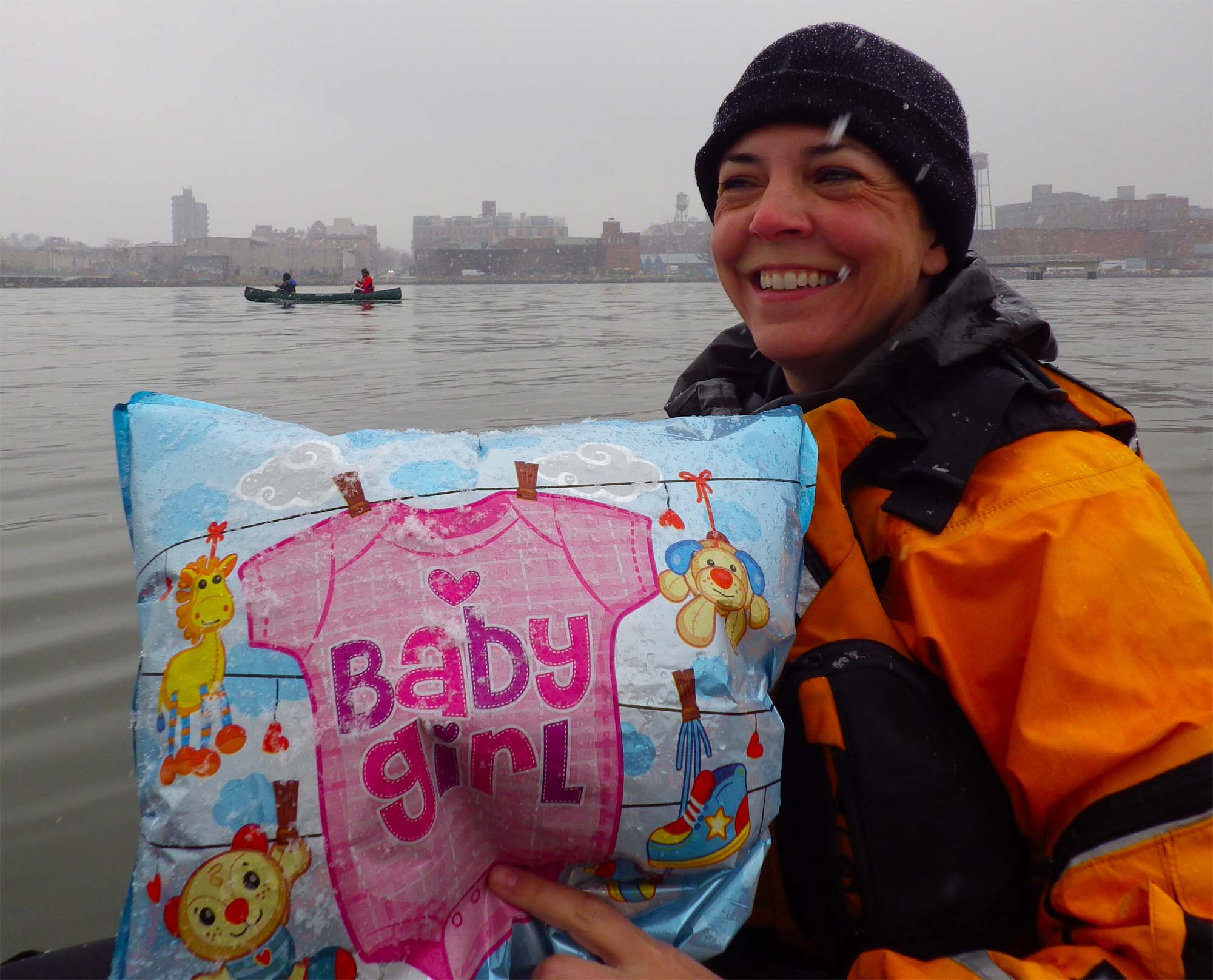
Baby girl!
“What’s that?” Vlad exclaimed. There was something floating off in the water, silvery and pink. We padded up closer and it was a balloon, which felt appropriately celebratory. We turned it over and had to laugh at the message: “Baby Girl!” Still, it felt like an encouraging note from the benign universe.
That feeling was only enhanced shortly thereafter when we encountered a brace of paddlers, including our friends Nancy Brous and Harry Spitz, who’d also been out observing the dolphins. It’s unusual to encounter other paddlers in the winter, so meeting our friends felt like (yet another) happy coincidence. We chatted and exchanged notes, and said goodbye.
Then we settled in for some serious paddling.
By now the current had well and fully turned against us, and we were looking forward to a long slog up the east side of the river. We weren’t sorry—the delay to take photos and observe the East River Dolphin had been more than worth it, and we might never had seen the dolphin had we started earlier. But no getting around it: we were in for an hour, or more, of hard paddling.
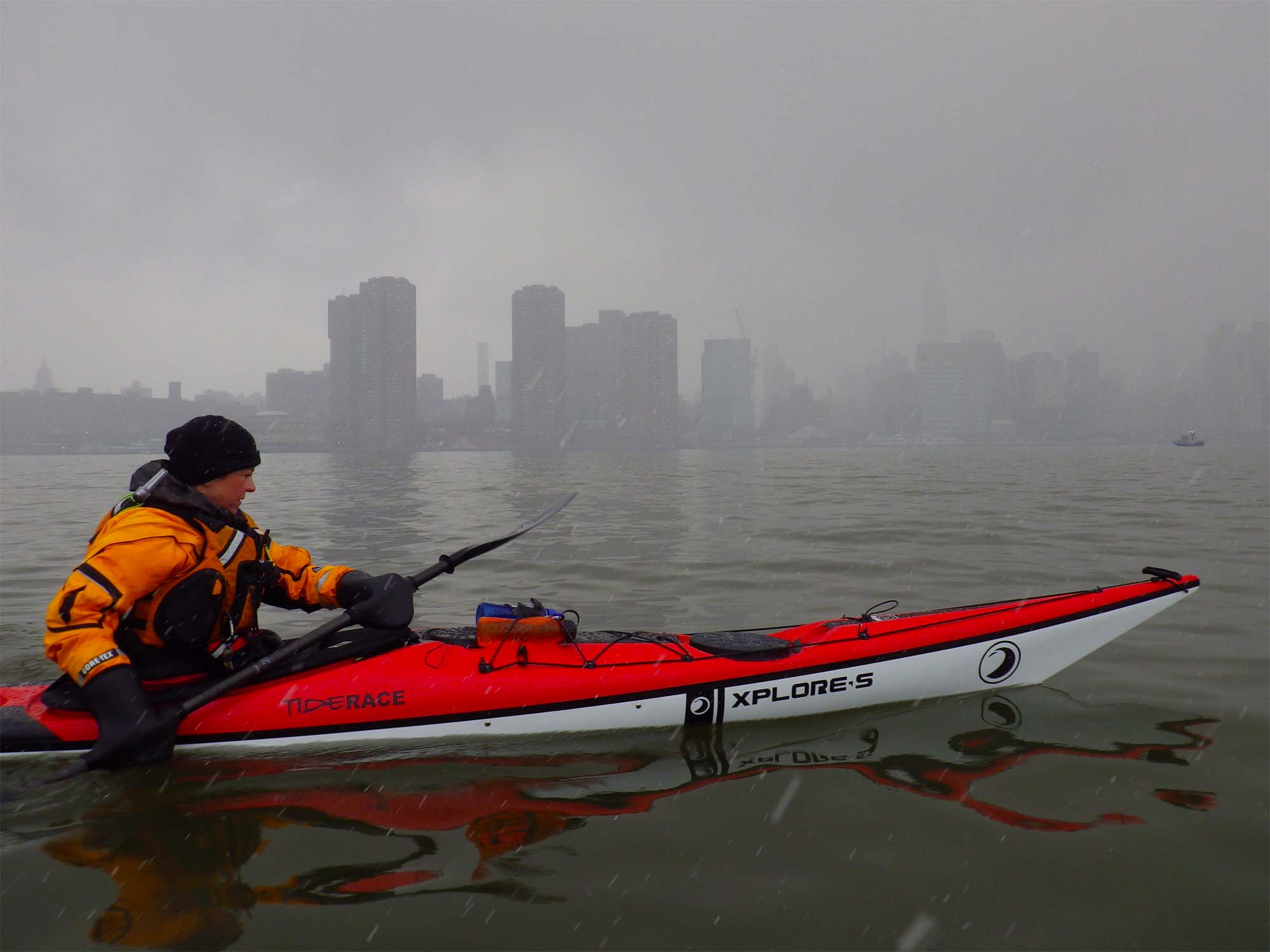
It’s going to be a slog…

… but a lot of fun too!
Fortunately, those are the conditions the Xplore is made for, and I was pleasantly surprised in my ability to maintain momentum against the current.
What I did discover—and more on this in a minute—is that the Xplore (like many long, thin boats) is acutely sensitive to variations in the current. It’s long enough that its bow and stern are almost in different time zones—and they’re responding to different current conditions.
As soon as I encountered an eddy line, the boat seemed to have a mind of its own as to which way it would turn—and I had to learn to work with it rather than against it.
“This boat design is clearly male,” I said to Vlad. “There’s no arguing with it, but if you nudge it in the right direction, it does what you want in the end.” (Perhaps wisely, Vlad had no comment.)
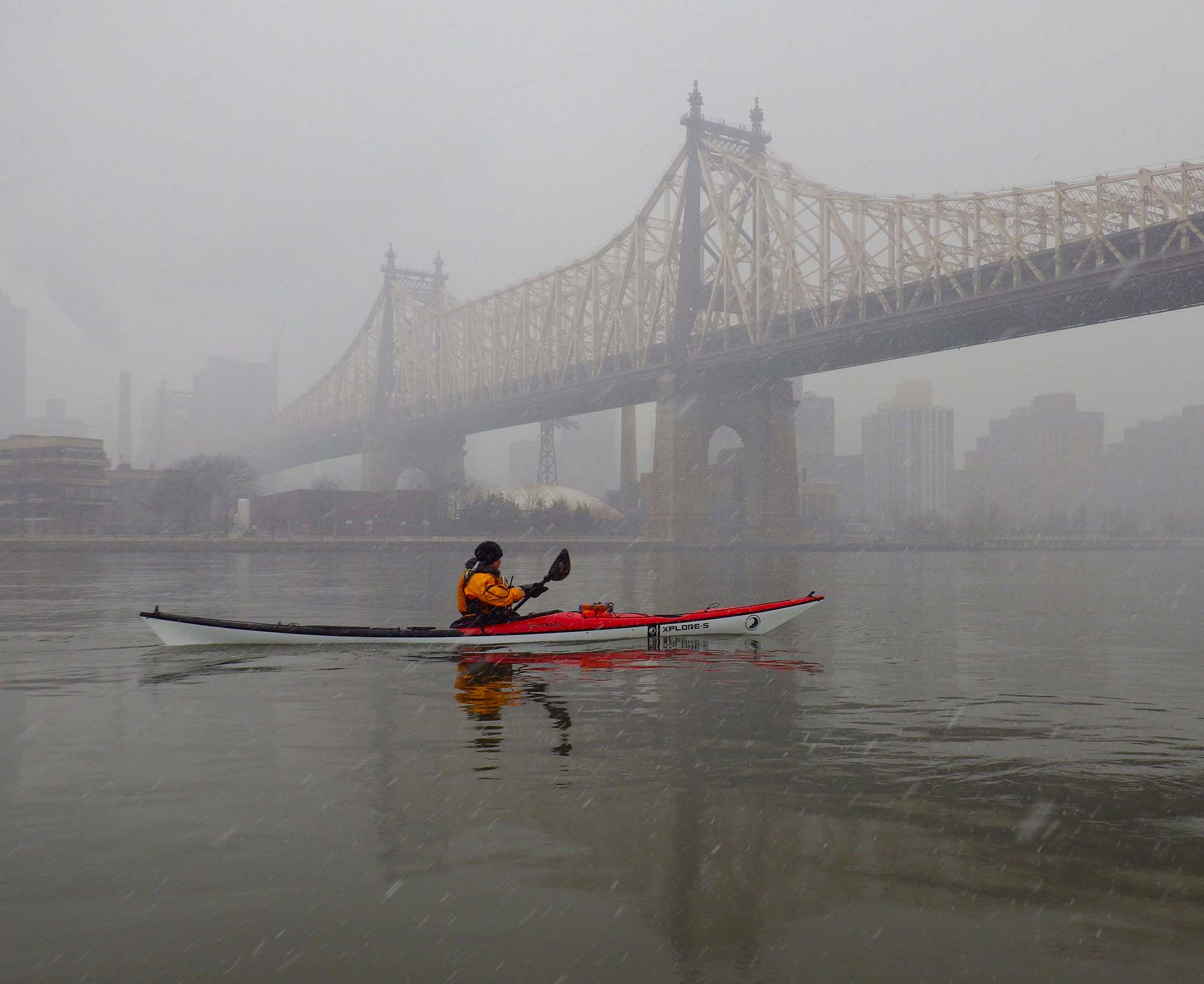
We approach the Queensboro Bridge

Monochrome tableau

We struggle on against the current…

… past the barges
After we’d powered past two big barges, obstacles that forced us into the middle of the river where the contrary current was strongest, we were able to turn into Hallet’s Cove and take a breather in the large shoreline eddy that develops there.
Now out of the current, I was paddling in a happy sort of daze, with the snow, the gray clouds, and gray water blending together. Out in front of me, I noticed something bobbing in the water. “It looks a bit like a dog,” I thought idly to myself… and then thought… “Wait a second…!!!!”
Seal-heads look a lot like dog-heads, particularly in the water. And there certainly are seals down by Swinburne Island, in the Lower Bay of New York Harbor.
But all the way up here? In the East River?
Sure enough… it was a seal, eying us curiously from the water. Yet another omen!
Vlad took several photos before it dived out of sight.

East River seal
By this time, it appeared nothing would be beyond belief. Dolphins, seals… what could be next?
A barge, as it turned out. Fortunately the captain had been regularly announcing himself on the commercial channel, and by the time we got to Hell Gate, we knew a barge was coming through from Long Island Sound, destined for the Battery by way of the East River.
So we holed up in another eddy to wait for the passage of the barge. Or at least, Vlad did.
I’d somehow gotten myself just a yard or two outside the eddy line, and spent some time spinning around in the whirlpools and tiderips that characterize Hell Gate when the current’s flowing.
I was well out of the way of the barge, but nonetheless it’s an unsettling feeling to be swept beyond your control by the current. I quickly learned that the Xplore rewards good technique: The thing to do when the current takes control is to take it back, by paddling forward (regardless which direction that sends you). Once you have momentum you have control of the boat, and can turn however you need to. But if you try to fight the current, bad things ensue.

We wait in a Hell Gate eddy for the barge to pass
At any rate, I soon pulled in beside Vlad and we watched the barge float past. Then it was time to make it across “the Gate” and into the Harlem River.
Normally we ferryglide to the north of Mill Rock, along the most direct route into the Harlem River. But by this time the current was pretty strong—we were two hours past slack—and I had my doubts about our ability to make it by that route. Vlad took off, and seemed to be doing a credible job making his way against the current.
After a token attempt, I gave up, and let the current sweep me south of Mill Rock, from where I paddled happily (and quickly) up the sheltered back side. We reconnected just north of Mill Rock, and heading into the Harlem River, settled in to enjoy the steady push of current for the rest of the way home.
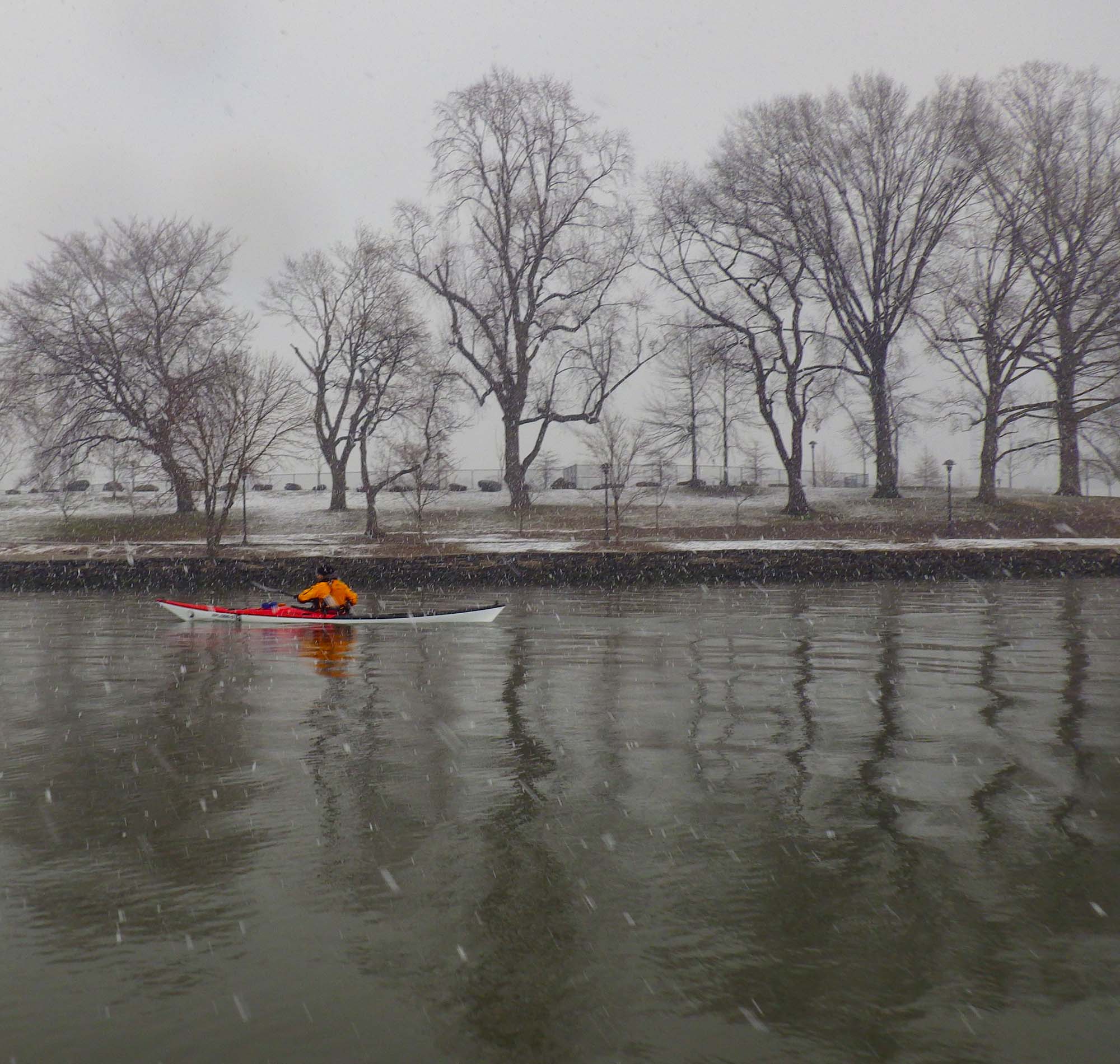
The Hell Gate drama over, we head into the calm, wintry Harlem River
But first: Lunch. We stopped at our usual barge just inside the Harlem River, and shared a lunch of sausages, cheese, apples, and tea.
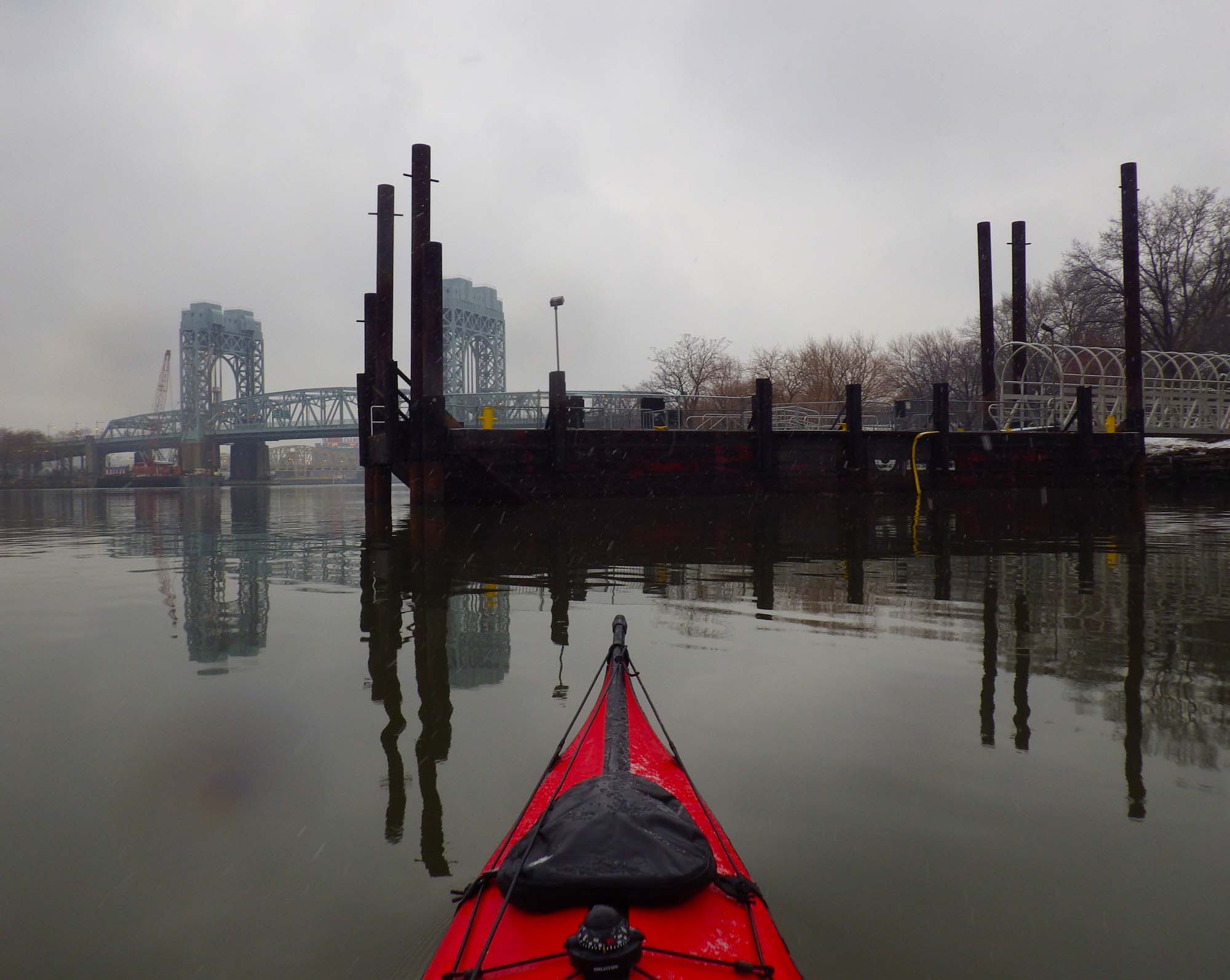
We head for our lunch barge…

… where we raft up…

… for a cozy lunch in the snow
Then we set off up the Harlem River.

Onward up the Harlem!
By this point, I’d gotten a good sense of how the Xplore handles (at least in the day’s conditions of low wind and waves and moderate current).
The Xplore truly rewards good technique: I found you can turn it purely by edging, so long as you edge “properly”—by which I mean driving your sit-bones downward, rather than trying to yank the boat up with your knees. If you do it properly, the boat will reward you with a 180-degree turn regardless of whether you even remember to add in a sweep stroke, low brace, or bow rudder.
It also responds wonderfully to a well-executed forward stroke—you can speed up measurably by simply switching your stroke to high angle, without changing the cadence or effort you put into it. (If you speed up your cadence, or increase your effort, it will speed up still more. It doesn’t accelerate particularly quickly, but you can maintain a fairly high speed with relatively low effort once you get there.)
And it simply loves good torso rotation—the boat can tell the difference between merely rotating your torso and making a full-on effort from the hips.
In sum, if you pay attention to form and balance (or are lucky enough to have good intrinsic abilities in both), the boat is an absolute joy to paddle. After a bit of practice, I found I could maneuver the Xplore with just a half-inch shift in my torso placement. And, as Randy had advised, the boat responds with precision, doing the same thing each time.
It lets you know immediately if you’re getting sloppy, though, and if you try to maneuver it with strokes alone—not paying attention to balance and form–you’ll be pretty unhappy with the outcome.
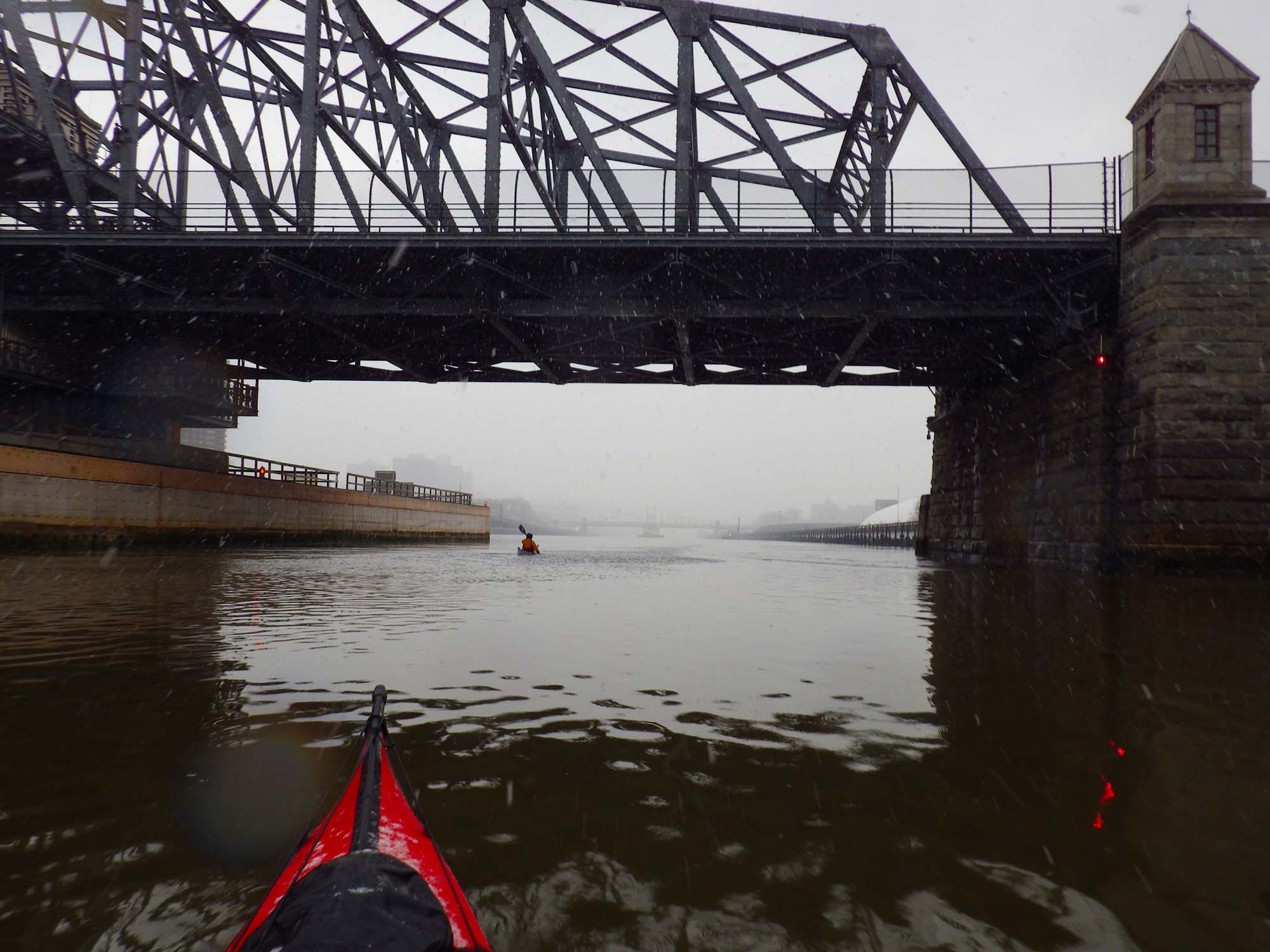
Under the lower Harlem River bridges…
As we headed up the Harlem, we found ourselves in our favorite conditions: Wind against current. The current was with us, and the wind (admittedly, a light breeze ) was in our faces. We whipped by under one bridge, then another, and another, with snow-frosted trees on both sides…
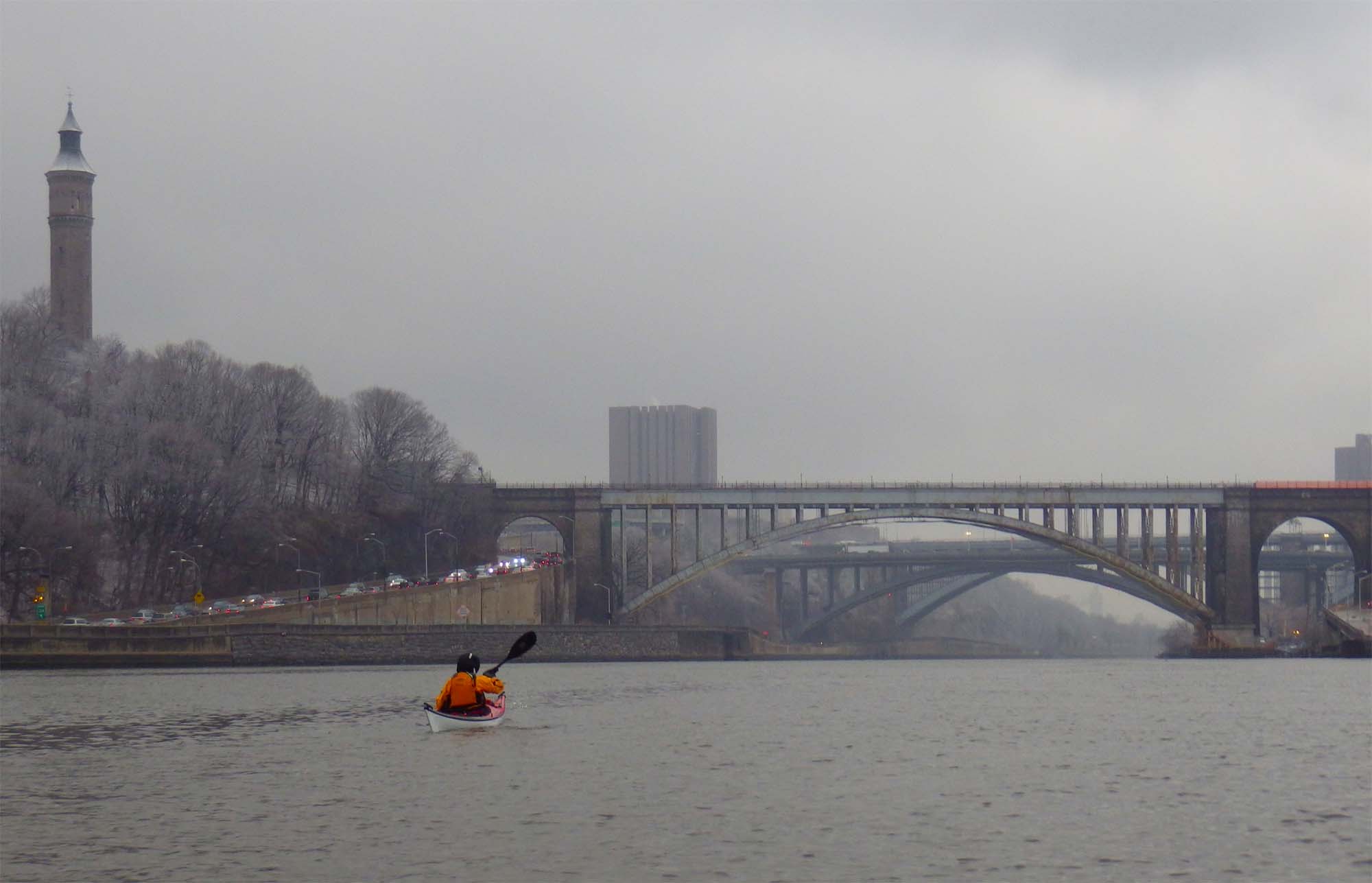
… toward the trio of mid-Harlem bridges
But wait? What was that? Something familiar-looking floating in the water, silvery but blue this time. We paddled over: Another balloon. “Happy Birthday!” was the message this time.
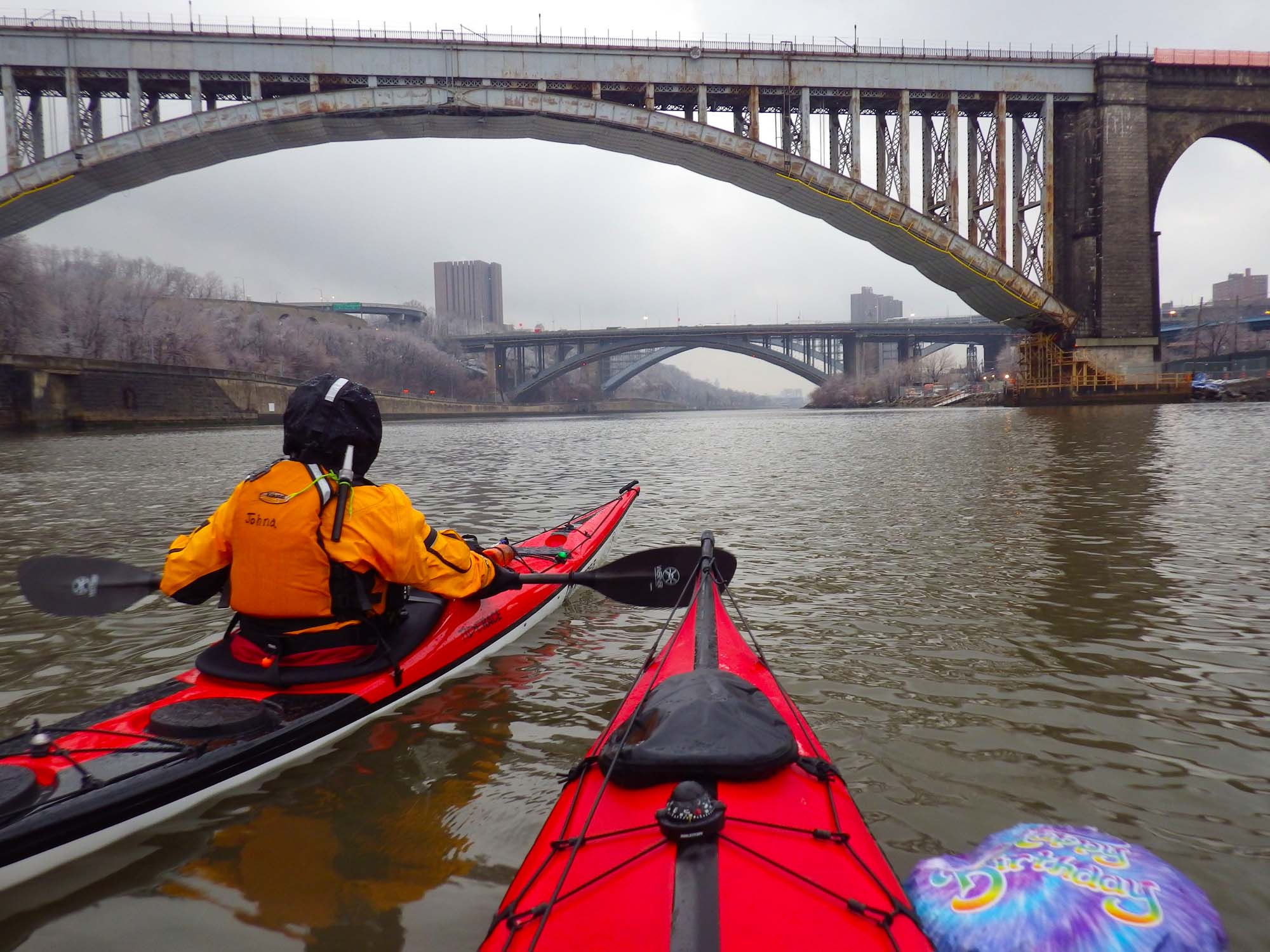
Happy Birthday!
And not long afterwards, we found our third (and final) balloon of the day: “Happy Valentine’s Day!”

Happy Valentine’s Day!
Okay, so maybe no dancing unicorns. But a rainbow of three colorful balloons… more than we’d seen on a single trip before… and they certainly felt festive and celebratory. So what about those angelic choirs?

Near the top of the Harlem now…
As always happens, the Harlem River portion of the trip ended too soon. Almost immediately after the Bette Middler boathouse appeared against an icy backdrop, we saw the Columbia “C” and the Spuyten Duyvil bridges and cove.
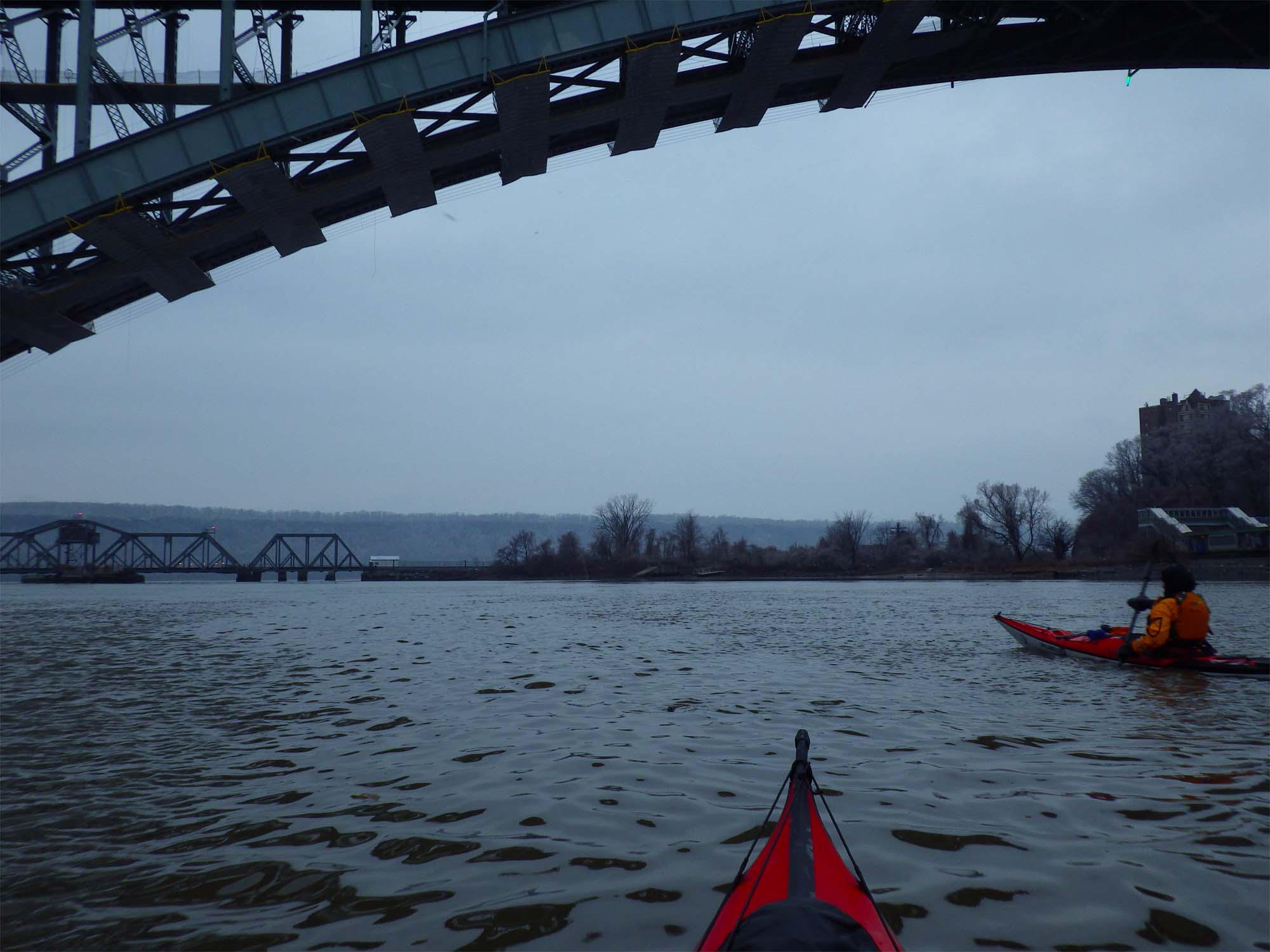
We pass under the Henry Hudson Bridge…
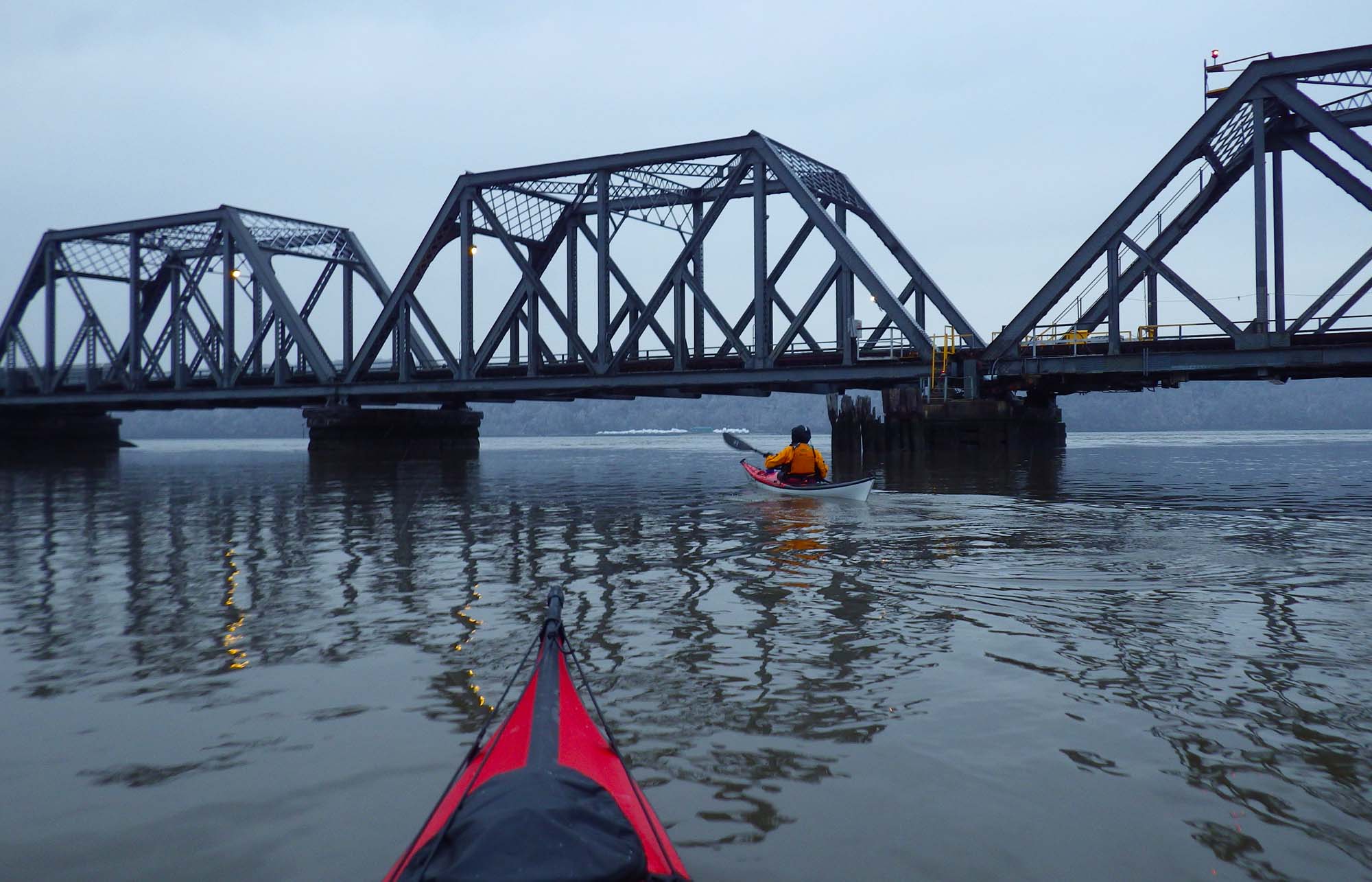
… and under the Amtrak railroad bridge into the Hudson
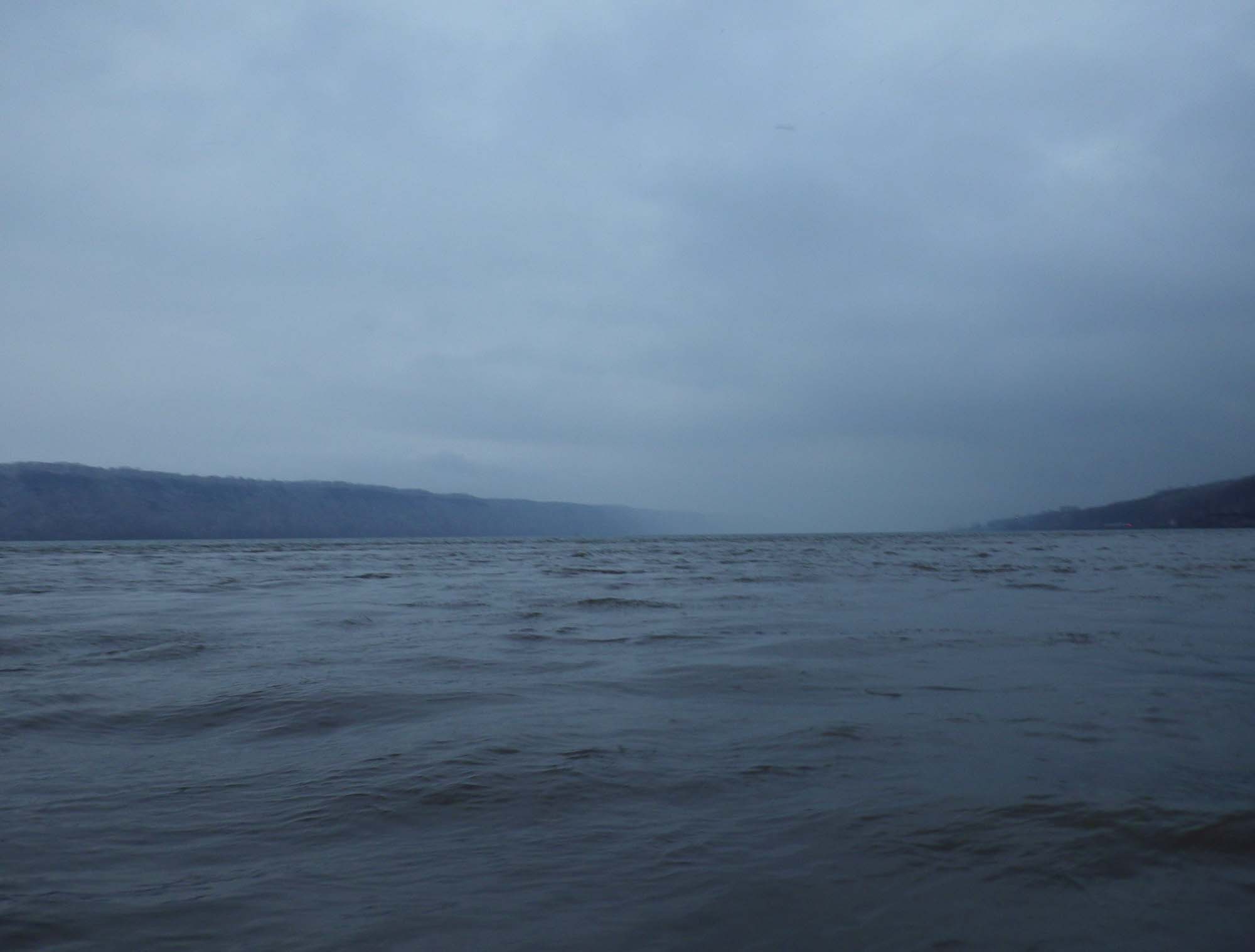
Out in the Hudson, looking north…
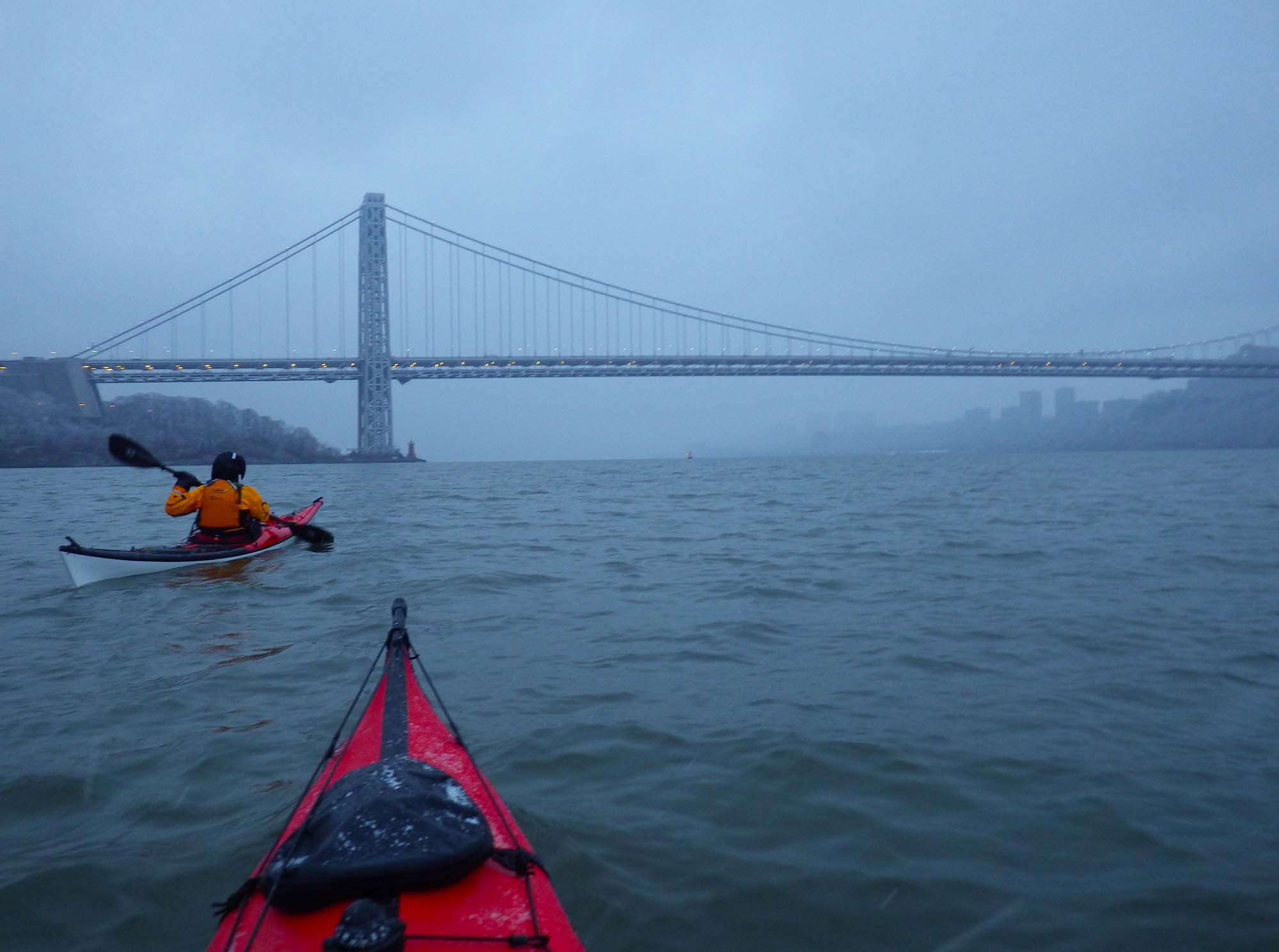
… but paddling south
Then we were out in the Hudson and rocketing with a strong ebb current southward, towards home.
As we passed the Dyckman Street pier, some people on the pier started shouting and waving. I waved back, but was too far out in the water to hear what they said, until the wind changed direction and I caught a short burst of words: “…. You guys are AWESOME!!”
Okay, I can’t be sure these folks were angels. But I’m telling you, there was our choir singing encouragement.

We approach the George Washington Bridge in the blue twilight

But where is Manhattan today?
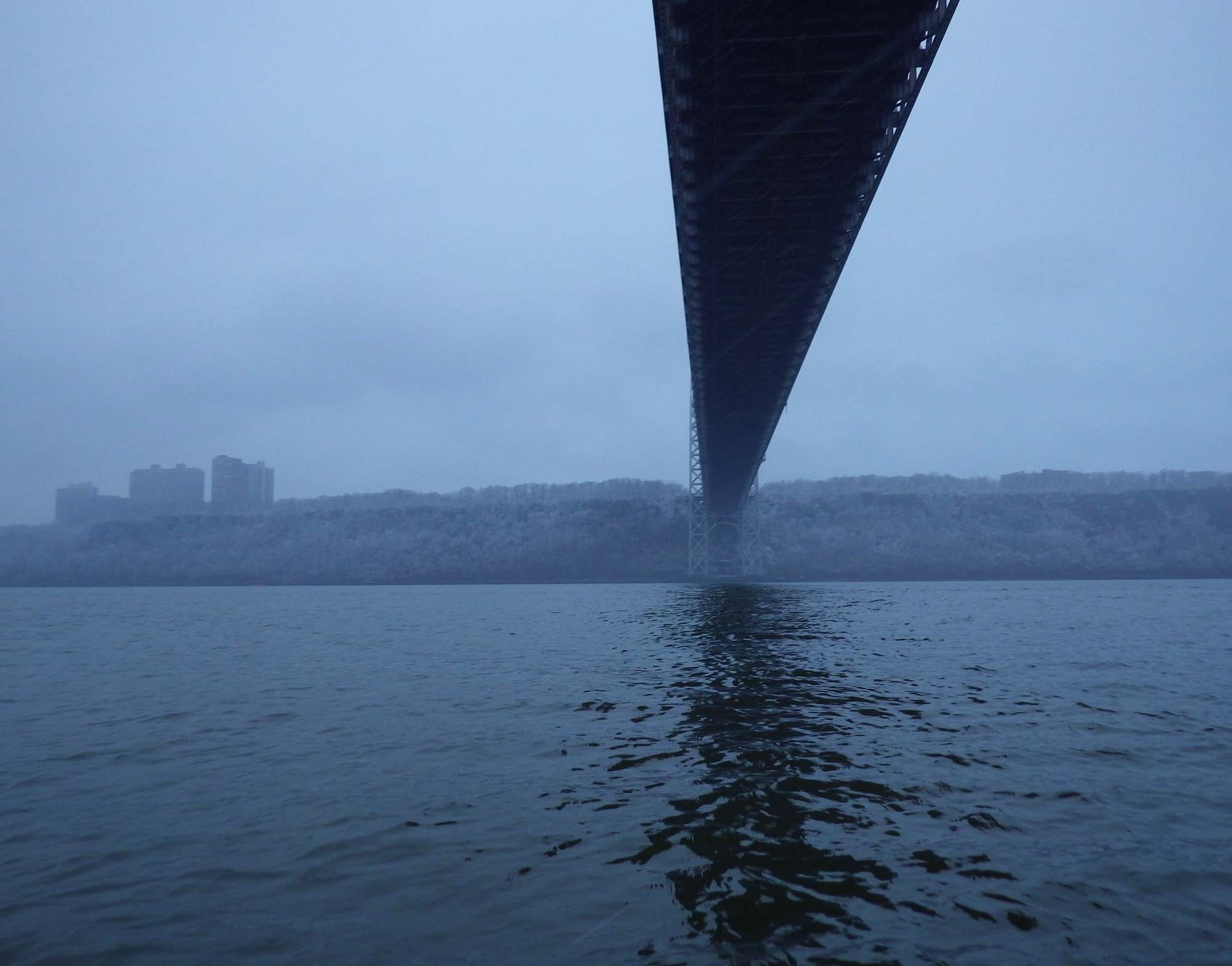
Blue bridge nocturne
And then it happened again…!
We paddled down the Hudson into the deepening dusk, watching the city lights wink on and listening for ferries and other boat traffic on the radio. The snow had mostly stopped, although occasionally a flurry or two would pile flakes on our boats.
And as we paddled by one of the piers, yet again we heard shouted encouragement, in the same words…”You guys are awesome!”
Now, that’s never happened before—plenty of times we get waves, or a thumbs-up. (And a few times, Vlad has been threatened and had rocks thrown at him.) So to be told twice—in so many words—that we’re awesome… well, you can tell me that’s not an angelic choir.
And I’ll tell you we’re all entitled to our own beliefs. :-)

The lights of Midtown Manhattan

Almost home…. the top of the Freedom Tower is still wreathed in snow clouds
As we drifted into the luminous night, all we could think was…. Could a maiden voyage have been any more magical?

Finale
More photos from the trip are here.


 Vladimir Brezina (RIP)
  Johna Till Johnson


 Wind Against Current
Pingback: Reward | Wind Against Current
Love the contrast of red & grey, and what a wonderful day. Just shows how cold weather doesn’t have to stop you enjoying yourself.
LikeLike
It was a wonderful—magical, as the title says—day indeed :-)
LikeLiked by 1 person
Pingback: Snowfall by the River | Wind Against Current