By Johna Till Johnson
Photos by Vladimir Brezina
<—Previous in Everglades Shakedown

Start: Highland Beach.
Finish: South Joe River Chickee.
Distance: About 23 nautical miles.
Paddling time: Roughly 10 hours; average pace 2.3 knots.

By Johna Till Johnson
Photos by Vladimir Brezina
<—Previous in Everglades Shakedown
Start: Highland Beach.
Finish: South Joe River Chickee.
Distance: About 23 nautical miles.
Paddling time: Roughly 10 hours; average pace 2.3 knots.
Posted in Kayaking
Tagged Everglades, Everglades Challenge, Florida Kayaking, Kayak Camping, Kayak Expeditions, Photography, Sea Kayaking
By Johna Till Johnson
As many of our readers know, I’m a huge fan of bridges. To me, they’re beautiful both physically and metaphorically—lovely structures that bring two sides together. Although my favorite bridge is the Hell Gate Bridge, I’m passionate about all the New York waterway bridges.
So it’s a big deal to me that New York will be replacing the Tappan Zee Bridge—and the new structure will be complete relatively soon (supposedly, by 2018).
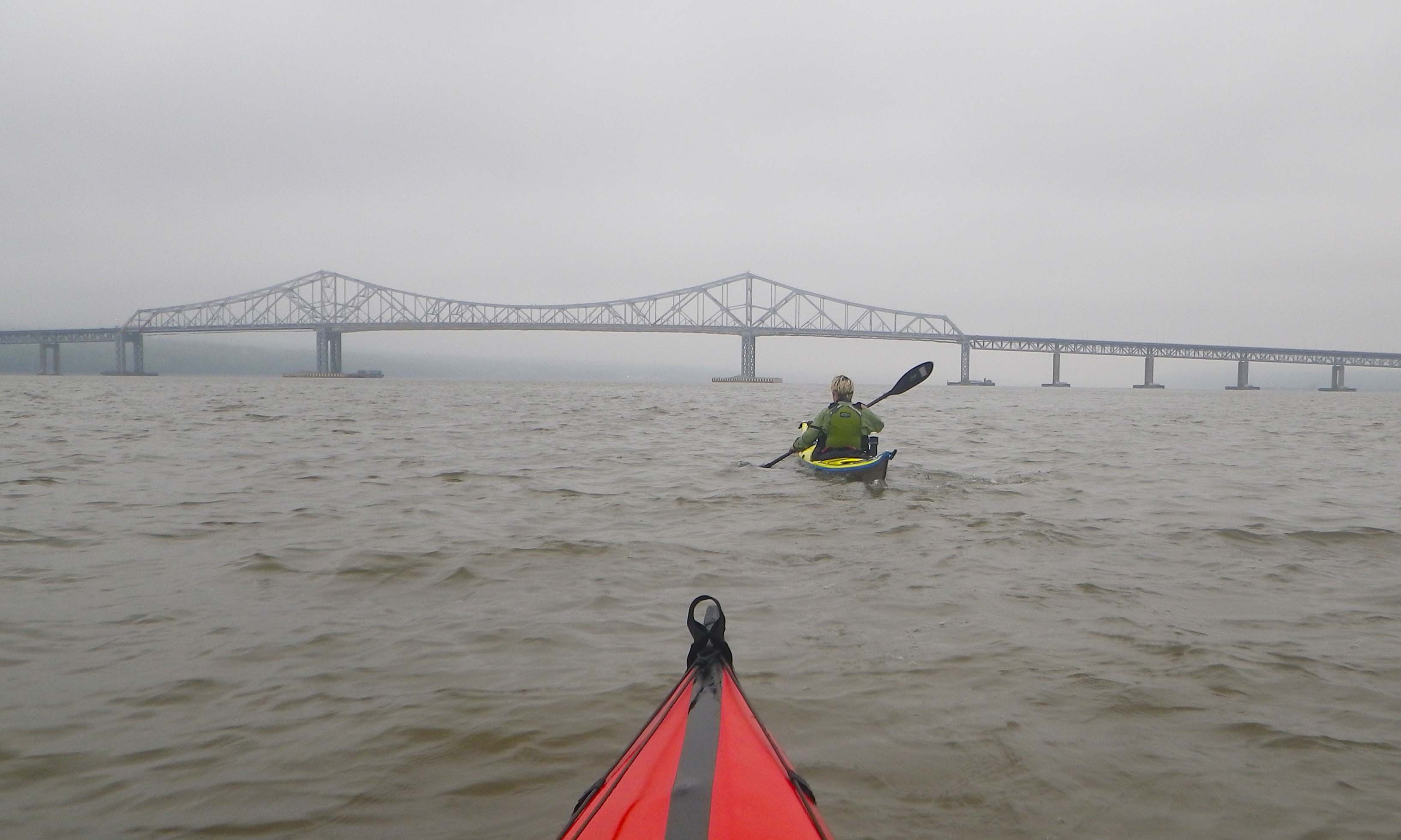
Here’s what the Tappan Zee Bridge looks like today:
And here’s what it’s supposed to look like in future:
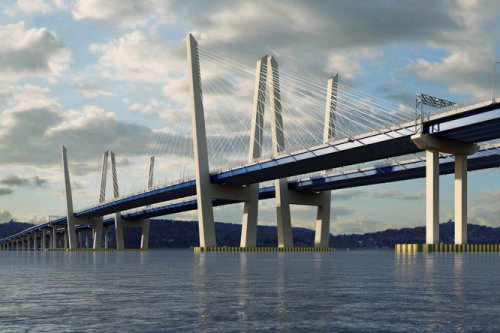
I’m not crazy about the outward-reaching “harp” towers… but it is a bridge, and I love bridges… What do you think?
By Johna Till Johnson
Photos by Vladimir Brezina
<— Previous in Everglades Shakedown
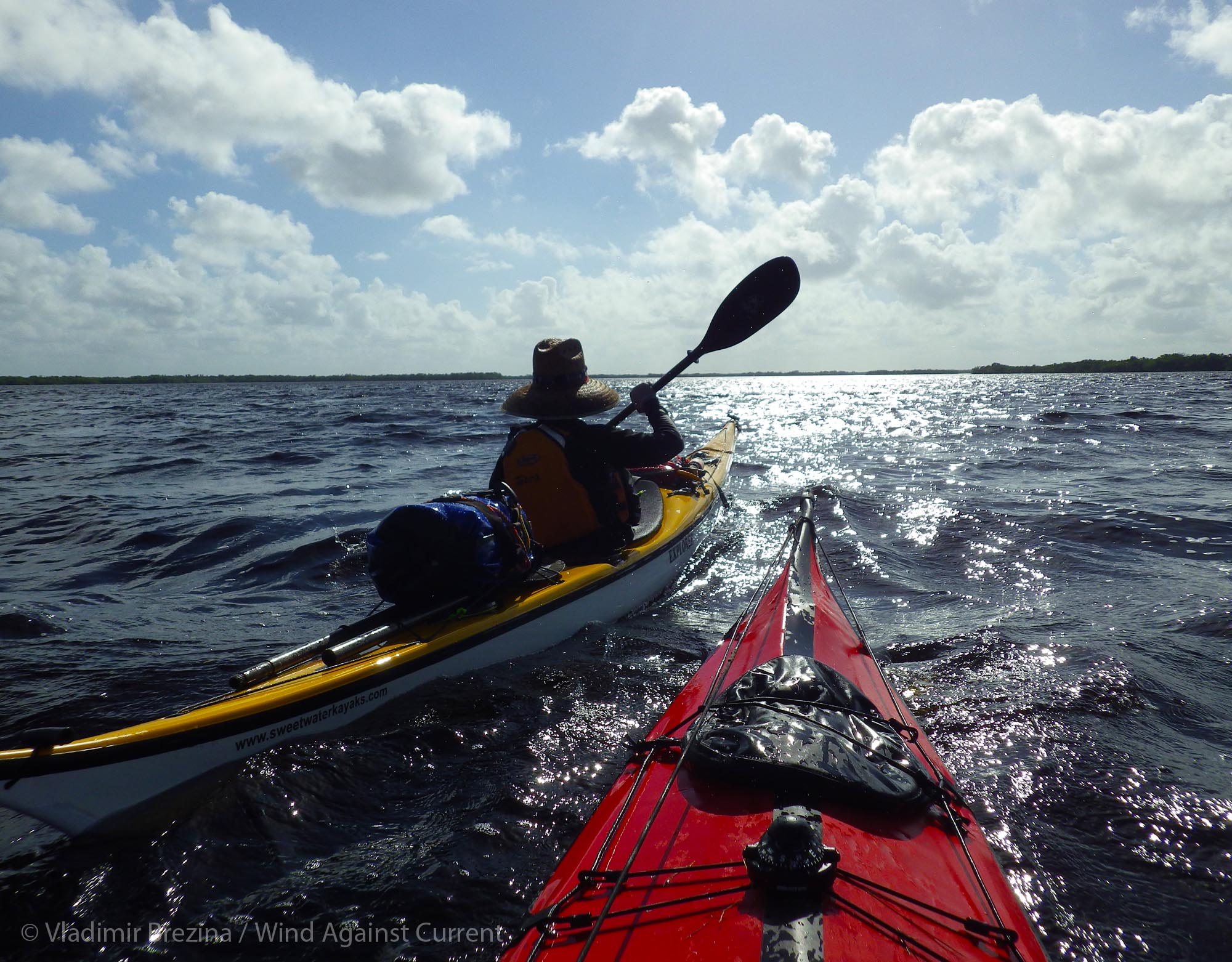
Start: Darwin’s Place.
Finish: Highland Beach.
Distance: About 18 nautical miles.
Paddling time: Roughly 8 hours; average pace 2.3 knots.
Posted in Kayaking
Tagged Everglades, Everglades Challenge, Florida Kayaking, Kayak Camping, Kayak Expeditions, Photography, Sea Kayaking
By Johna Till Johnson
Photos by Vladimir Brezina
<— Previous in Everglades Shakedown
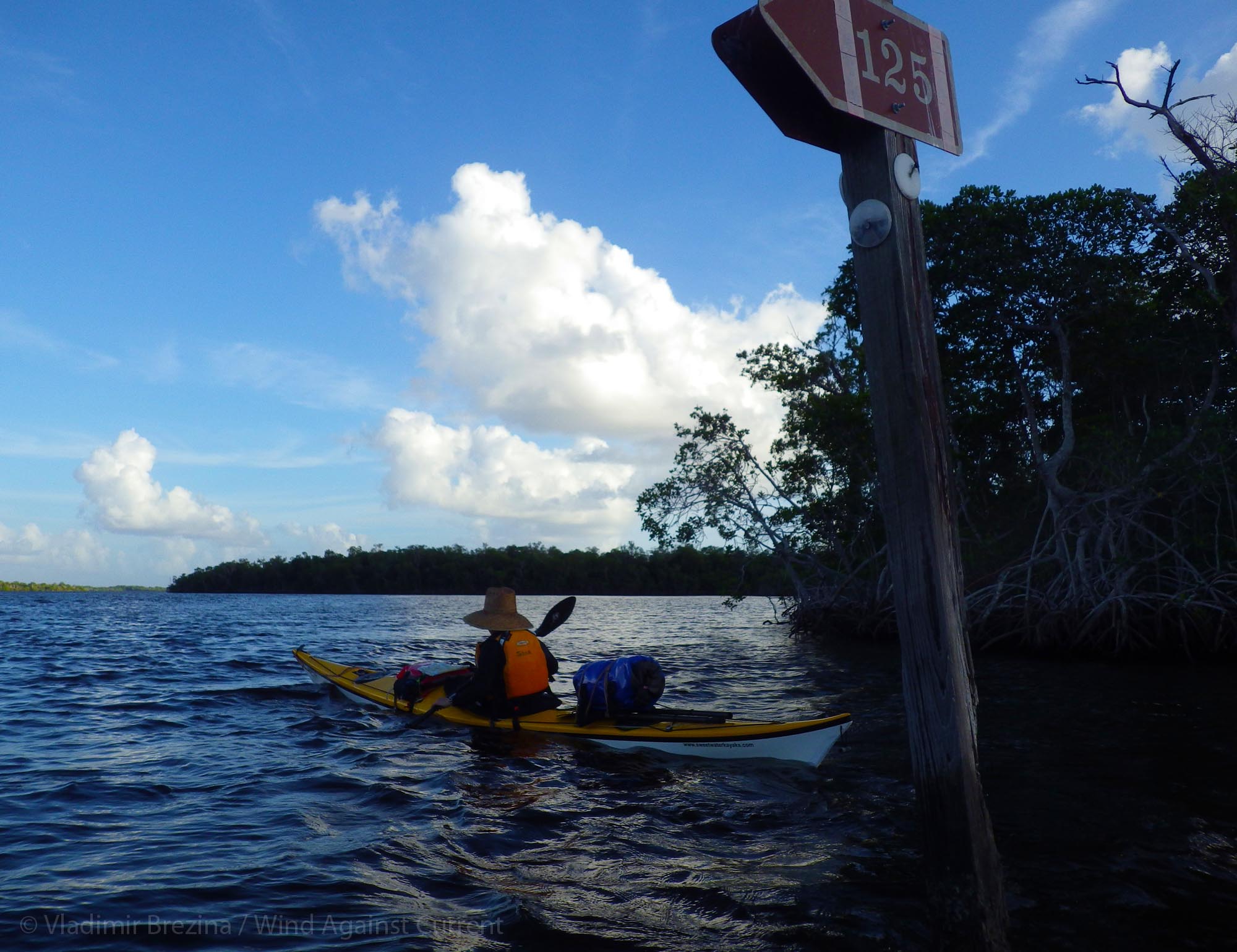
Start: Chokoloskee.
Finish: Darwin’s Place.
Distance: About 21 nautical miles.
Paddling time: Roughly 8 hours; average pace 2.6 knots.
Stop time: Roughly 2 hours (30 minutes lunch plus a 90-minute stop at Everglades City to obtain permits).
By Johna Till Johnson
Photos by Vladimir Brezina
<— Previous in Everglades Shakedown
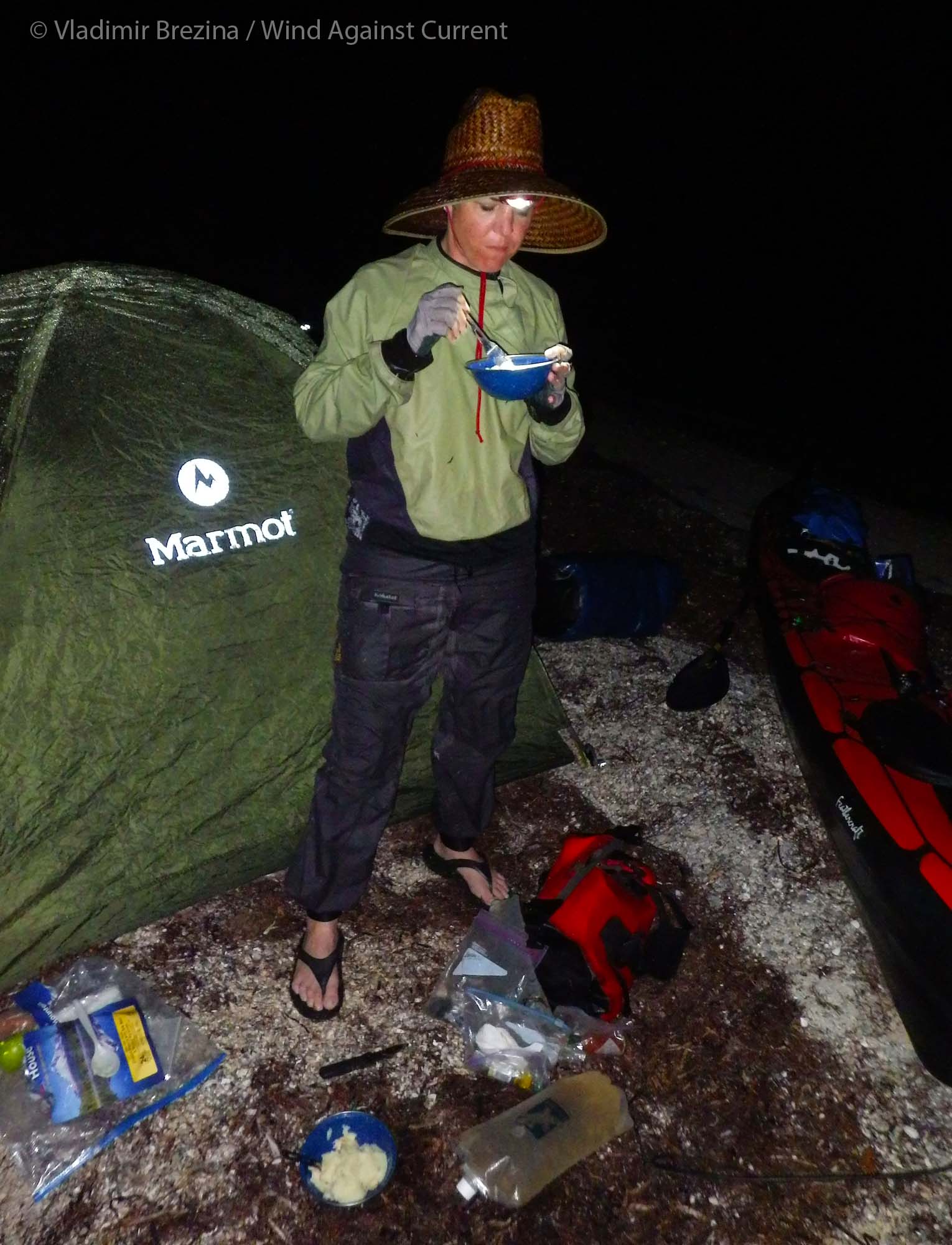
Christmas dinner, 2013
The goal of our Everglades Shakedown Expedition of December 2013 was to gain an understanding of the Everglades environment for the upcoming WaterTribe Everglades Challenge, and we’re happy to say it succeeded. Our biggest lesson learned was that we’d largely been worried about the wrong things. Snakes and crocs? No worries, mate! But midges and skeeters can be more than a nuisance—they can derail your trip by keeping you penned in your tent, unable to cook or pee.
Similarly, I’d been deeply concerned about paddling in the Everglades at night. It’s pitch-black (actually, not quite: the lights of Miami loom on the horizon) and the thousands of mangrove islands look all the same. Sure, we do plenty of nighttime paddling in New York—but that is our backyard, and even if you are a visiting paddler, the city is well-illuminated and chock full of landmarks, from the Statue of Liberty to the various bridges, so it’s fairly easy to keep your bearings. Turns out that with a compass and charts, a good flashlight, and ideally a mapping GPS, nighttime paddling in the Everglades is very much doable, as well. (And in some respects, it’s more pleasant than daytime paddling.) That relieved my worry about being limited to paddling only during the daylight hours in the Everglades Challenge itself.
And some things that seemed trivial from our perch in New York were not trivial at all. Headwinds across the shallow water that abounds in the Everglades generated chop and slowed us down considerably—our average pace for the trip was 2.3 knots, and that’s with fast boats and good technique. (Our standard average, in calm waters with no wind or current, is around 3.4 knots.)
Here are some of the highlights of what we learned:
By Johna Till Johnson
Photos by Vladimir Brezina
Florida paddling!
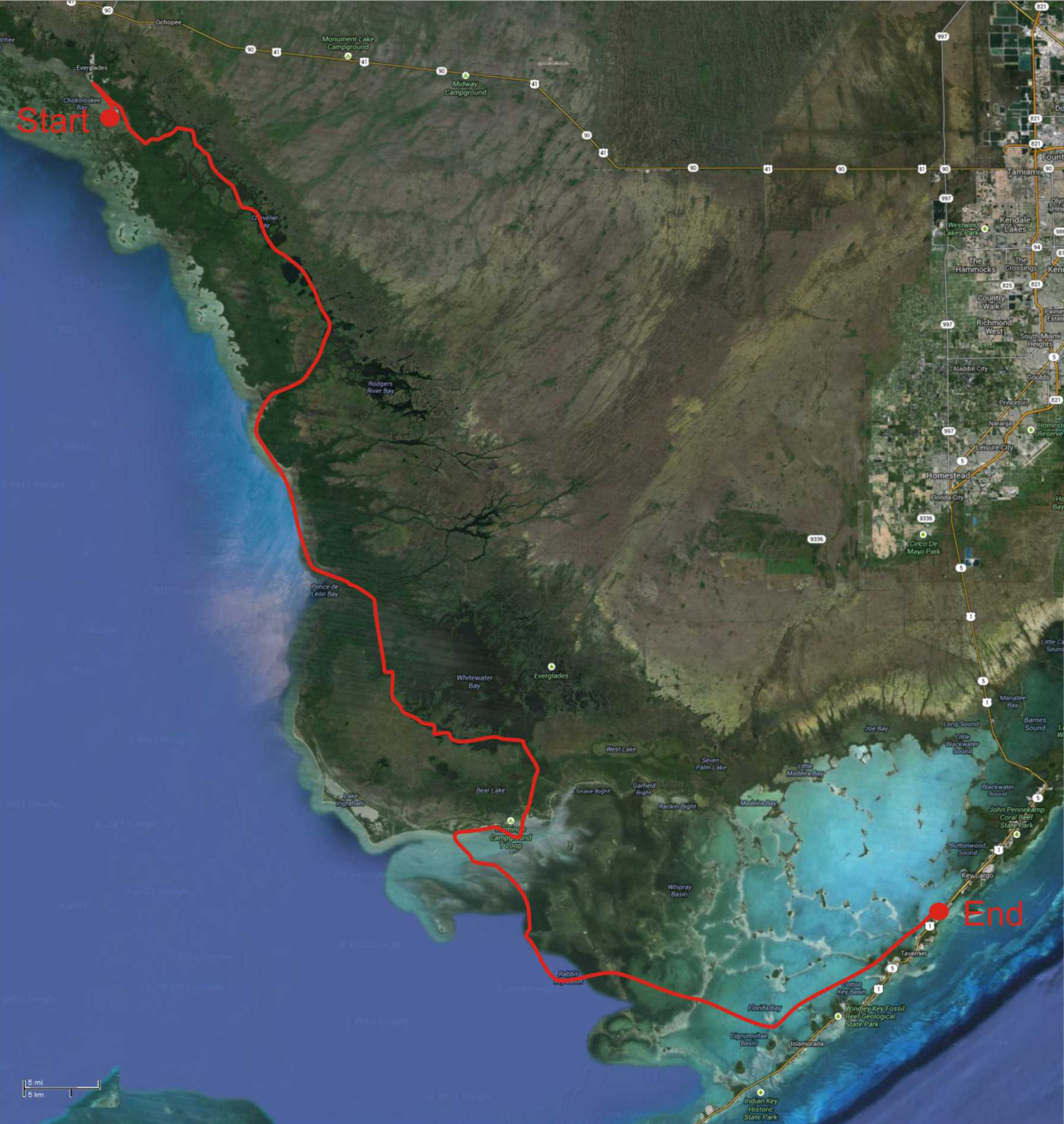
Our route
Last month, we headed down for some kayaking in Florida over the Christmas holidays. Nothing unusual about that—this time of year, plenty of people head south for the sunshine and warm water.
In our case, though, the goal was what the Scouts call a “shakedown expedition”: A trip you take before the expedition itself, to get a feel for the environment and its challenges, and decide which equipment is truly necessary. (The usual mistake is to pack too much, which is where the “shakedown” part comes in…)
As many readers know, we’re planning to compete in the WaterTribe Everglades Challenge in March. It’s a 300(ish) mile race for kayaks, canoes, and small sailboats from Tampa Bay to Key Largo. The details of the route are left up to the participants; the only route-related requirement is checking in at three specified checkpoints on the way. (Other requirements include carrying some mandatory gear, and managing your boat and gear without external assistance.) To complete the challenge, you have to finish in 8 days or less, though the awards ceremony is on the afternoon of the seventh day, and if you anticipate placing, you’ll want to finish much earlier!
We don’t take it lightly—a trip like this requires careful planning as well as physical endurance. We’re no strangers to long-distance paddling, but until last year we hadn’t spent much time in the Florida waterways. So we went on our first “shakedown” expedition in April…
…and in six days of paddling, made it just a third of the way, a bit past the first checkpoint. (We’re still writing up that trip, but we described the first three days of it here and here.)
Obviously, more practice was called for!
Now, there were mitigating circumstances—I was in an extra-slow boat (a 12’10” Feathercraft K-Light, my Baby Vulcan). Plus, early in the trip we decided to take it easy and just get a feel for the Florida land- and seascape. So we weren’t too upset by our slow going in the first shakedown expedition.
But one thing we noticed was that we spent an inordinate amount of time making and breaking camp—partly because we were still overpacking, but also because we weren’t as tightly organized as we needed to be.
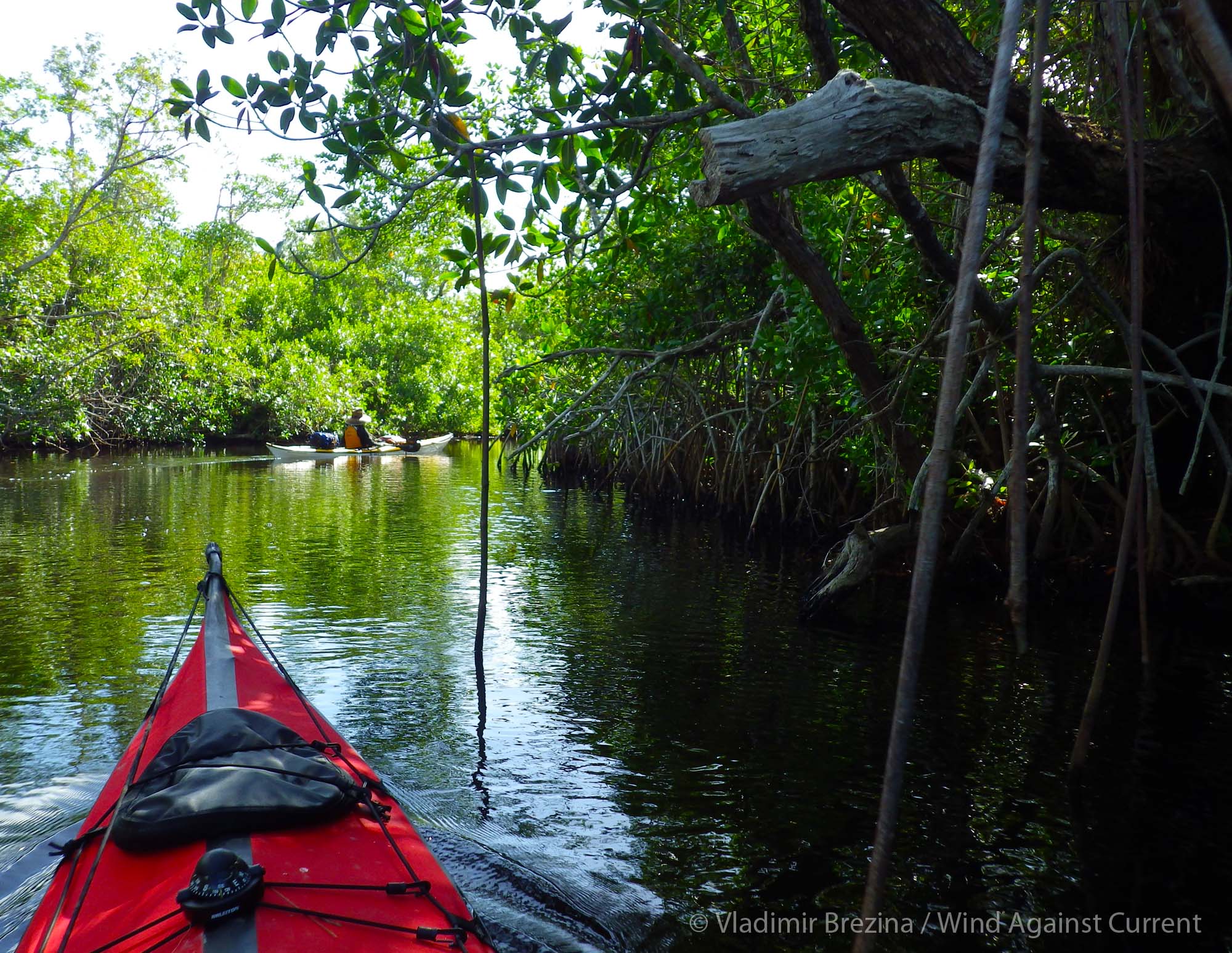
Through tortuous creeks…
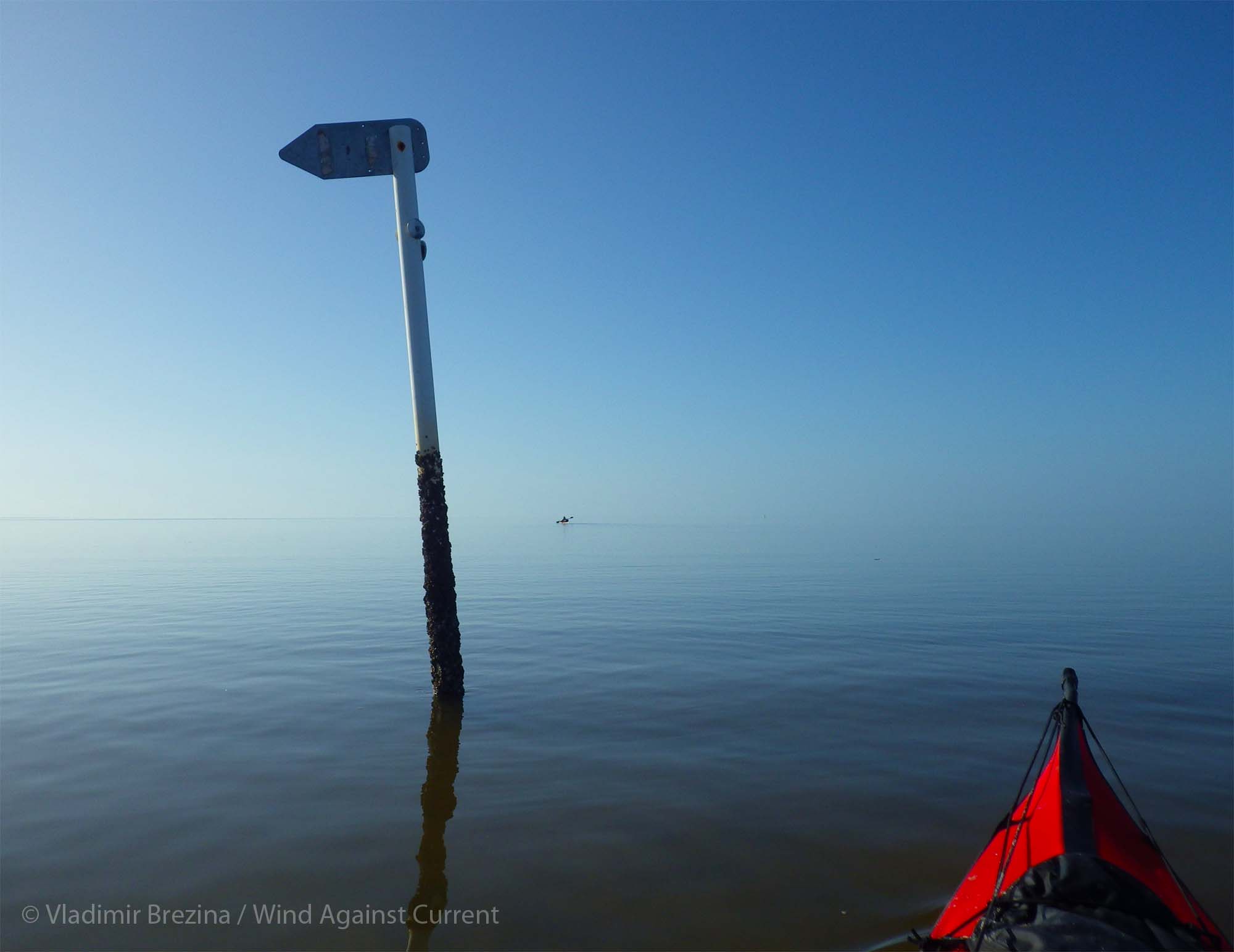
… and shallow waters
So the goal for this trip was twofold: Optimize our organizational skills, and gain a feel for the Everglades, which present what could be called unique navigational and environmental challenges. (That’s a rather bland way of putting things, as you’ll see…)
For this trip, I planned to rent a long, fast boat from the ever-fabulous Sweetwater Kayaks in St. Pete, which as far as I’m concerned is the premier watersports outfitter in all of Florida. (Thanks again to Russell and friends!) Vlad would take his trusty Red Herring. And we’d launch from Chokoloskee, the second checkpoint, and paddle to Key Largo. That would still make for a much slower pace than in the actual challenge, covering only about 40 percent of the distance over 6 days of paddling. But it would be enough, we hoped, to test-drive our newfound organizational skills and learn how to handle the Everglades.
The short version? It was—and then some! To make the story a bit more readable, we’ve broken it down into several sections. Click on the links below to read about what we learned, both overall and on each day of the trip:
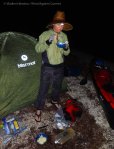 Overall: Challenges and Lessons Learned
.
.
.
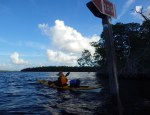
Day 1: Headwinds and Night Navigation
.
.
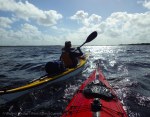
Day 2: Barking Vultures, Beaches, and Bugs
.
.
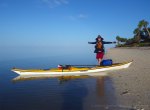
Day 3: Wind, Waves, and Chickees
.
.
Day 4: Portage, Paddling in the Pitch Dark, and Fending Off Furious Crows
.
.
Day 5: Navigating the Shallows
.
.
Day 6: Headwinds and Homelessness
.
.
A few preliminary photos from the entire trip are here.
Posted in Kayaking
Tagged Everglades, Everglades Challenge, Florida Kayaking, Kayak Camping, Kayak Expeditions, Photography, Sea Kayaking
By Johna Till Johnson
Photos by Vladimir Brezina
As the season descends into Winter, we figured it would be good to post a long-overdue writeup of a trip that we took during the magical boundary between Summer and Autumn—a trip up the Hudson River in October 2013.

In mathematics, a boundary condition is a constraint imposed on the solution of an equation. By imposing boundary conditions, you focus on a specific subset of solutions, rather than all solutions.
In ecology, there’s also the concept of a boundary—in this case, the transition from one habitat to another. Boundary conditions are then conditions at the habitat boundary. And as a tidal estuary, the lower Hudson River itself is a permanent habitat boundary, since it’s the interface between salt water and fresh, between the ocean and the rivers and streams that feed it.
The two meanings are different, but what they have in common is the notion of focusing on a particular part of the cosmos, one embodying flux, change, and intermingling of diverse forces.
That’s what we did one day this Fall when we drove north for an extended weekend of kayak-camping on the Hudson River, at our favorite spot, the Hudson River Islands State Park, about 20 miles south of Albany.
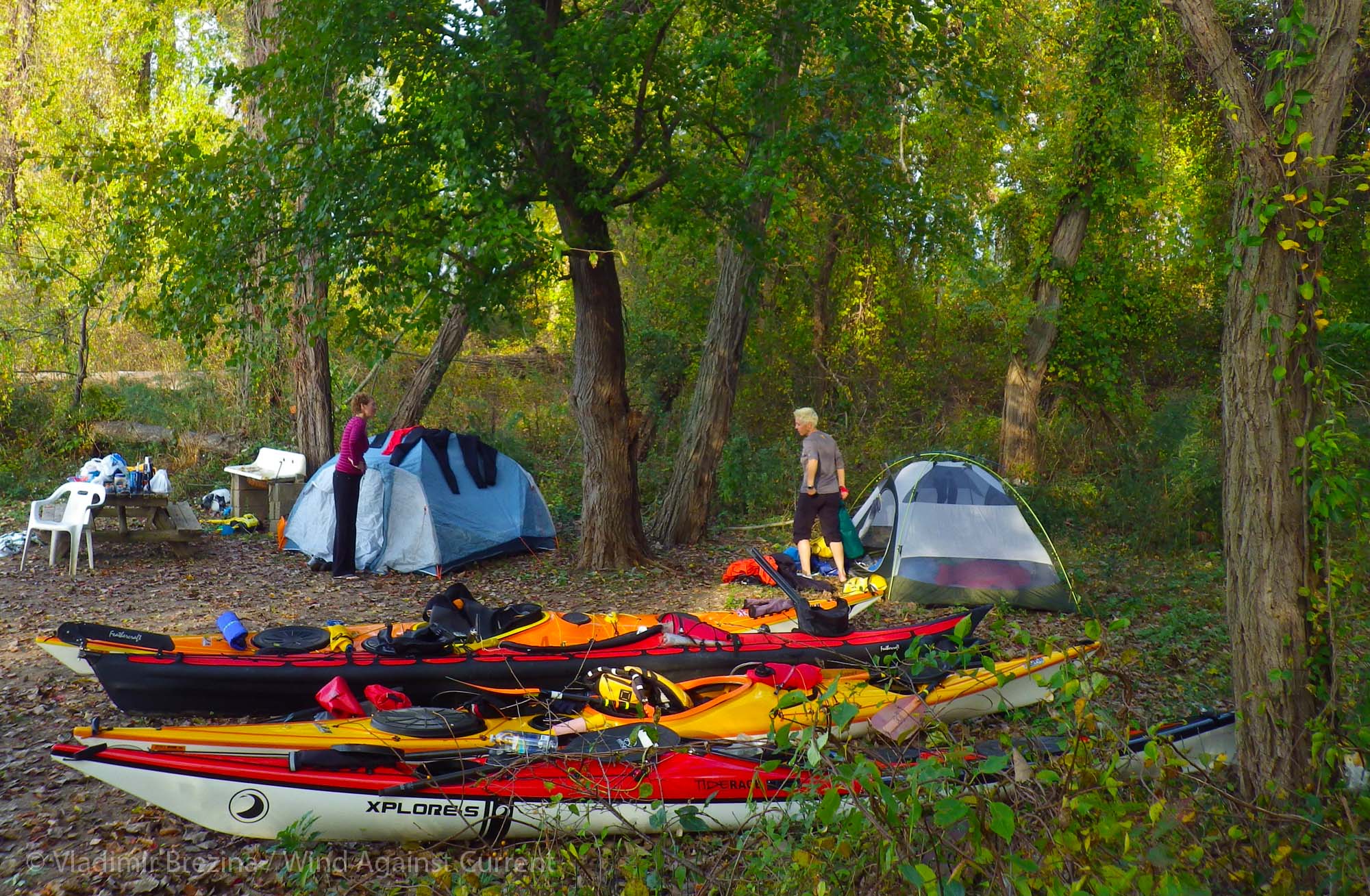

For this excursion, we’d joined forces with Alex and Jean, fellow paddlers and fellow bloggers at 2Geeks@3Knots, who drove up from New Rochelle. And we were hoping to meet up with Mike and Julie, paddlers from Albany with whom we’d shared a lively correspondence over the past year but had never met. And also, with luck, with our friend David, who lives both in NYC and upstate, and was planning to be on the river up there that weekend.
All of us from different habitats, in other words, but with our common boundary—the Hudson River.
Posted in Kayaking
Tagged Autumn, Fall, Fall Colors, Hudson River, Hudson River Islands State Park, Kayak Camping, Kayaking, Photography
By Johna Till Johnson and Vladimir Brezina
 .
.
.
.
,
.
Blame it on Rilke… Or his translators, actually.
On a recent late-fall evening, Vlad was chuckling over the varied translations of the poem “Autumn Day” by Rainer Maria Rilke:
Herbsttag
Herr: es ist Zeit. Der Sommer war sehr groß.
Leg deinen Schatten auf die Sonnenuhren,
und auf den Fluren laß die Winde los.Befiel den letzten Früchten voll zu sein;
gib ihnen noch zwei südlichere Tage,
dränge sie zur Vollendung hin und jage
die letzte Süße in den schweren Wein.Wer jetzt kein Haus hat, baut sich keines mehr.
Wer jetzt allein ist, wird es lange bleiben,
wird wachen, lesen, lange Briefe schreiben
und wird in den Alleen hin und her
unruhig wandern, wenn die Blätter treiben.
The translations are here.
And even if—like Johna—you don’t read German, it’s rather obvious they’re rather, ahem, divergent when it comes to cadence, connotation, and tone. Different from each other and from the original meaning.
Johna read them over Vlad’s shoulder and burst out laughing. “‘Summer was awesome?’ We could do better than that!” Well, maybe not better… but different. If it’s acceptable to say “summer was awesome”—well then, that opens up a whole host of possibilities!
So here you go. “Autumn Day” loosely translated for the modern era:
Autumn Day
By Rainer Maria Rilke (sort of)
Dude, it’s time! Summer rocked, but
It’s over. Sucks.
The sun slants low now.
The autumn wind sweeps through abandoned
Bodega stalls. Across the last bruised fruit,
Fermenting fast.
At least you’ll have some awesome vino.No place to crash? Tough.
Too late. You’re solo now.
Time to stay out long
And ride the board
Up and down darkening alleys
Where the trash swirls.
By Johna Till Johnson

“We must use time wisely and forever realize that the time is always ripe to do right” — Nelson Mandela
Nelson Mandela is dead.
It’s hard to believe—not that he’s dead, but that it happened today.
His life was so epic, so mythic, that it’s hard to believe he was actually alive in our time. He has always seemed to me to be one of the heroes of yore, the kind that doesn’t live any more in these diminished times.
And although I know shamefully little about South African politics or history, I’ve always been captivated by one part of his story: that he spent 27 years in prison—a significant chunk of his life sentence—before not only being set free, but becoming President of South Africa.
I often try to imagine that: being sentenced to life in prison, and actually spending 27 years, a lifetime by itself, imprisoned under brutal conditions.
How do you keep believing in yourself, your cause, and in the possibility of having some kind of impact on the outside world? What keeps you from just giving up, as year after year goes by, with no hope, or reason to hope?
Only Nelson Mandela knew the true answer, and now he’s gone. But as I try to imagine it, here’s what I imagine:
–That after the first shock of the realization settles in, you recognize that although you can’t control your circumstances, you can control your response to them. (And really, that’s no less true in the outside world—we think we have control over circumstances, but how much of your day do you actually spend reacting to them, rather than creating them?)
–That you never give up hope that the dream itself will exist one day, whether or not you are there to see it. And you take faith and nourishment from that dream, and from your ability to believe in it.
–That you remind yourself constantly that your adversaries are humans, too, and seek a genuine connection with them. (Mandela learned Afrikaans in prison, and ultimately succeeded in making friends with the guards.)
–That you refuse to let your failures define you. By then, Mandela had failed many times in his life—he didn’t pass his law examinations, his first marriage ended because of his unfaithfulness, and the fact of being imprisoned (no matter how unjustly) had to have felt like a failure. But none of those defined him. What defined him was his belief in the dream.
These are all easy to write, and inspirational to think about.
But living them—day by day, hour by hour, moment my moment—must have been difficult.
Each moment he had to have made up his mind to resist hopelessness and embrace the dream, to work passionately towards his goals while detaching himself from the desire to be present when they were achieved.
And do all that not once, or twice, but over and over again—there are a lot of moments in 27 years. That takes not just inspiration, but persistence (stubbornness, if you will) and consistency.
There are many lessons here, but this is the lesson I take away from the life of Nelson Mandela: The way to survive, and triumph, is not just to believe in your dreams, but to work doggedly, persistently, with a strong heart, towards achieving them. Day by day. Moment by moment. And focus not on your failures, but upon your efforts.
RIP Nelson Mandela.
And thank you.
Posted in Biography, History, Life, Politics
Tagged Biography, Inspiration, Nelson Mandela, Obituary, Prison, South Africa
By Johna Till Johnson
Photos by Vladimir Brezina
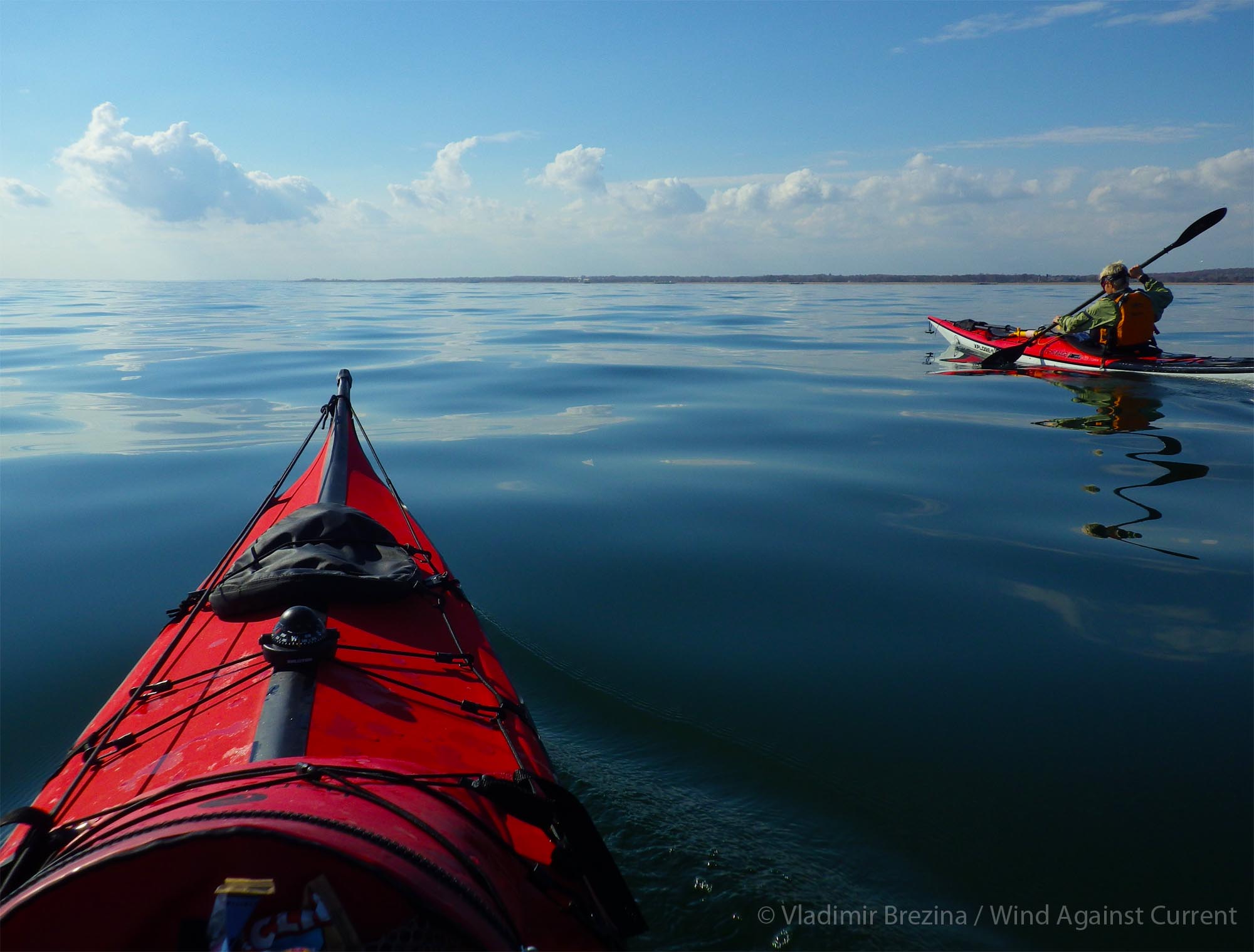
It was the first Saturday in November, and we desperately needed to get out for a long paddle—we’re seriously starting to train for the Everglades Challenge next spring, and we need to start putting in the mileage.
The currents indicated a southerly trip, and Vlad suggested one that had become very familiar over the years: An out-and-back trip to Sandy Hook. I wasn’t enthusiastic. Much as I love the trip—the closest you can get to open water in New York City’s waterways—we’d done the trip quite often recently, and it felt a bit like a treadmill workout: Paddling for the sake of exercise, not adventure.
I counter-proposed a trip around Staten Island, which we haven’t seen much of this year. I particularly missed the beaches along the south shore, and the excitement of traversing the Kill van Kull at night. But Vlad pointed out that the day wasn’t ideal for a Staten Island circumnavigation—given that the southbound current would only start late in the morning, we’d get back at midnight, if we were lucky. And he didn’t want to do an out-and-back down the coastline of Staten Island, because he likes having a destination.
So Sandy Hook it was.
Posted in Kayaking, New York City
Tagged Great Kills, New York Harbor, Photography, Sea Kayaking, Staten Island


... kayaked the waters around New York for more than 15 years in his red Feathercraft folding kayak. He was originally from (the former) Czechoslovakia and lived in the U.K. and California before settling down in New York. He was a neuroscientist at the Mount Sinai School of Medicine in New York City. He died in 2016.

... is a kayaker and technology researcher at Nemertes Research. She's an erstwhile engineer, particle physicist, and science fiction writer. She was born in California and has lived in Italy, Norway, Hawaii, and a few other places. She currently resides in New York City.
 | Johna Till Johnson on Where We Like to Land on Sandy… |
| Canada to Key West P… on “A Bizarre Boating … | |
 | Eunice Miller on A Meditation on Gratitude |
 | Harry on A Meditation on Gratitude |
| Johna Till Johnson on A Meditation on Gratitude |
| Harry Itagaki on A Meditation on Gratitude |
 | Love is still the an… on Travel Theme: Signs |
 | David McLean on Where We Like to Land on Sandy… |
 | davidloh24 on Endless Reflection |
| Paddle Log: North Mo… on Circumnavigating Monomoy | |
 | Brian on Long Island Kayak Circumnaviga… |
 | Andi the Slime on Yellow |
 | Mark S on The Dry Salvages |
 | Dudi on Everglades Challenge, the Days… |
 | Francie Chew on The First Leg! |

 Wind Against Current