Category Archives: Society

All Roads Lead Home

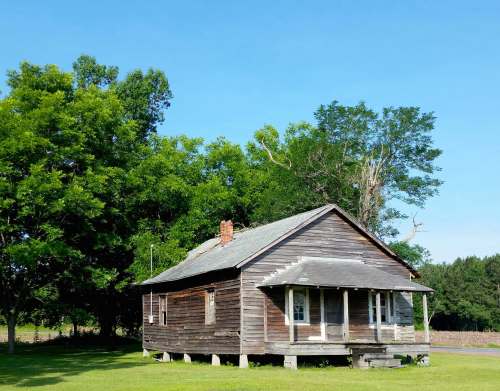
Wooden house in North Carolina

By Johna Till Johnson

Country roads, take me home
To the place I belong…
—John Denver

It was almost as if my apps were in collusion to bring me home.

It started when I turned on the Pandora station in the car last spring.

The trip ahead was long: 1200 miles, from New York to Florida, where I hoped to pick up my boat and spend a few days camping and paddling. Music would keep me from getting bored.

The Pandora algorithm isn’t complex—in fact, I could probably write the code myself. The app starts by playing the music you’ve asked for (a particular artist or genre). Then for maybe 10% of the songs, it gradually inserts other artists that are “sort of like” the artist you selected. As you indicate your likes and dislikes of the material by clicking the thumbs up/thumbs down button, it adjusts the selection it plays.

So after a while, the station reflects your favorites.

I’d expected that.

What I hadn’t expected was the way the algorithm had mixed favorites from all different times of my life, creating a kaleidoscope of memories as I drove.

While the endless gray-and-green strips of landscape unfurled outside the car, references and long-forgotten images flashed through my brain.

There was the song I played repeatedly when I went out running on the hot autumn nights in Texas when my father lay dying.

Then there was the song I associated with falling in love with Vlad. And the song that comforted me in the shattered weeks after his death.

But there were songs from earlier times, as well.

Songs from the time, years past, that I played on the car radio during my late-night and early-morning commute between New York and Connecticut to my job as a hotshot technology executive at an engineering company…

Songs from my arrival in New York, years earlier, with ripped jeans and a meager budget, in the time when I still skateboarded in Union Square, and a female skateboarder was still a novelty: “Look! It’s a chick skater!” someone yelled once…

And songs from the years before that, in Florida. As the wife of a young professor, a freelance writer, and a new homeowner, I lived out a kind of delayed adolescence, hanging out with a group of bright underachieving perennial undergraduates at punk clubs and science fiction conventions…

There were the songs I listened to at those clubs, and also the songs I played on my headphones in those years as I ran, lithe and tan, near my house on the trail through the green-and-grey Florida woods (since paved over for a shopping mall).

And farther back still, during my college and graduate school years, the songs I listened to on an aging boom box, songs that were simultaneously upbeat and cynical, or preternaturally moody and depressed.

Yes, I was prepared for the mix of favorites—but I wasn’t quite prepared for the memories they’d summon.

And it wasn’t just Pandora. Google Maps appeared to be in on the plot, because for some reason, it  ingeniously routed me past nearly every place I’d ever lived in the continental US.

Yes, it helps that many of the places I’d lived were along the I-95 corridor.  But Google went out of its way to take me right by former homes.  Instead of zooming down the relatively straight line between Baltimore (where I’d lived for my college years) and Richmond, for instance, it took me on the spur towards Annapolis, where I’d lived between the years of eight and 11.

And then past the suburban Maryland enclave, where a few years later, I’d spent time as a surly, sullen adolescent. (Apparently my parents didn’t understand me. What a surprise! )

There was also the Virginia suburb where I lived as a very young child, and the exit where my then-husband and I had lived for one of the summers he worked at NASA.

Over the hours, I realized again and again how many places I called “home”.

It got to be almost a joke: I’d get out of the car somewhere—say the rest stop just outside Baltimore where I’d stopped on trips to, from, and past that city—breathe deeply, and say out loud: “I’m home!”

And I really meant it. I was home. These were all the places I’d lived, to which my memories were attached.

Those of us—like me and like Vlad—who have lived in many places don’t have the same experience of those who have grown up in a single place, imbued and invested with all our emotions and memories.

Yes, Vlad spoke of his home in Prague—which I visited (sadly, solo) the year before his death.

But he’d left there at the age of ten, and between then and when I’d met him in New York, “home” for him had been Libya, Iraq, Scotland, London, Heidelberg, San Diego, and Los Angeles.

Just as for me there had been California, South Carolina, Hawaii, Virginia, Maryland, Rochester, New Jersey, Florida, and New York City—not to mention Norway and Italy.

I can close my eyes and summon all the “homes” where I’ve lived: The garden in Naples. The terrace in Rome. The dark trees by the house in Oslo. The majestic four-story white house on the grounds of the Naval Academy in Annapolis.

And on this trip, it seemed like the Universe was working to visit almost all of them, through memory and proximity.

The place I was traveling to—St Petersburg, Florida—was also home. Although I’ve never lived there, one of my boats now does. And it had served as the center of my kayaking existence outside New York for nearly a decade.

It was there that, much to my surprise, I managed to pass the challenging British Canoe Union (BCU) test to become a three-star paddler, as part of the Sweetwater Kayak symposium.

And it was there that served as the launch point for the Everglades Challenge Vlad and I completed in 2014, and for which we conducted multiple “shakedown” (practice) trips. Not by pure coincidence, it was also there that my company had elected to hold its annual conference for the past several years.
So when I arrived at long last at Fort De Soto campground, I stepped out of the car, took a deep breath and said (once again): “Ahh. I’m home!”

And then I had to smile at the number of times I’d said that on this trip.
Goodbye and Godspeed, Dear Friend

By Johna Till Johnson

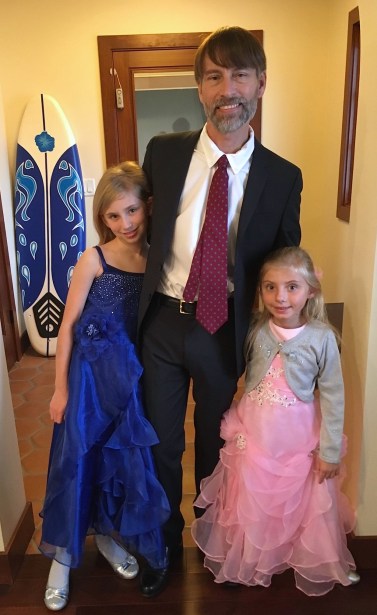
Tom on father/daughter day, 2016

Earlier this week, a man who had become very dear to me and to Vlad slipped the surly bonds of earth.

Tom Marsilje, a cancer scientist, patient, and patient advocate, left this world on Tuesday November 14. I can’t write a better obituary than the one that appeared in the Philadelphia Inquirer, for which he wrote a regular column.

As with Vlad, Tom’s loss is more than personal. He was a beacon of hope and optimism for all of us dealing with cancer, in no small part because he lived every possible role in that experience.

As a graduate student, he became caregiver and patient advocate for his mother, helping to get her into one of the earliest immunotherapy clinical trials (in 1999) and quadrupling her life- and health-span in the process. He went on to co-develop a breakthrough drug for lung cancer. And from the time of his diagnosis in 2012 to his death this week, he experienced the disease “from the inside”–all the while serving as a guiding light for those of us in the same situation.

The loss of that light, as much as of Tom the person, was a real blow to all of us in that world.

And because cancer will strike nearly 1 in 2 of us, and touch the lives of nearly all of us, I’m including here a Facebook post I wrote for my friends in the cancer community (and yes, I hate that there is such a thing, as much as I love the fact that through it I’ve met some of the smartest, bravest, nicest people on the planet).

Tom’s approach is not a bad way to live for any of us, cancer or no.  Life, after all, is a terminal condition.

Some thoughts on Tom, and the impact of his death on me and on us. Some background: Tom and I were friends in real life, as well as on Facebook. We visited in NY and CA. He knew and respected Vlad, and vice versa.

He coordinated closely with Vlad (neuroscientist) and Dan (Vlad’s best friend from grad school, and an immunotherapy researcher at Emory). We would literally strategize together (the four of us) about the most promising treatments. Vlad was the most skeptical (he knew the odds, and also the science).

So to me, Tom wasn’t a superhero, he was a really smart scientist with early insight into how science was turning into cures.

As we all know, he also had that incredibly contagious combination of optimism and humility. Anyone who interacted with him walked away feeling, “Heck, if it can work for Tom, it can work for me!” (or my loved one).

So.

The fact that it did NOT work for Tom is a gut-punch to many folks. I mean, if super-hero-cape-wearing-scientist died ANYWAY, what are the chances for us ordinary folks?

I didn’t have quite that reaction, because I knew him better, and knew the science pretty well.

Here’s the thing.

Tom’s approach was spot on, and it continues to be spot on:

Step 1. Stay alive, and as healthy as you can possibly be, for as long as you can. That means: Build an exercise, nutrition, and treatment routine that works FOR YOU. That could be 5 minutes a day of yoga and a steady diet of Bic Macs to keep the weight on. You don’t have to run triathlons. Do whatever works for you.

Step 2. Take joy in every day, and every moment. Your “joy intake” is as important as what you eat, drink, and do. That new puppy might possibly have the same ability to inhibit tumor growth as the latest radiation therapy.

Step 3. Stay on top of the research. Keep leveraging your network. We are here, and we’re NOT going to stop researching for you. There is going to be an exponential explosion of new treatments over the next 5 years.

I know this. Tom knew this. Vlad knew this.

Some treatments will work amazingly.

Some will keep you alive until the next treatment.

And some will fail.

The stronger you are, the more runway you have, and the more treatments you can try.

And the more knowledge you have, the better able you are to point that runway in the right direction. That’s what Tom did.

And it DID NOT fail him!!

The science failed him, as it failed Vlad, and will continue to fail people we love (maybe even us). Until it doesn’t any more.

That’s how science works. It fails, until it doesn’t any more.

And we are so, close to the science not failing any more.

As awful as it is to say this, if you’re reading this now, you’re already ahead of Tom, because you’re 24 hours closer to that day (very soon now) when the science won’t fail us.

Why am I writing this? Because I know how devastating it is when your magic talisman for the future is lost.

I’ve been dreading Tom’s death less for the loss of the unique and beautiful soul that he is, and more for the fact that I’m afraid it will emotionally devastate so many people that I love, because they will lose hope.

And it does devastate people. I can’t fix that.

The only thing I can say is… following the three steps above is what Tom did, and what he’d want all of us to do.

And what, in my considered opinion as a scientist and engineer, is what is most likely to result in the CURE of everyone dealing with this awful disease.

And a permanent cure is NOT an unrealistic hope for people dealing with this disease. A long shot, yes. But It’s out there, and very, very close.

I know Tom is fighting for all of us, still.

A Prayer for Puerto Rico

By Johna Till Johnson
Photos by Vladimir Brezina

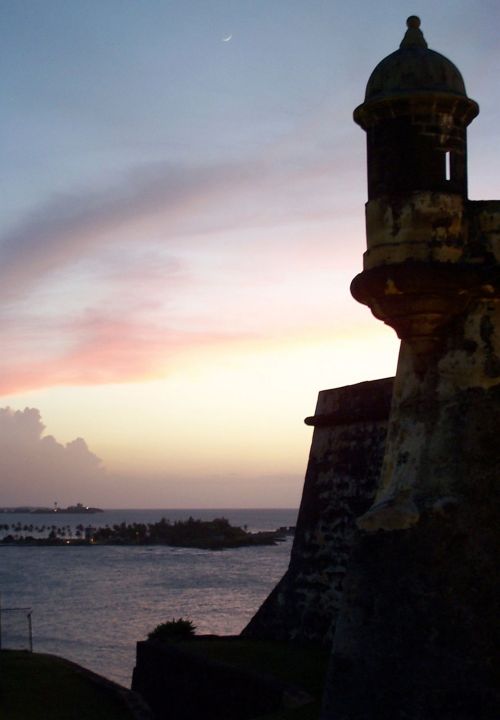
Crescent moon high above the Castillo San Felipe del Morro

Vlad loved Puerto Rico. One of his dreams was that we’d go there together some day, perhaps even circumnavigate the island by kayak (though he warned me about sharks).

Vlad knew the island well. For many years, he collaborated with a colleague at the Institute for Neurobiology at the University of Puerto Rico. That meant taking regular trips to Puerto Rico, at least annually, sometimes more often. And he took advantage of those trips to explore the island and its environs.

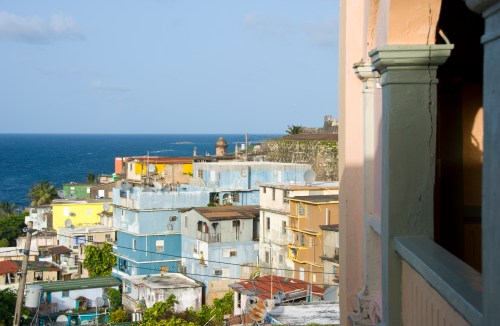
View of La Perla from the Institute of Neurobiology

Entirely aside from the exciting work he did with his colleagues, Vlad really loved the place itself: the warm, moist tropical air, the vivid colors, and most of all, the people.  He often told stories about his time there. One of my favorites was about the “palmetto bugs” that scientists caught from the lab floor for experiments (apparently it was cheaper and easier to catch your own than to order them from suppliers.)

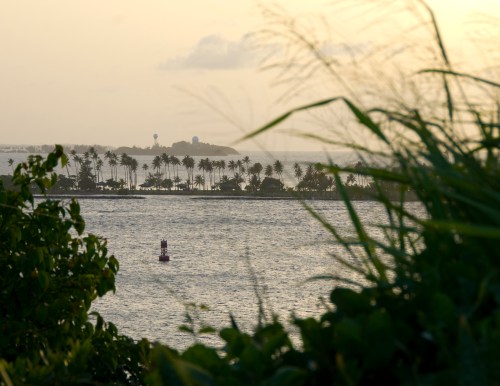
View from the Castillo San Felipe del Morro

But my all-time favorite story was when he talked about how the scientists in his lab were almost universally young, beautiful women. I didn’t believe him, so he forwarded a photo “as evidence” (as he put it). Unfortunately I can no longer find it, but the photo indeed featured a half-dozen or so mini-skirt-clad young women holding martini glasses and smiling at the camera (it was an evening outing of the lab). Not exactly the first image that comes to mind when one thinks of “a gathering of neuroscientists”–no wonder Vlad was enamored of the place!

Beyond the sheer physical beauty of the island and its inhabitants, Vlad also appreciated its many biological wonders. Among  them: the bioluminescent bay
at Vieques Island, the bat caves, and the El Yunque Rain Forest.

Clouds after sunset, San Juan, Puerto Rico

I know he would be deeply saddened by the devastation that Hurricane Maria has wreaked on Puerto Rico. Fortunately the Institute for Neurobiology has reported that it has survived; but recovery will be a long, slow, painful process for them, and for everyone affected by the storm.

If you want to contribute, here is a list of charities that have been highly rated by CharityWatch and are contributing to Irma relief in Puerto Rico.

Blown Away

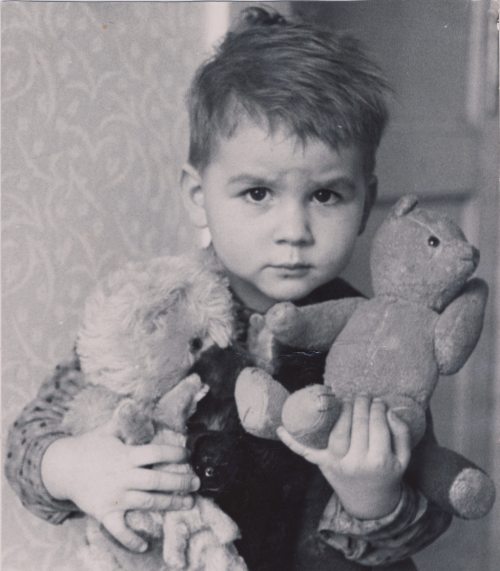
Vlad as a child

By Johna Till Johnson

It’s 11:30 on a sweltering summer weekday. I’m on my way to a client meeting downtown. I step into the subway car, grateful there’s a seat and working air conditioning. The people in the car are the usual mix of ages, races, genders. We avoid eye contact.

At the next stop, a heavyset young man gets in, with a little boy, about three, in a stroller. The man settles into a seat across from me, and I glance at the little boy.

He’s adorable. There’s something hauntingly familiar about his expression: placid yet worried, with his brows drawn up in a look of concern. I smile at him and try to get his attention. Out of shyness or embarrassment he looks away, towards his father. Or maybe he’s put off by my unnatural hair color and the giant, bug-eyed sunglasses covering half my face.

“Can you wave hello?” the father asks, but the boy won’t turn towards me. “It’s ok,” I say, smiling, to the father. “He doesn’t have to wave at the strange lady.”

Then I suddenly realize, with a pang, why the child’s expression is so familiar.

I turn to the woman next to me, a kind-looking middle-aged Hispanic woman. She’s also smiling at the little boy.

“My husband has a photo of himself at about that age, with that same expression,” I say to her. “So sweet!” I notice I’m speaking of Vlad in the present tense, but don’t bother to correct myself.

“So sweet,” the lady agrees, and tries to get the boy to look at her, but he won’t.

The familiar wave of grief washes over me. I feel my eyes watering, and I’m grateful for the sunglasses hiding my face. To distract myself, I look at the people across from me. There’s a couple, sitting close together. Both are looking down at their phones, oblivious. The only way I know they’re a couple is how close they’re sitting. A couple. Another pang.

A few moments later, my stop is approaching. In preparation, I get up and head towards the door. As I do, I hear the people around me start to stir and murmur, but I’m not paying attention. Then the man who was across from me says, “Ma’am, look!”

I turn, and the boy is reaching out for me, his hand a starfish, his body straining against the stroller straps. He says nothing, but the beseeching look on his face is clear, and clearly directed at me.

“He doesn’t want you to leave!” the woman gasps in surprise. We all exchange looks of wonder.

The subway doors open. I step off the train, glad once again for the oversized sunglasses.

No Comment

By Johna Till Johnson

This is why I love NYC…

Halloween Postmortem, Part II

By Vladimir Brezina and Johna Till Johnson

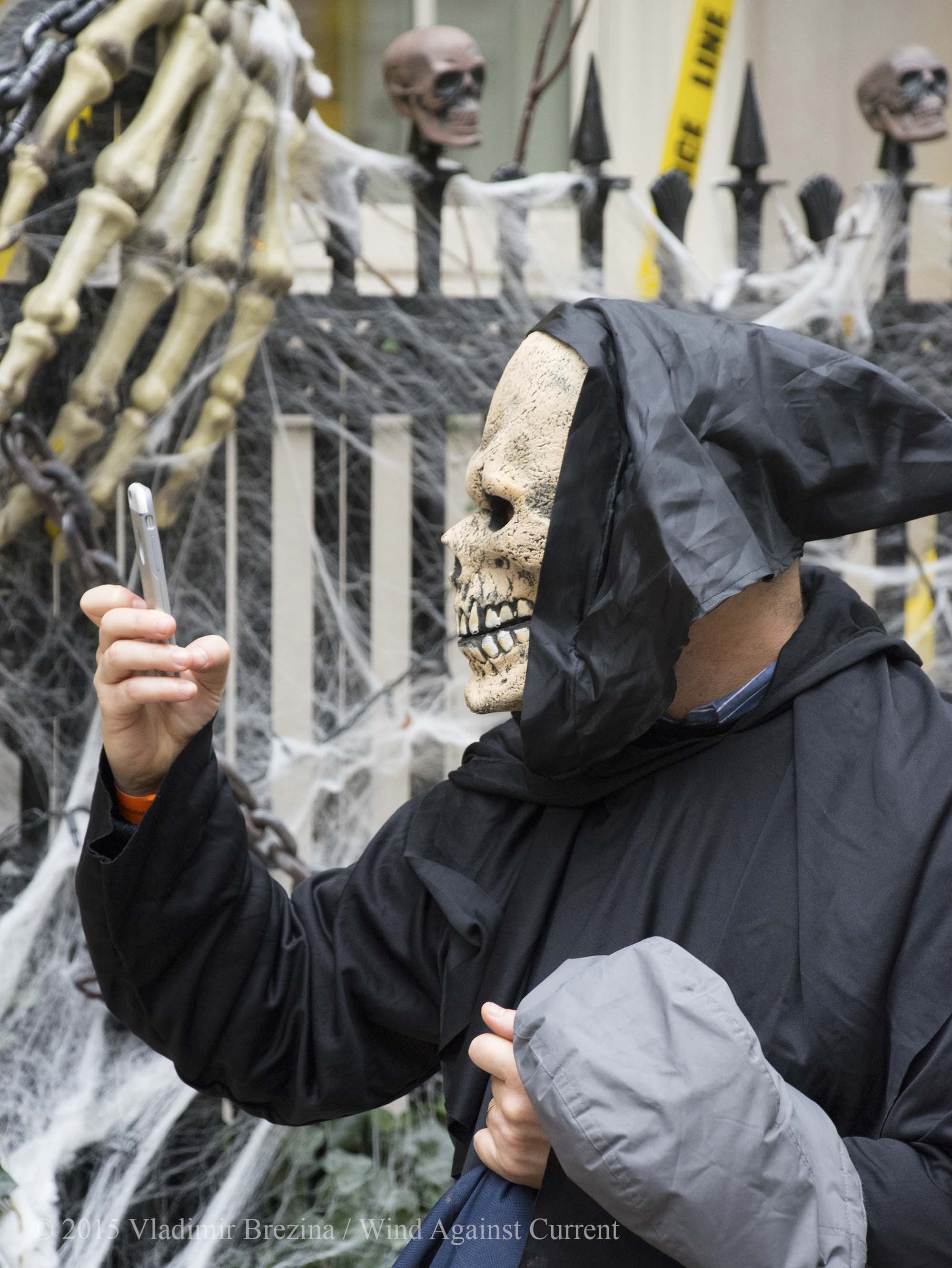
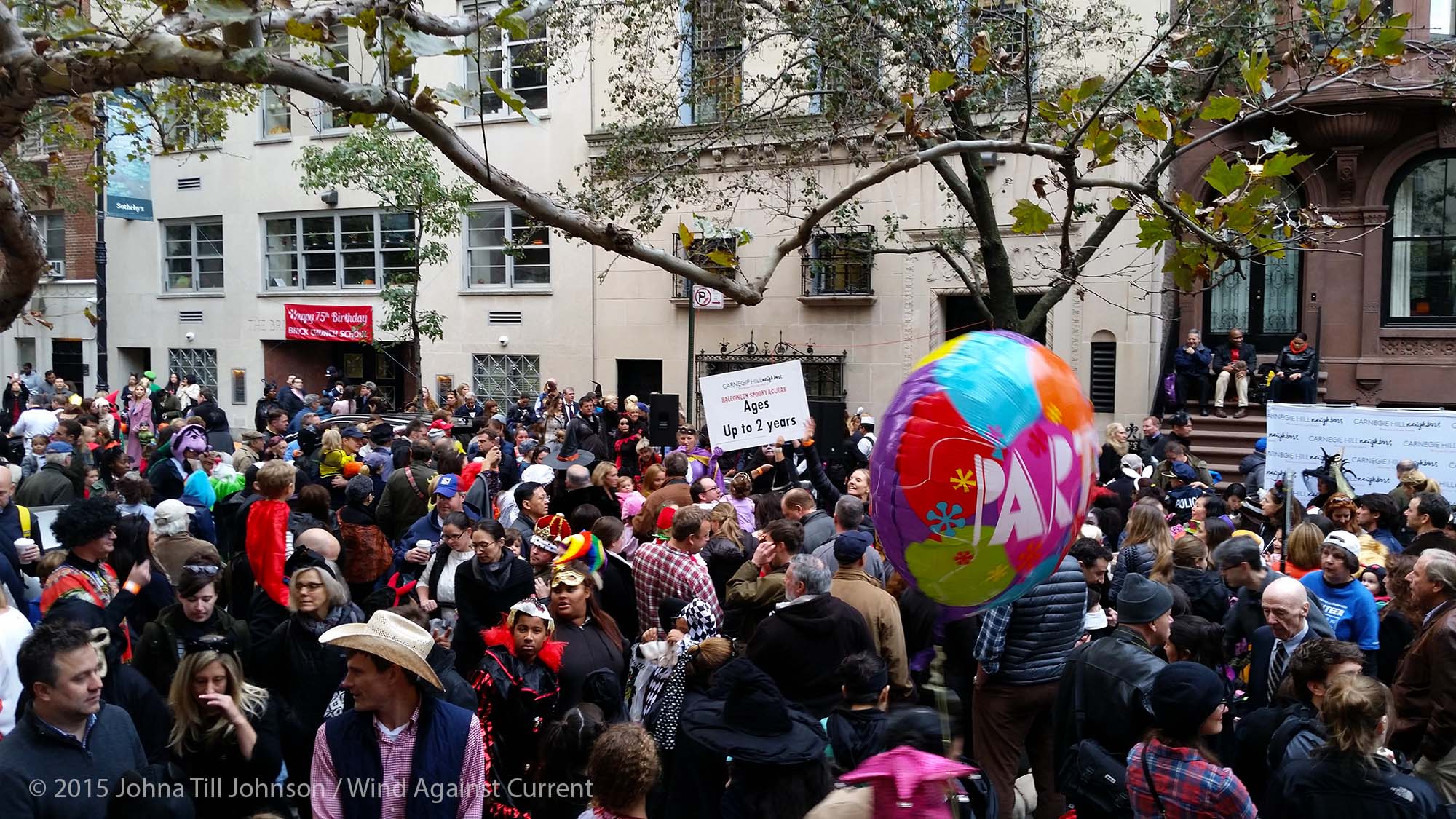
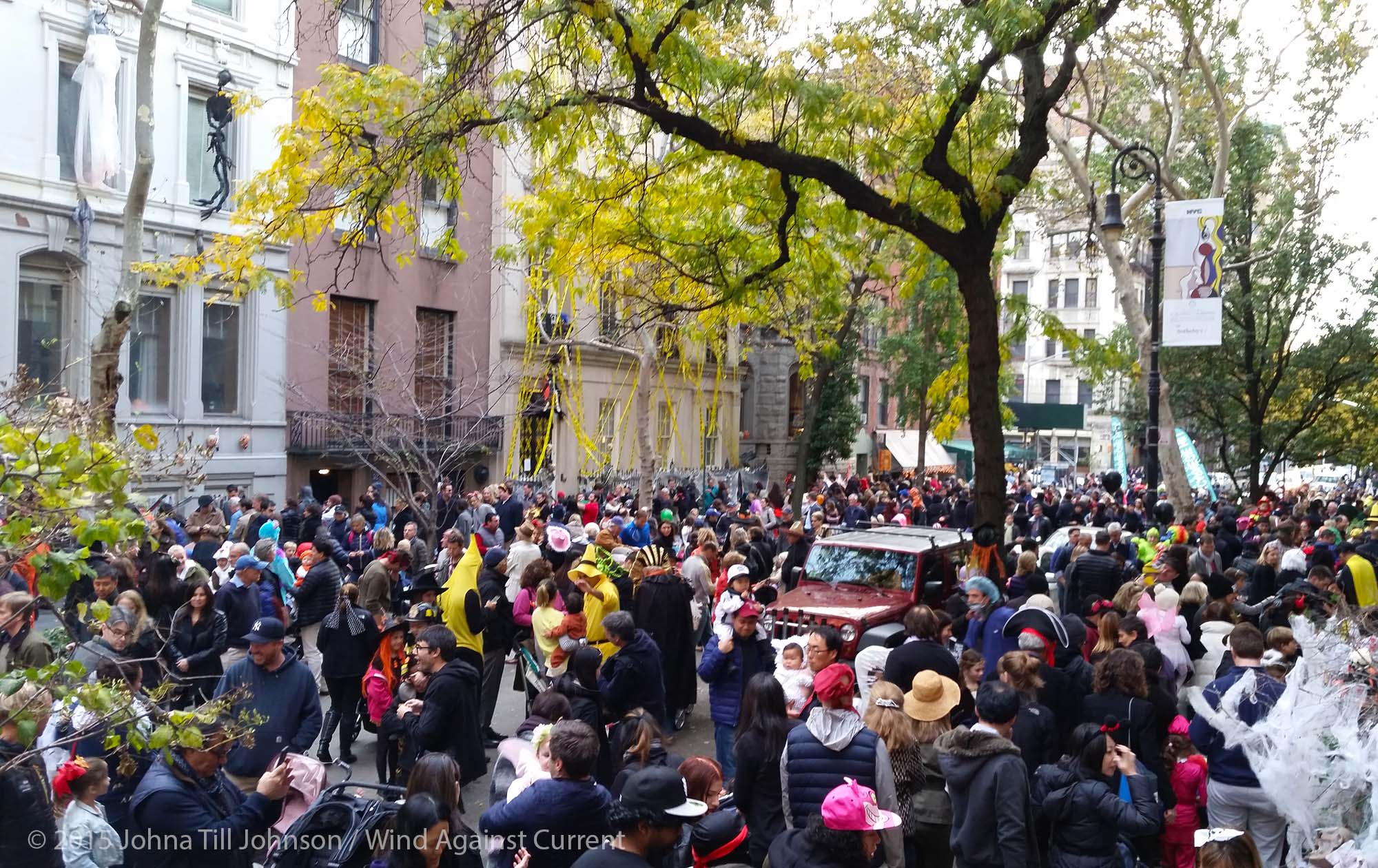
Even skeletons check their cell phonesThis year’s Halloween decorations were plenty scary. But in our neighborhood, they’re just the backdrop: Every year, Carnegie Hill Neighbors, the local neighborhood association, puts on “Spooktacular”, a Halloween block party that features entertainers (including a lively DJ/MC playing dance music) and a costume contest—and of course trick-or-treating, with lots, and lots, and LOTS of candy!

Whole families show up in costume, including mother, father, kids, pets, and—this being the Upper East Side—nanny. (For those who don’t know, the Upper East Side is home to financiers, top lawyers, and other Masters of the Universe.)

The party is open to the whole neighborhood, and it seems to be getting bigger, and better, each year.  (Here are the photos from 2011, 2012, and 2013.)

Looking left... and looking rightVlad in the crowd

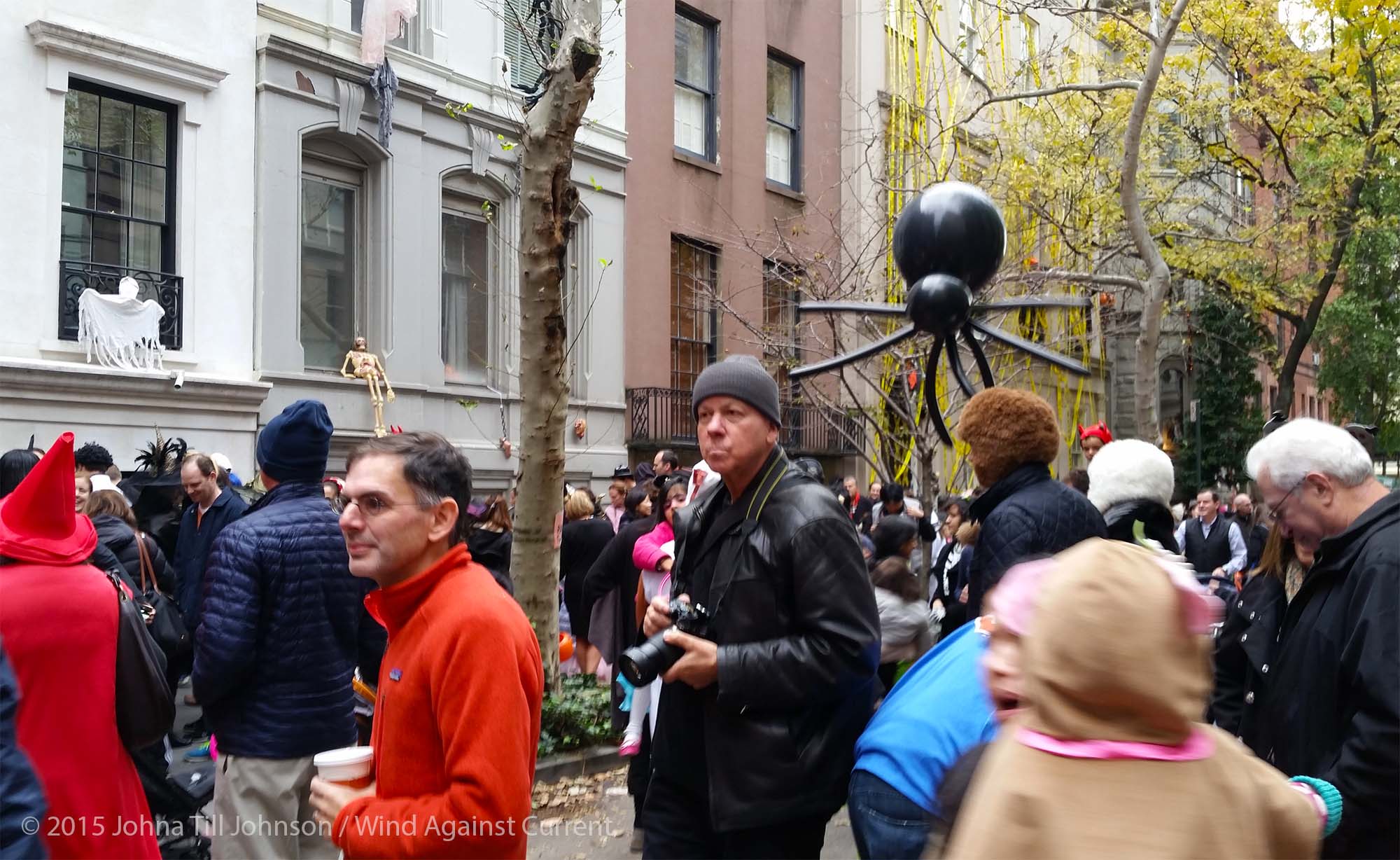
The photographer stalking his prey (while being stalked by a giant floating spider)…

.
… and here are some of his photos:

Continue reading

Christmas in February

By Johna Till Johnson

IMGP0001 cropped small

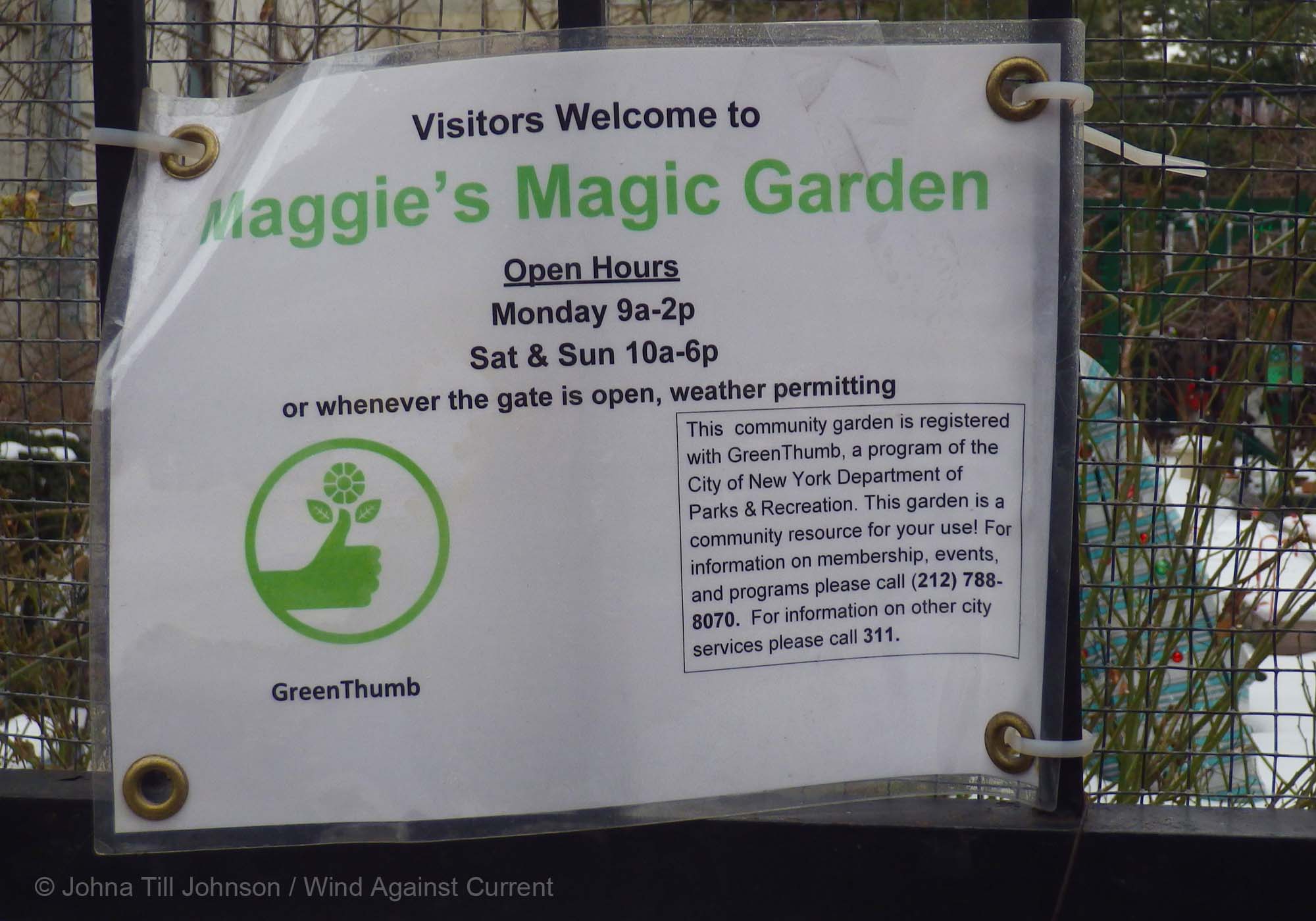
Maggie’s Magic Garden

Last week I did something I’ve been meaning to do for a while: I went to Maggie’s Magic Garden to take a few photos.

Vlad and I had passed this space many times. It’s a community garden, a small, open plot of land surrounded by buildings. As the seasons changed, it provided a lovely glimpse of nature amidst the urban setting.

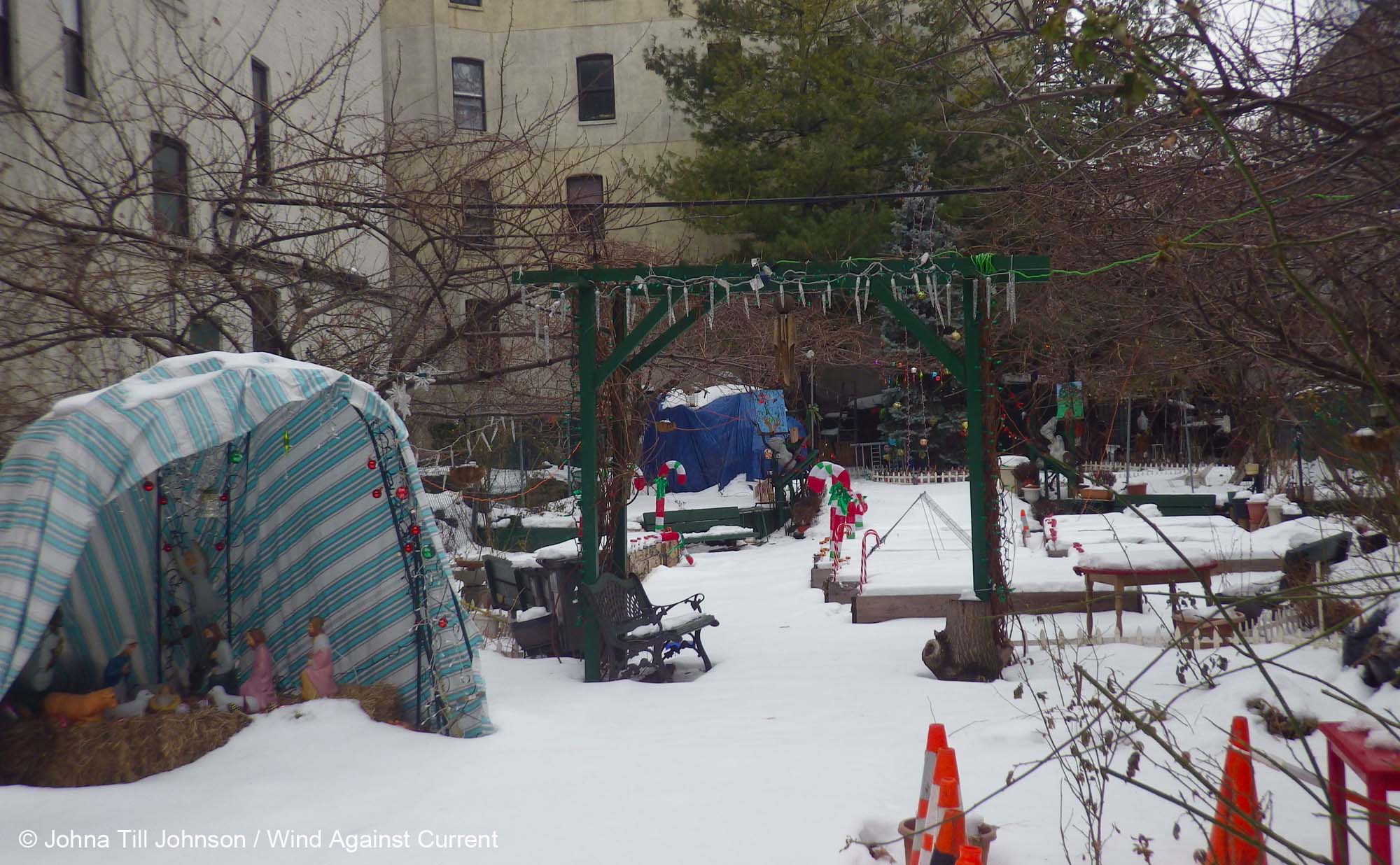
So I was curious to see what I’d find in midwinter, after the first few snowfalls of the year. I don’t know what  I expected, but it wasn’t what I found: Christmas in February!

IMGP0005 cropped small

Christmas in February

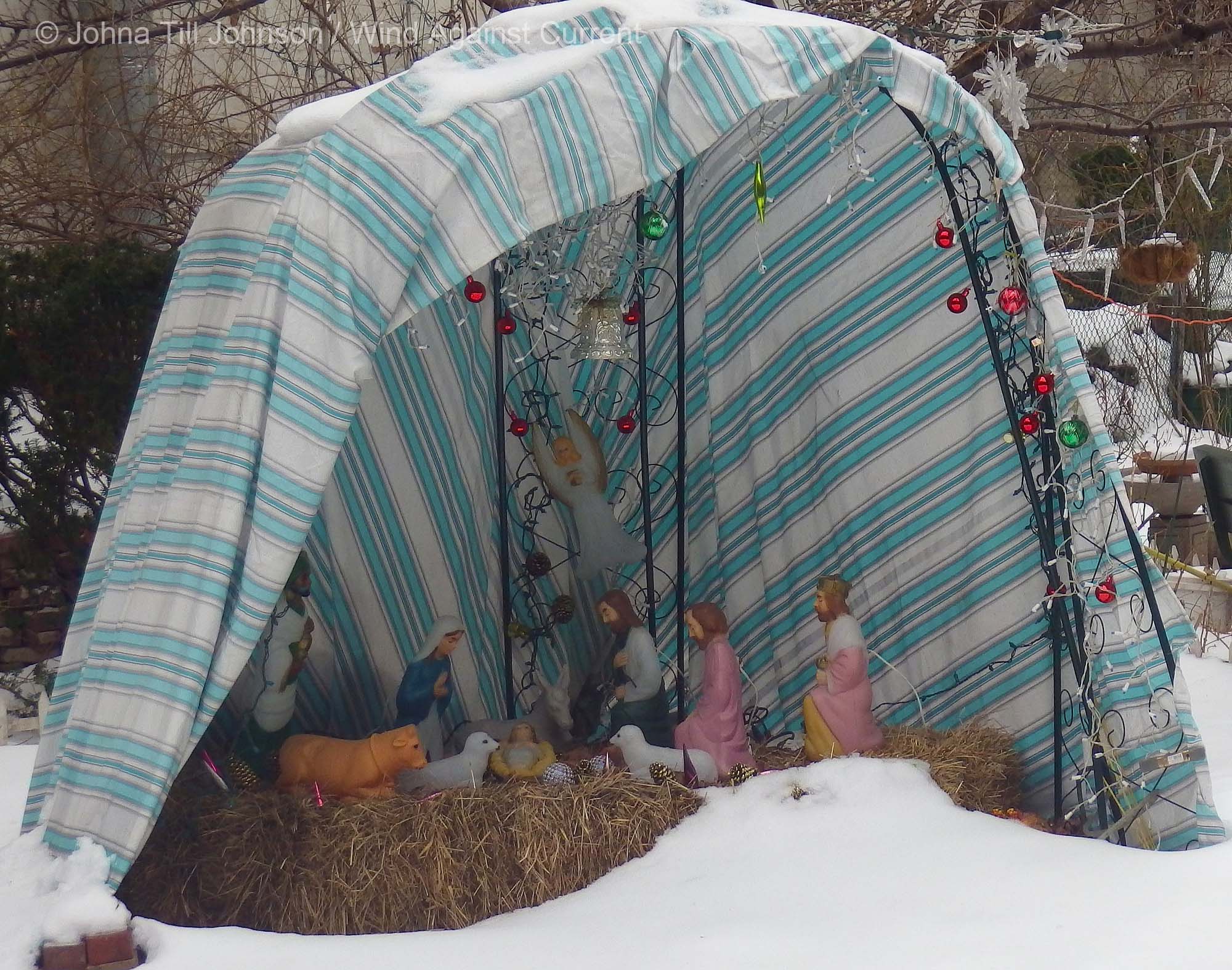
My favorite part of the Christmas decorations was the homemade creche, with what looked like a bedsheet draping over the figurines. (Also note the angled angel over the manger.)

IMGP0004 cropped small

Homemade creche

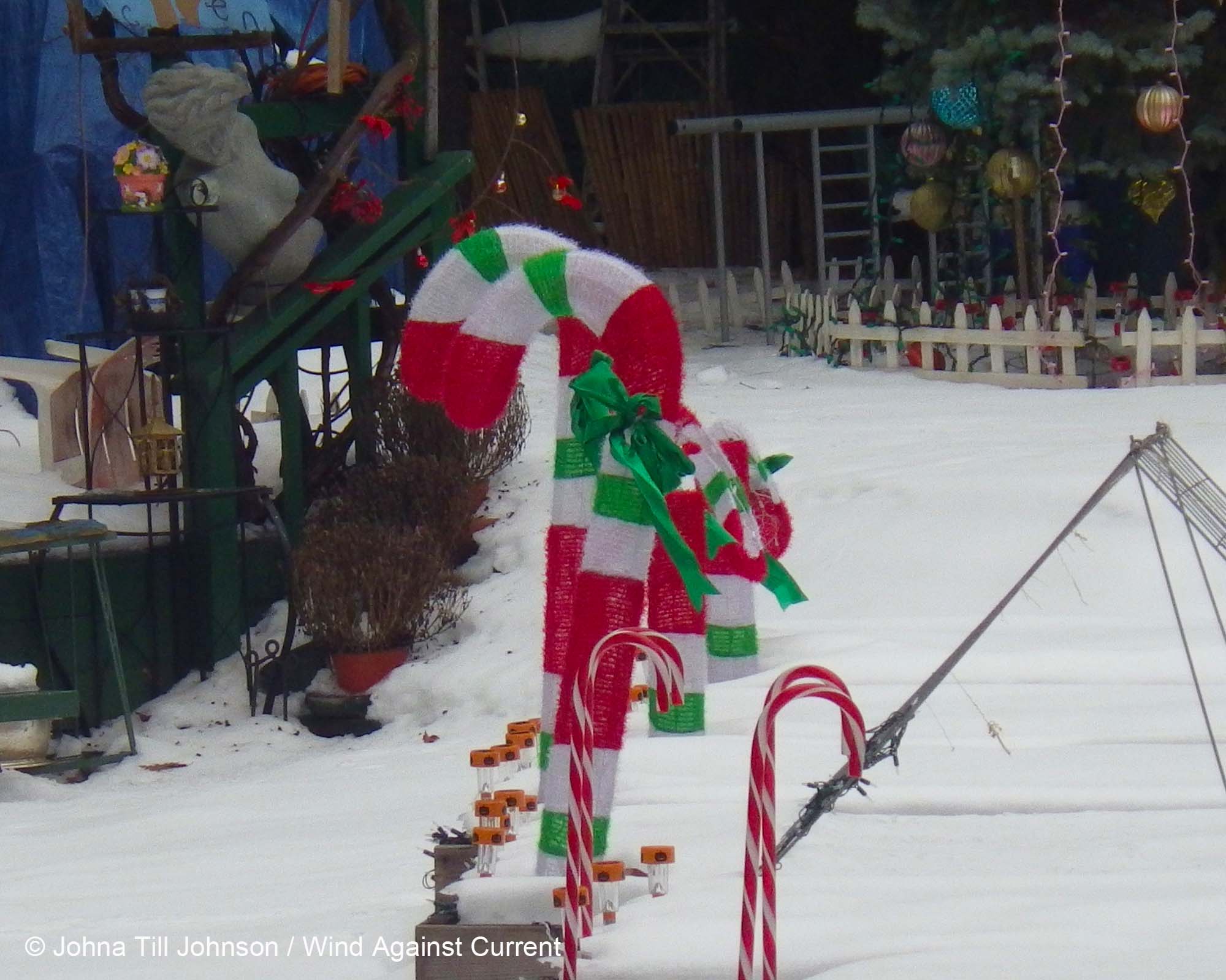
And there were more secular decorations as well…

IMGP0008 cropped small

Bright candy canes

Alas, I wasn’t able to get into the garden to explore—despite the sign, it was closed when I visited. But it clearly lives up to its description: Magical indeed. I’ll be back there in the spring, to see what magic is afoot then!

The Sunspot Story

By Johna Till Johnson

Suspended lion face
Spilling at the centre
Of an unfurnished sky
How still you stand,
And how unaided
Single stalkless flower
You pour unrecompensed.

The eye sees you
Simplified by distance
Into an origin,
Your petalled head of flames
Continuously exploding. …

—Philip Larkin, Solar

.
What’s the longest-running scientific experiment in history?

I bet you didn’t think of monitoring sunspots.

Sunspots

Sunspots (photo by NASA)

And I can’t definitively say it’s the longest-running experiment —there may be others I haven’t heard of yet. But the first recorded systematic observation of sunspots in the West was by astronomers Thomas Harriot, Johannes and David Fabricius  in 1610 (Chinese astronomers observed them as far back as 300 BC). Scientists have been monitoring sunspots ever since—which means that sunspots have been monitored for the past 405 years!

Continue reading

Two MacArthur Geniuses

By Johna Till Johnson

I don’t normally pay a lot of attention to the MacArthur Genius awards. The name alone annoys me, because it’s simultaneously elitist and undefined.  What makes artist X a “genius” while her peers are merely “talented”? And how can we be sure that out of all the talented people in the universe, the committee has miraculously selected the 12, or 20, that are talented enough to be considered geniuses?

But I do like the notion of awarding creative people a big chunk of change—this year, it was $625,000 over a period of five years—with no constraints. And I also think it’s cool that the awards are so broad-ranging. They go to poets, activists, artists, musicians… and even the occasional scientist, mathematician, or engineer.

Which brings me to this year’s awards. I was overjoyed to see the award given to two people in particular.  One was Craig Gentry, a cryptography researcher at IBM’s T. J. Watson research center, who’s done groundbreaking work in the area of homomorphic encryption.

Craig Gentry

Craig Gentry

Homomorphic encryption is, in some respects, the holy grail of encryption, because it enables machines to process encrypted data without ever decrypting it. That doesn’t sound like much, but consider: Today, if your email is stored on Google’s servers, it’s fully accessible to Google (which has been known to turn it over to the NSA).

It’s fully accessible because you need Google to do useful things for you (like sort the mail into folders). With homomorphic encryption, you could keep your mail entirely encrypted without giving up any of the functionality (such as folder-sorting). But Google would have no idea what you named your folders, or what was in your email—and the NSA couldn’t read it, either.

Now imagine that instead of ordinary email, we’re talking about medical or financial records—and you can see the benefit.

The issue at the moment is that the computational horsepower required to make homomorphic encryption is immense, so only starting to become practical in real-world applications. But Craig was among the first to show it was theoretically possible. And he did it incredibly elegantly, using a Zeno’s-paradox-like approach that started with “somewhat homomorphic” encryption that iteratively refined itself to become “fully homomorphic”.

And there’s one other thing I like about Craig: He writes really, really well. His Stanford University PhD thesis, which you can find here, is a joy to read. I don’t mind ploughing through dense scientific papers—but I really appreciate it when someone writes gracefully and well.

Yitang Zhang

Yitang Zhang

Another one of this year’s “geniuses” is Yitang Zhang, who is a number theorist at the University of New Hampshire in Durham. Yitang (who I’ve read goes by “Tom”) recently proved the “bounded gaps” conjecture about prime numbers.

Slate’s Jordan Ellenberg (who’s a mathematics professor at the University of Wisconsin) does a much better job explaining what this is and why it matters than I could do. I urge you to read his writeup here.

Suffice it to say that Tom cracked a really, really hard problem in one of the most demanding areas of mathematics. And he’s apparently a really nice, funny, down-to-earth guy, as described in this University of New Hampshire Magazine article.

But that’s not all: Tom is 57—and has done much of his most creative work in the past 10 years (ie from his late 40s onwards).

Mathematics is a field as notorious as gymnastics or ballet for having a youthful peak–the joke among mathematicians is that anyone over 30 is washed up. Gauss, one of the most famous mathematicians ever, did his most significant work by the age of 22—a fact pointed out by my overly gleeful number theory professor when I was 21 or so.

So it’s great to see someone not only doing great things, but doing them at the relatively “advanced” age of 57.

I’m sure the other 19 MacArthur Fellows have done equally great work in their fields. But seeing the awards go to these two made me happy—and I wanted to share my joy with you!

Spooktacular!

By Johna Till Johnson
Photos by Vladimir Brezina

DSC_0112 cropped smallMy favorite holiday is Hallowe’en. What’s not to love? There are small children, gaudy costumes, and plenty of candy. Plus, my Goth-girl side revels in the idea of celebrating darkness, death, and the onset of winter.

But over the years, I’ve celebrated more in the breach than in the observance, since the end of October is one of the busiest times in my industry. (I’ll never forget hearing the joyous noises of the Austin Hallowe’en parade from my hotel room, where I was chained to my computer with an imminent deadline.)

So this year, I was delighted to break free from work and meet Vlad over at the Third Annual Halloween Spooktacular. It’s an Upper East Side block party, or rather mini-street fair. The organizers block off the street and hold costume contests—not just for children, but for adults, families, and pets too. There’s a DJ, a bubble artist, and did I mention the candy? And the houses are lavishly—indeed, extravagantly—decorated. (After all, this is the Upper East Side.)

Continue reading