Category Archives: Life

Circumnavigating Sanibel Island, Florida

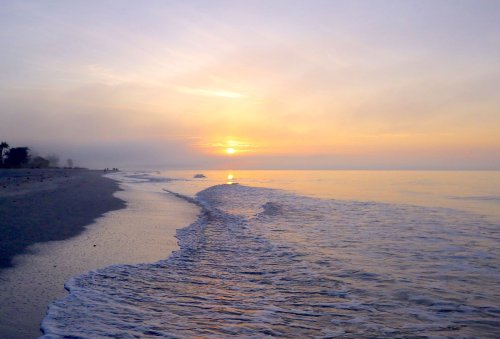
Sanibel sunrise

By Johna Till Johnson

Vlad and I used to joke that in Florida, the wind and current are always against you: the “Florida rules” of kayaking.

So when I planned a circumnavigation of Sanibel Island (13 nautical miles, give or take), I knew better than to apply “New York rules”. In favorable conditions you can complete a circumnavigation of Manhattan (26 miles) in 6 to 7 leisurely hours (averaging around 4 knots). So in theory, you could zip around Sanibel in four hours, plus stops.
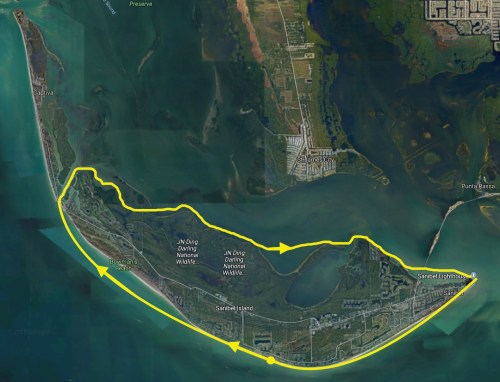
Clockwise around Sanibel Island

But in Florida, you’re lucky if you can average much more than two to three knots, unless you’re doing a one-way run with wind and current consistently in your favor. Even then, Florida conditions have a way of confounding the best-made plans—as I was about to re-discover.

To get around Sanibel Island, I figured a conservative 7 hours, maybe 8, just to be on the safe side. I had picked a perfect day: Not only was the air temp in the 80s,  and water temp in the 70s, but the winds were predicted to be a modest 7 mph (6 knots). If I timed things correctly, I should be able to travel up-coast on the flood and down-coast on the ebb.

The first inkling that Florida planned otherwise came the day before my trip, when I was checking the tides to decide which direction to go (clockwise or counterclockwise) to catch the flood and the ebb as I’d planned.

What was this? The mid-day low tide was missing entirely (see tide chart below). That meant no matter what I did, I’d be paddling against the current for at least half the trip. Still, I figured if I launched by 10 AM with the predicted light breeze, I’d make it home by dark.
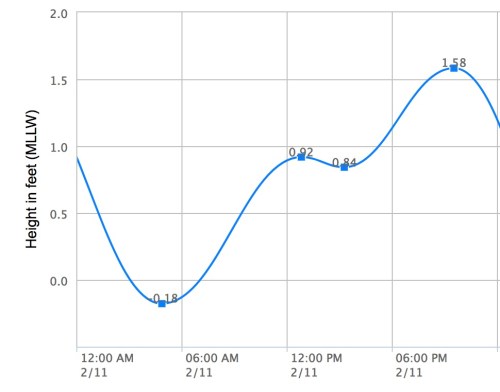
Where did the midday low tide go?

Just to be sure, though, I packed a headlamp… and a backup headlamp… and a GPS… and boat lights. Good thing, as it turned out!

That morning, there was a lively dumping surf on the beach; not big waves, but strong ones. So I was pleased to make a successful surf launch, and set off a few minutes after 10. The sun sparkled off the waves, the moderate breeze was behind me, and I was flying up the Gulf towards Captiva Island, propelled by the rising tide.

In what seemed like no time I reached the bridge separating Sanibel from Captiva. I briefly entertained the notion of continuing on toward the next inlet, but it would add miles to the trip, and if my calculations were correct, I’d be traveling against both the wind and the current soon. So I regretfully decided to turn in as originally planned. (Good thing!)
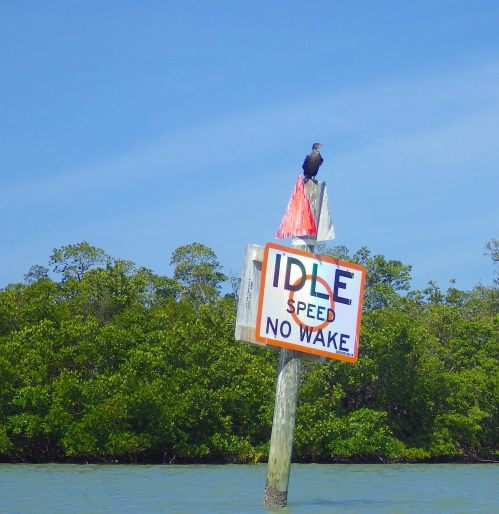
Idle speed, no wake…

As I passed under the bridge, the environment made the usual shift from “outside” to “inside”. Outside—on the Gulf coast—are rolling swells crashing onto long sandy beaches. Inside, the water is placid and peaceful, gently lapping the roots of mangroves.

I paddled past a cormorant blinking lazily on the sun atop an “idle speed” sign. Up ahead… was that a tiny island made up of gray boulders? No, it was a tightly packed flock of pelicans roosting together on a sand bar.
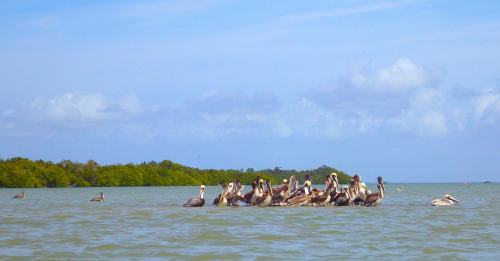
Passel of pelicans

A little further on, I tried to take a photo of some white birds in trees (either ibises or egrets, I couldn’t tell from the distance).  But characteristically, though they tolerated my approach without fear, the sight of the camera sent them flapping away.

I rounded the western point of Sanibel Island and began heading east down the coast. Up ahead I saw a fin lazily slicing through the water. Was that a shark? Dolphins typically arc up and down, disappearing for long moments, then reappearing with somewhere else. But this fin was moving in a level horizontal motion…

It wasn’t until I saw a fine spray and heard the characteristic gasp that I was confident the fin belonged to a dolphin.   I paddled up close and got a shot, then continued on my way.
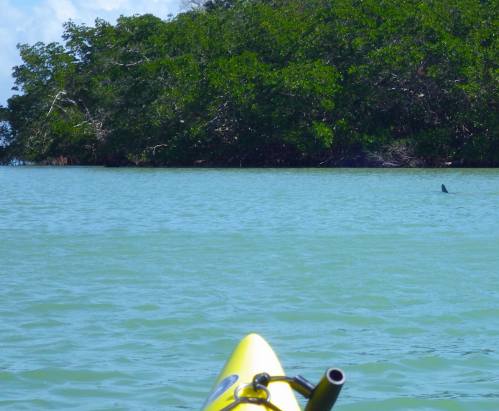
Not a shark

True to my prediction, I was paddling against both the current and what seemed to be a light, but stronger-than-predicted, breeze. I was now moving quite a bit more slowly, and having to work harder at it. Seemingly endless mangrove swamps and keys unspooled to my right. My mind spun free, and for long stretches of time, all I thought about was the next stroke.

Slowly, a line of electrical poles appeared in front of me, linking Sanibel with the mainland. I remembered with a jolt when I’d seen them last: In the middle of the night during the Everglades Challenge. The first traces of the hallucinations that would dog both me and Vlad at night had just begun; I had begun hallucinating a giant George Washington bridge overhead. (Vlad was seeing pop-up decoy ducks on the waves).

Things looked very different in the bright light of early afternoon, but one thing that hadn’t changed was the frustrating slowness of my pace. I recalled how the Ding Darling preserve seemed to go on forever, the mangroves dark against the starry sky. Now they were dark green against bright blue, but it still seemed as though I was inching along.

And there was something else: The wind was picking up. There were small whitecaps everywhere, and the placid water had become choppy. When I caught sight of a flag on a boat, it was usually straight out and flapping crisply. The predicted 6 knot wind had become more like 16 knots.

It was coming from the south, which meant I could shelter from it by staying close to the mangroves—except where there were shoals. As I drew closer to the embayment right before Tarpon Bay, I realized I had to make a choice: Either cut straight across the embayment (and deal with the full force of the wind), or go a couple miles out of my way to keep out of the wind.
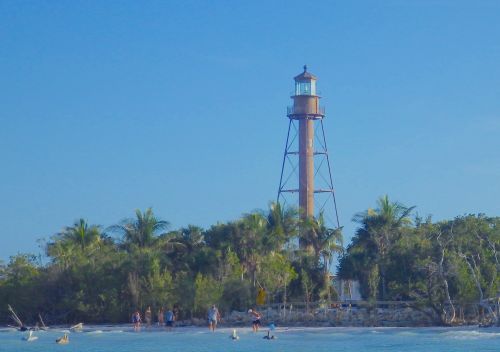
Lighthouse in late afternoon

I decided to cut across.

After a few minutes, maybe half an hour, a boat pulled up to me. “Are you okay?” the captain asked. “It’s pretty windy out!”

I explained that I was fine. (Note to concerned boaters: if a paddler is making steady progress with regular strokes,  not attempting to attract your attention, the chances are extremely good that she is fine. Even if she’s alone. Even if she’s a woman!)

Still, it was good of him to check—and he was right, the wind had picked up. Nearly every swell sported a wind-against-current whitecap. It was definitely bouncy!

Slowly, slowly, I pulled across the embayment, and once again approached land. Thankful for the shelter, I set my sights on the next milestone: The Sanibel causeway. Once again, my mind flashed back to the last time I’d seen it from the water: In the middle of the night, surrounded by bioluminescence. Four years ago.

It seemed like another lifetime.

I passed under the bridge without incident, and began pulling towards the lighthouse. The sun was low in the sky by this time, but I was still fairly confident I’d make it home by dark. How far could it be? An hour, tops?

I stopped to take pictures of the lighthouse, where people and pelicans clustered in a happy riot. Then I rounded the tip of the island, skirting the predictable chop at the point.

Home stretch!  It would be a straight shot up the beach from here. The only challenge would be locating which, among the seemingly identical condos, was the place I was staying.

The wind had died down slightly, and the current was at last with me once more, but I was still riding swell after swell. Trees, houses, and white sandy beach unspooled to my right. And the sun sank slowly in the sky.

I stopped to take a photo as it sank behind Knapps Point. Lovely, but it meant that for sure,  I’d be paddling home in the dark.
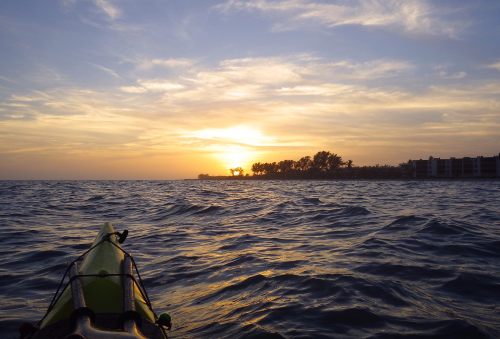
Sanibel sunset

I put on the headlamp and kept going, as the sky faded into purplish dusk. Before long  stars began to appear. The moon was waning,  last quarter, so I knew better than to expect the help of moonlight.

Slowly the buildings blurred into the night sky. Where was the condo? Even with the headlamp, the silhouettes of the condos seemed frustratingly similar. Which one was mine?

Finally I picked a location that I thought looked good, and did a surf landing.

I dragged the boat up the beach and looked around. There was a sign: Hurricane House.  I remembered the location: just a bit short of where I was staying.

Could I walk there, pulling  the boat along in the water behind me using the tow rope, as I’d done in the past?

Nope.

The surf was too strong; the first incoming wave swamped the boat. Damn it! Now I had to drag the boat back up the beach and empty it.

After doing that,  I launched again and paddled further up the beach. I glimpsed down at my deck, and realized that the wave that had swamped the boat had also washed away my chart. Double-damn it! (Note to self: When making surf landings in the dark, stow chart inside deck bag.)

Oh well. I could always order another one. I kept paddling, into the deepening night.

After about fifteen minutes, I pulled into shore again. Once again, I dragged the boat up the beach. Once again, I looked around.

This time I saw the silhouette of someone—a woman—on the balcony. I asked her for the street address, which she gave me. Figures! This time I’d overshot.

By now it was pitch dark. I got back into the boat and paddled back in the direction from which I’d come. Suddenly the silhouettes to my left began looking familiar: Two palm trees… a big space… and a cluster of palm trees.

This was it! Third time’s a charm. Sure enough, that was the silhouette of my condo.

I checked my watch after dragging the boat up the beach. 7:45 PM. It had taken me nearly 10 hours to travel a dozen nautical miles (including about 45 minutes of going back and forth in the dark).

I could feel the sunburn on my cheeks, and my hands were blistered.  And of course, I’d lost a chart.

But I was home. And it had been a splendid paddle, “Florida rules” and all!
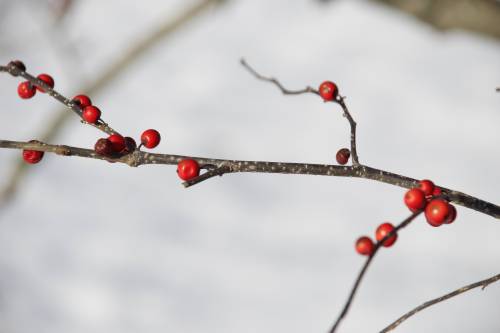
Berries In the Snow

Berries against the snow, Connecticut

By Johna Till Johnson

Berries in the snow
Bright hopeful against the cold
How long will they last?

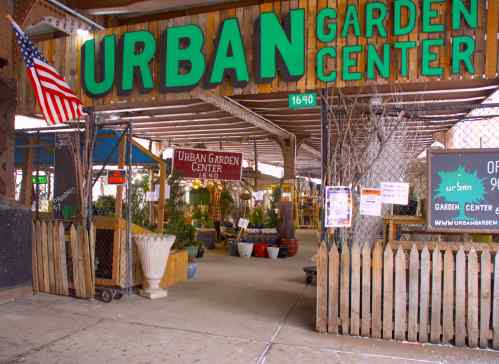
Urban Garden Center NYC

Urban Garden Center

By Johna Till Johnson

When it’s cold and snowy out, where does a New Yorker in search of lush greenery go? The Urban Garden Center, of course!

It’s a whimsical wonderland hidden under Park Ave at 116th St., and one of the many crown jewels of Spanish Harlem.  In summer, there are live chickens (because what’s a garden center without chickens?). Children love to come and visit, and feed the chickens.

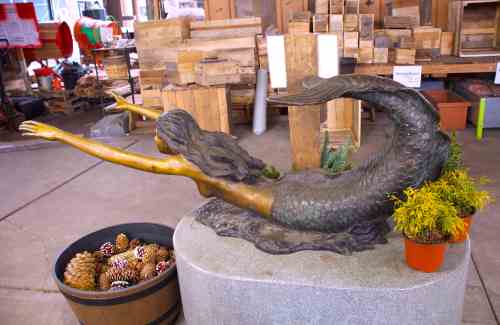
In winter the fauna are more limited: Teddy bears and mermaids.

Fairyland (with teddy bears!)

And speaking of fairyland, the center’s owner, intrigued by my picture-taking, regaled me with stories of New York “back in the day” (we are pretty much the same age).

My favorite was the time when he, as an 18-year-old from Long Island City, Queens, drove his brand-new Honda CRX right into the middle of a gang war in Spanish Harlem.

As he drove into a narrow alley, the two sides stopped fighting each other and attacked him. They lobbed a Molotov cocktail at his car, lighting the hood on fire.  There was nowhere for him to turn, so he threw the car into reverse and burned rubber backing out of the alleyway, flaming hood and all.

Ah, New York… those were the days!

Fairyland fauna: Mermaid


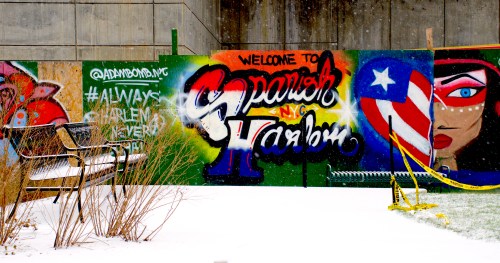
Welcome to Spanish Harlem

Welcome to Spanish Harlem!


By Johna Till Johnson

They say old New York is dead.

The city’s hot lifeblood has gone thick and sluggish. Starbucks and suburbanization have driven a stake through its  heart.

They’re wrong.

The beating heart of New York never dies. You just need to know where to find it.  The pulse is particularly alive in Spanish Harlem, which shimmers with dynamic energy. It’s bright with color, even on a dark snowy day.

Spanish Harlem street corner

Like much of old New York, Spanish Harlem (also known as East Harlem or El Barrio) is known for many things: Poverty. Addiction. Gang violence (the area is home to the most dangerous block in the city, according to police statistics).

But Spanish Harlem is not defined by those things, or not defined only by them.

It’s diverse: Puerto Ricans, African Americans, Asians, and a remnant of the original Italians who settled there in the early 1900s mingle with displaced WASP Upper East Siders and the influx of international staffers working at Mt. Sinai, the steadily-growing medical complex that dominates the southern part of the neighborhood.

There’s also a spirit of pride, and neighborliness. You’re more likely to be greeted with a nod and a smile here than anywhere else in the city.  “We’re all in this together,” is the unspoken sentiment.

Helping each other

More than that, Spanish Harlem is characterized by hope. It boasts one of the best high schools in all of New York state,  Manhattan Center for Science and Mathematics, which regularly sends local students to top-ranked universities.

There are a number of community gardens, decorated with whimsy and offering bright spots in the urban landscape.

And a surprising number of artists, poets, and musicians hail from Spanish Harlem. A notable one is Marc Anthony,  the top-selling salsa artist (and Jennifer Lopez’ ex-husband).

Above all, Spanish Harlem is the land of dreams.

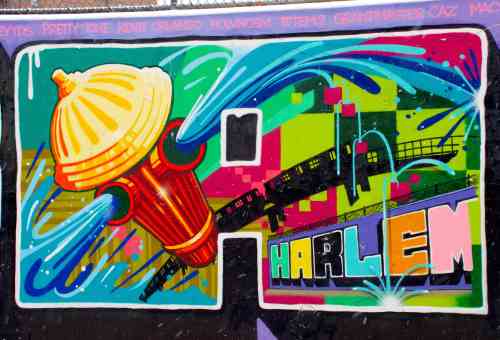
Hall of Fame

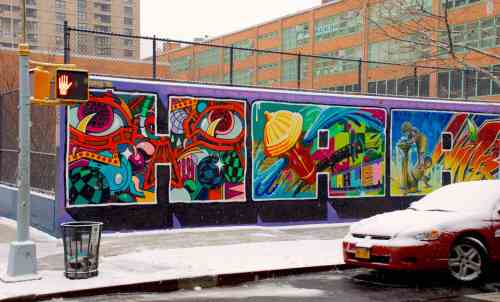
I am not certain, but I suspect that the graffiti in this mural refers to the song Hall of Fame, which celebrates setting high goals and working to achieve them.

Yeah, you could be the greatest
You can be the best…
You can be a master
Don’t wait for luck
Dedicate yourself and you can find yourself…

Standing in the hall of fame
And the world’s gonna know your name
‘Cause you burn with the brightest flame
And the world’s gonna know your name
And you’ll be on the walls of the hall of fame…

Do it for your people
Do it for your pride
How you ever gonna know if you never even try?

Harlem: Do it for your people

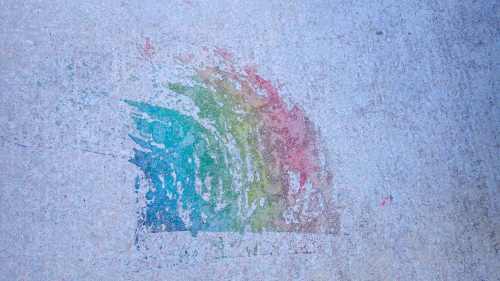
Zlarin: Rainbow

Rainbow sidewalk stencil on the island of Zlarin

By Johna Till Johnson

Croatians can be whimsical.

As I was walking along a pier on Zlarin, a small Croatian island in the Adriatic, I noticed a rainbow stenciled on the sidewalk. Who put it there? And why? There are no answers.

But it made me smile.

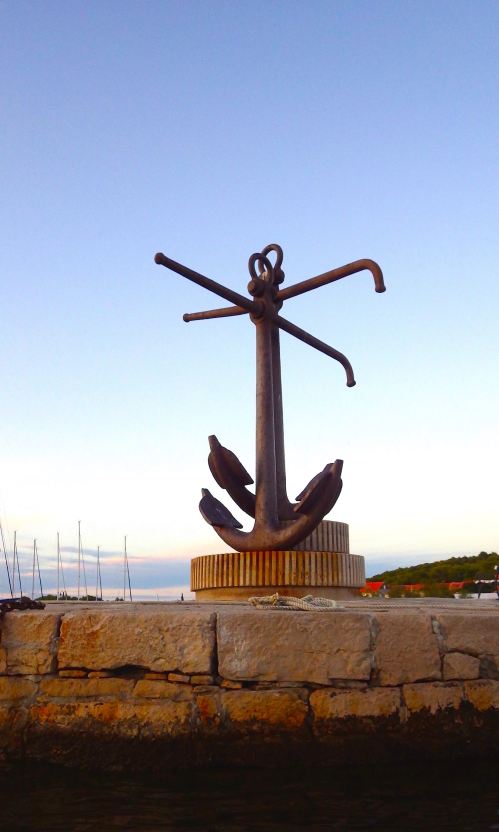
Zlarin: Anchors at Sunset

The double anchors of Zlarin

By Johna Till Johnson

Last September I paddled the Croatian Adriatic coast with Peak and Paddle Croatia. It was enchanting.

For the first part of the trip, we stayed on the island Zlarin.  It’s a small island (winter population of 284), but has been inhabited since Neolithic times, and is famous for its coral divers.

This double-anchor monument was erected in 1977 to honor Zlarin sailors and emigrants. (Interestingly enough, that group includes Anthony Maglica, the founder of Maglite, who was born in New York City of Croatian parents, but returned to their hometown of Zlarin during World War II.)

I took the photo from the kayak at sunset, after one of our first trips. Stories are to come!

Democracy is Coming

American flag at the Intrepid, as seen from my kayak

By Johna Till Johnson

July 4, 1976. The Bicentennial.

I remember it vividly. Earlier that year with the rest of my sixth grade class I’d prepared a multimedia report, with photos and artwork and carefully crafted text. That night as the fireworks lit up the sky, and the grownups chatted over drinks and hors d’oeuvres, I thought to myself, “Pretty cool! I need to catch the next one!”

Then I realized that meant I’d have to live to be… 111 years old.

Not impossible. But definitely a stretch. It would take luck, work, and considerable scientific and technological advancement. (My interest in life extension stems from that moment, because I really do want to be around.)

And then something else occurred to me: What if we didn’t make it? What if I lived to be 111, but there was no longer a U.S.A.?

By then I’d learned something about the Greeks and Romans, and that democracy was an inherently unstable form of government. Like many children, I couldn’t truly believe that anything bad would really happen. So I tried to shut down the thought. But it remained: What if…?

In the decades since, I’ve become increasingly pessimistic, while still clinging to my native idealism. I’m an American not because I was born here, but because I believe in the principles on which this country was founded, however imperfectly we’ve managed to adhere to them over our history:  Every person is entitled to life, liberty, and the pursuit of happiness. Every citizen gets a vote. And most importantly, government is here to serve us, not the other way around.

Over the years, I’ve thrown citizenship parties for more than a few friends who have chosen to throw their lots in with the U.S.

And I’ve shared with them the hope that we can defy the odds, remain a democratic republic, and continue to adhere as closely as possible to those cherished ideals.

Sometimes, that hope feels faint and flickering.

So it’s no small irony that it’s the Canadian Leonard Cohen who helps fan that flickering flame.  His song “Democracy” was written shortly after the fall of the Berlin Wall in 1989.

It’s apolitical (neither right nor left, as he says in the song). And as he said in an interview: “It’s not an ironic song. It’s a song of deep intimacy and affirmation of the experiment of democracy in this country…This is really where the experiment is unfolding…This is the real laboratory of democracy.”

That’s as true today as when he wrote the words below. Every day, every hour, democracy is being tested. Sometimes it fails the test. And sometimes, against the odds, it succeeds.

If you haven’t heard the song,  it’s worth a listen.

Lyrics ©Leonard Cohen 1992

It’s coming through a hole in the air
From those nights in Tiananmen Square
It’s coming from the feel
That this ain’t exactly real
Or it’s real, but it ain’t exactly there
From the wars against disorder
From the sirens night and day
From the fires of the homeless
From the ashes of the gay
Democracy is coming to the USA
It’s coming through a crack in the wall
On a visionary flood of alcohol
From the staggering account
Of the Sermon on the Mount
Which I don’t pretend to understand at all
It’s coming from the silence
On the dock of the bay,
From the brave, the bold, the battered
Heart of Chevrolet
Democracy is coming to the USA

It’s coming from the sorrow in the street
The holy places where the races meet
From the homicidal bitchin’
That goes down in every kitchen
To determine who will serve and who will eat
From the wells of disappointment
Where the women kneel to pray
For the grace of God in the desert here
And the desert far away:
Democracy is coming to the USA

Sail on, sail on
O mighty Ship of State
To the Shores of Need
Past the Reefs of Greed
Through the Squalls of Hate
Sail on, sail on, sail on, sail on

It’s coming to America first
The cradle of the best and of the worst
It’s here they got the range
And the machinery for change
And it’s here they got the spiritual thirst
It’s here the family’s broken
And it’s here the lonely say
That the heart has got to open
In a fundamental way
Democracy is coming to the USA

It’s coming from the women and the men
O baby, we’ll be making love again
We’ll be going down so deep
The river’s going to weep,
And the mountain’s going to shout Amen
It’s coming like the tidal flood
Beneath the lunar sway
Imperial, mysterious
In amorous array
Democracy is coming to the USA

Sail on, sail on…

I’m sentimental, if you know what I mean
I love the country but I can’t stand the scene
And I’m neither left or right
I’m just staying home tonight
Getting lost in that hopeless little screen
But I’m stubborn as those garbage bags
That time cannot decay
I’m junk but I’m still holding up
This little wild bouquet
Democracy is coming to the USA

Note: Astute observers may note the British Airways logo on the airplane in the photo. That’s the British supersonic airplane the Concorde, which was donated to the Intrepid museum upon its retirement in 2003. As in so many things, the U.S. remains indebted to Britain.

Watch Out For a Man With a Hot Grill!

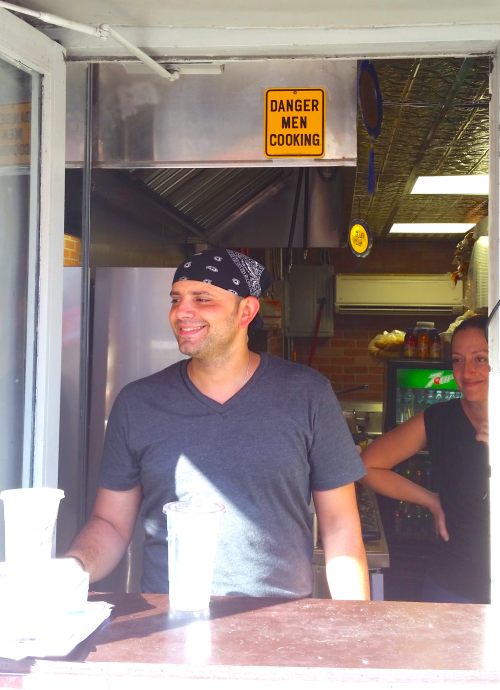
He doesn’t LOOK that dangerous…

By Johna Till Johnson

Two years ago, a new falafel shop, Gyro 96, opened up on my street. It focused primarily on lunch, so I investigated immediately—there are few good lunch options near me, and I was looking for something fast, cheap, tasty and reasonably healthy.

It was a tiny hole in the wall, no seating, just a grill/kitchen behind a serving window. But the way the crowd of construction workers, hospital employees, and assorted denizens of the Upper East Side and Spanish Harlem gathered around told me the food had to be good.

Aside from serving up the best chicken gyro salad I’ve ever had (and introducing me to hibiscus iced tea),  the shop did something better: it made me laugh.

I don’t know whether the sign behind chef/owner Waled Harady’s head is intended to be humorous. But the way he and his partner Inna Sobel laughed when they saw me taking the photo makes me suspect it is.

Harady seems to be the kind of guy who’s well aware of gender roles—and doesn’t mind upending them a bit. He’s a former aeronautical engineer who ended up running a falafel restaurant in Harlem, then after a few iterations ended up at the current location with his partner.  There’s a great piece about the story in the New York Times.

Harady’s recipes are all authentic. They come from his mother and his grandmother, and he makes them the old-fashioned way. And that hibiscus iced tea? It’s not only a lovely drink on a hot summer day, but may be a wonderful natural way to lower blood pressure.

So if you’re in the neighborhood, stop by. But watch out for those men cooking!

All men shall be sailors…

Sailing and freedom

By Johna Till Johnson
Photo by Vladimir Brezina

“All men shall be sailors then
Until the sea shall free them…” — Leonard Cohen, “Suzanne”

I’ve been listening to a lot of the singer-songwriter Leonard Cohen lately. I’m not alone in this; he’s experiencing an (in my mind deserved) groundswell of popularity in the 14 months since he died.

His themes are universal and serious: the inevitability of loss, imperfectability of human nature, the ephemeral transcendence of love.

His fundamental stance is religious, but while it’s rooted in his native Jewish tradition (he remained devout all his life), it draws from a broad set of perspectives, with a pragmatic bent. He once told the New Yorker:  “Anything, Roman Catholicism, Buddhism, LSD, I’m for anything that works.”

He wasn’t joking. Over the years, he studied Scientology, became an ordained Buddhist monk, and studied at an Indian ashram—along with pursuing various intoxicants (from acid to alcohol) and ascetic practices (particularly fasting). His goal was less the abstract pursuit of enlightenment than to ameliorate the bouts of depression that struck him throughout much of his life.

Sylvie Simmons wrote a wonderful biography of Cohen in 2012, “I’m Your Man,” One of the interesting paradoxes of Cohen’s life is that although he was deeply embedded in the contemporary cultural matrix  to a degree that’s almost Zelig-like, his essential formality was fundamentally out of step with the “anything goes” ethos of the times.

The Jewish magazine Forward has an insightful obituary that highlights this: “The “absence of the casual” may well be one of the singular characteristics setting Cohen’s work apart from his so-called contemporaries,” writes Seth Rogovoy.

And it paid off in the long run—Cohen is one of the rare artists who pursued his craft with intensity and diligence all his life, and  peaked as a performer in his 70s.

In a surprising twist that serves as a hopeful beacon to us late bloomers, after his business manager embezzled his money and left him broke early in the 2000s, he decided to go on tour to support his ex-wife and children. Although he had previously hated performing, he put together a stellar backup band and collaborated with them to develop innovative arrangements of his work.

The result was almost a decade of some of the best live performances in popular music history (you can find many of them in YouTube). Cohen not only accomplished his goal of earning back a fortune, he left a shining legacy that touches millions.

That “absence of the casual” is perhaps the most appropriate response to the inevitable tragedies of life, which may be one of the reasons Cohen’s work is experiencing a renaissance.

The lines above (“until the sea shall free them”) particularly resonated with me because the sea has always been associated in my mind with freedom. Towards the end of his life, my father (who was a naval officer)  turned to me and said, “The open ocean is closer than they led us to believe.”

He was referring, of course, to his imminent death, but what struck me was that he associated it with the open ocean—and freedom.


Tappan Zee Redux!

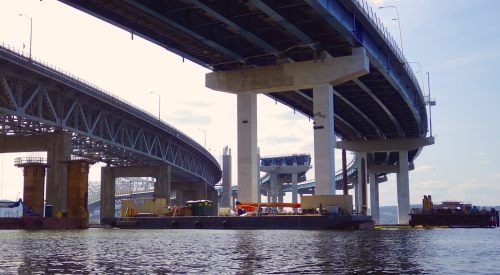
Unfinished span of the new Tappan Zee

By Johna Till Johnson
Photo composition by Brian Fulton-Howard

Four years ago this month, I wrote about the “New bridge over the Hudson” that was to replace the Tappan Zee. At the time, it was hard to believe the bridge would really be built; the project had been in discussions since 1999. At  $3.9 billion, the new construction would represent one of the largest infrastructure investments in New York this century. And it would be the first new bridge to be constructed since the Verrazano-Narrows in 1964.

A daunting prospect; skepticism was warranted.

Guess what? It’s here! And astonishingly, it was completed on time and on budget, as governor Andrew Cuomo was quick to point out.  The grand opening of the new bridge was last summer (though one span remains to be completed in 2018).

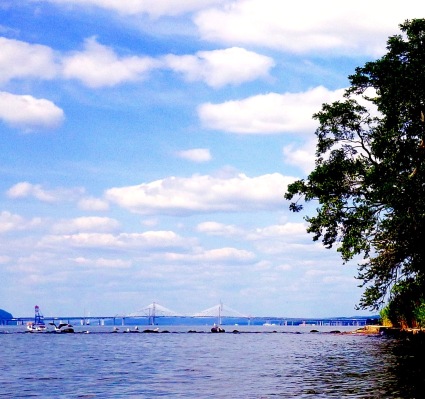
Right after it opened, on a bright summer day, Brian and I paddled up to see it. As we bounced over the slight waves, the twin peaks of the bridge’s profile (a cable-stayed design) slowly emerged from a dusting of clouds.

It looked strangely familiar…

The profile of the bridge emerges…

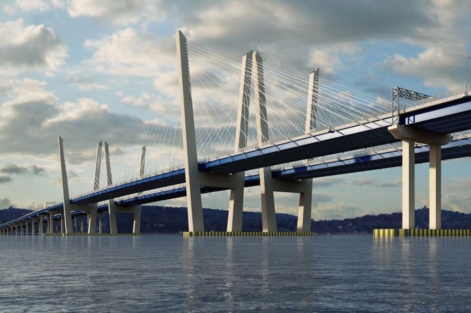
… Of course!  It was remarkably similar to the original artist’s rendering, below:

Artist’s rendering (New York Times)

I think the actual bridge is even prettier than the original conception, but it’s hard to say, as it’s still surrounded by the original Tappan Zee, which won’t be torn down until sometime this year.

As Brian and I paddled closer to the bridge, we were struck by the sight of the unfinished span that appeared in cross-section in the middle of the combined infrastructure.

It’s not every day you get to literally see the guts of a bridge as it’s being built, so we struggled to stay stable in the strong flood current as I took shot after shot. Brian finally figured out the exact location from which the unfinished span was framed perfectly (see photo above).


You’ll notice I’ve referred throughout to “the new Tappan Zee” and “the bridge”. The official name of the bridge, as of late last year, is the “Mario Cuomo bridge”, named after the three-term governor (and the current governor’s father). However, there’s a petition circulating to keep the original name.

As the petitioners explain, it’s nothing against Mario Cuomo, who “may be deserving of having something named after him.” (Don’t you love that “may be”?)

The problem is simply esthetic, petitioners assert. It sounds cool to say, ‘I’m taking the Tappan Zee,” the petition reads. “It does not sound cool to say, ‘I’m taking the Cuomo.”

I have to give them the point—”the Tappan Zee” sounds way cooler.  I doubt the petition will succeed, but I’m not sure the official name will stick, either. New Yorkers can be stubborn, and  even Google Maps still refers (confusingly to out-of-towners) to the Triboro Bridge rather than its official name of  RFK Bridge.

In any event, with my Tiderace now living happily at the Yonkers Paddling and Rowing Club, I look forward to many more trips to the, ahem, Tappan Zee.

Meantime, here’s a photo of Brian in the sunshine, just to remind everyone that summer will indeed return!

Brian in the sunshine (view looking north)

.