Category Archives: Life

Snowfall by the River

East River in snow

By Johna Till Johnson

I’ve always loved the East River.

She’s not really a river at all, but rather a connector between Long Island Sound and New York Harbor.  That topography accounts for her rapid currents, which are slightly out of sync with those of the Hudson (a tidal estuary). And it also accounts for much of her charm. To me, the East River has always been beautiful, mysterious, and slightly dangerous, with an allure that’s impossible to resist.

Before I learned to kayak, I’d walk along the river and think, “Wouldn’t it be lovely to go into the water?” Crazy thought! In addition to the swift currents, the East River was known in decades past for pollution and the occasional dead body. (These days, the water is much cleaner. There are even dolphins!)

After I took up paddling, I ended up actually in the East River more than once, usually by design (practicing capsizing in current) but one memorable time entirely by accident. And I’ve paddled its length many more times than that—my best count is that I’ve circumnavigated Manhattan around 40 times, and I’ve paddled out to Long Island Sound a handful of times as well.

But as is the case with most true loves, knowing the East River better only increases her allure.

It was natural, then, when a blizzard rolled in, for me to make time to go down to the East River and see what she looked like in snow.  I’m biased, but isn’t she gorgeous?

Potatoes, potatoes, potatoes!

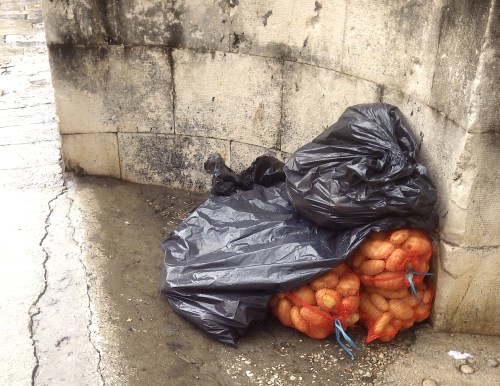
Potatoes carefully protected against the elements (Dubrovnik, Croatia)

By Johna Till Johnson

Vlad loved potatoes. I mean, he loved potatoes. He got a light in his eye and a lilt in his voice just talking about them: “Let’s have potatoes for dinner! Boiled ones! The little ones with the white skins!”

Sometimes I’d have to run all over town to find just the right potatoes. (The little ones with the white skins, of course.) Once the potatoes were procured, the cooking process was equally precise: Boil the potatoes in properly salted water. Don’t cook them too long, or they’ll get mushy. (You want the teeth to pierce the skin with a satisfying crunch, but the interiors should be soft and tender.)

Add plenty of butter to the hot, freshly drained potatoes. And don’t forget the dill, or lacking that, parsley!

But that’s not to say Vlad was a potato snob. Although he had his favorites, he loved them all. Mashed. Baked. Fried. I used to love to watch him at restaurants, when the server would offer a choice of starch: Rice or fries?

“Hmm…” he’d say, thoughtfully, appearing to consider all options. Inside, I was already chuckling, because I knew what would come next: “I’ll have the fries, please!” he’d say, as if it were were the outcome of long deliberation, rather than a foregone conclusion.

Although I knew Vlad loved potatoes, and I knew he was Czech, and that Czechs are Slavs, I didn’t entirely put the pieces together until I was in Croatia this past fall. Croatians are also Slavs—and they love their potatoes, with a love that’s delightfully reminiscent of Vlad’s own.

Even more delightful is the respect with which Croatians treat their potatoes. Walking into Dubrovnik in a torrential rain, I saw a bag of potatoes carefully protected from the elements, wrapped in a plastic bag. No rot would come to these cherished spuds!

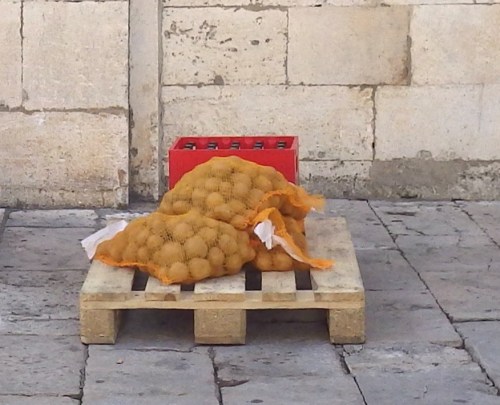
And a few days later, in a city square, there was another bag of potatoes—carefully resting on a pallet, safe against any morning dampness.

Hail the humble yet glorious potato!

The potato pallet (Dubrovnik, Croatia)

Happy New Year!

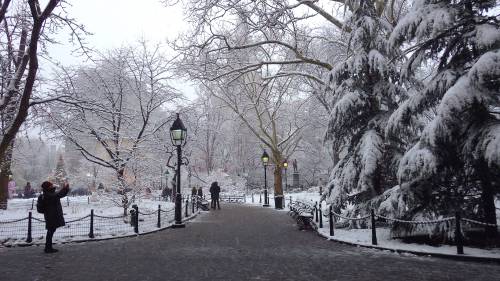
Snowfall in Washington Square Park

By Johna Till Johnson

The new year has begun, and with it, winter.

Somehow I’m never completely expecting the seasons when they finally arrive. On a sweaty day in July I truly can’t believe the ground will ever be covered in snow again… and yet, predictably, it is.

The beauty is no less delightful for its predictability. In fact, quite the opposite: each new snowfall is both like and unlike all other snowfalls.

Vlad used to say he never got bored, even paddling the same route over and over again. I believe this is partially what he meant: On a familiar route, you can appreciate both the familiar and the new.

May 2018 be full of both anticipated and unanticipated beauty. And may we appreciate it all!

Shoes

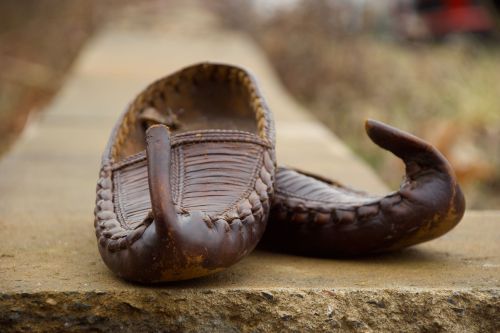
Shoes on cement wall

By Johna Till Johnson

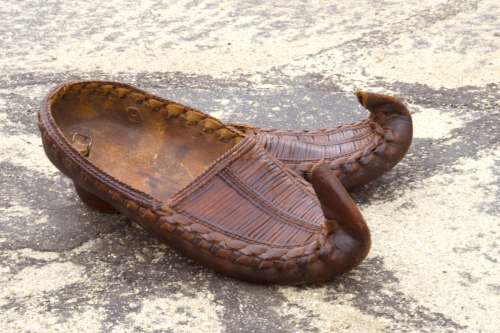
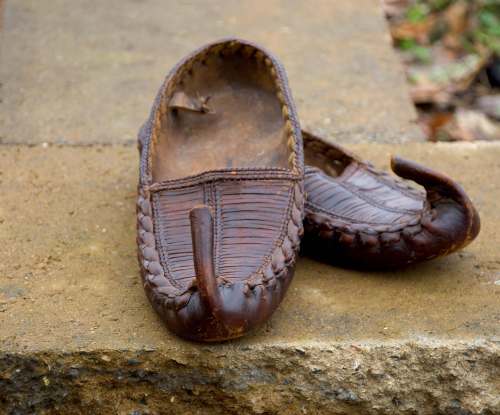
“Where did these come from?” I held the tattered leather shoes up to my mother. They had curved toes vaguely reminiscent of Scandinavia, but also of Native cultures. Were they Sami, perhaps? After all, we had lived in Norway for a few years…

The answer surprised me: “Oh, I got those in Sarajevo. When I went there in…let’s see… that would have been… the summer of 1953.”

My mother had spent the early 1950s (her mid-to-late 20s) teaching in Germany and traveling through Europe.

I’d known that, but I’d somehow forgotten, or possibly never known, that she’d paid a visit to the then-country of Yugoslavia.

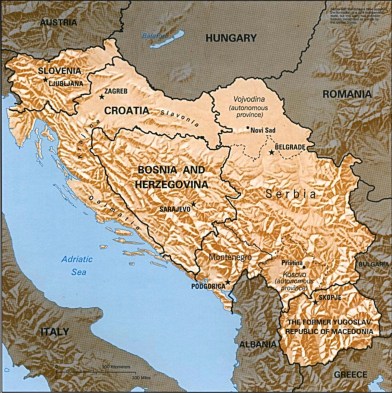
Yugoslavia in the 1950s

As she tells the story, her visit was in direct opposition to U.S. government orders. The iron curtain was beginning to fall over Eastern Europe, and the newly created “Socialist Federal Republic of Yugoslavia”, along with the other Eastern European countries, had initially aligned themselves with the Stalin-era Soviet Union.

By 1947 (just five years before my mother’s visit), that had changed: Yugoslavia, under Tito’s control, had opted to break from the Soviet Union and was accepting a limited amount of American aid. However, Tito remained a vocal critic of both the U.S. and the U.S.S.R., and the American government was concerned about the stability of the uneasy peace in the region, sandwiched as it was between Western Europe and the Soviet Union.

So the U.S. issued a warning that Americans were not to travel there. Undeterred, my mother nevertheless obtained a visa. With just a backpack and a change of clothes, she hopped on the train from Venice, where she had been visiting her future husband (my father), a naval officer whose destroyer had docked there briefly.

As it does today, the train wound around the northern Adriatic coastline before plunging inland to Sarajevo. My mother had colleagues in Sarajevo from the Experiment in International Living. So she was able to stay in a youth hostel there.  And she was confident in her ability to navigate a foreign country, government warnings or no.

So when she arrived in Sarajevo, she immediately went out to explore.

“What made you want to buy the shoes?” I asked, expecting to hear that she wanted a souvenir of her adventures.

“Oh, I liked them and needed a pair of shoes,” she replied cheerfully.

She wore them? Sure enough, when I inspected them closely I could see the soles were well worn. I slipped my feet inside and discovered they fit me almost perfectly. And they were surprisingly comfortable.

More comfortable than you’d think…

“And you know what the Yugoslavian college students told me about the curved toes?” she asked me mischievously.

No, what?

Apparently toilets in Yugoslavia at that time were often… primitive. (Think hole-in-the-ground.) So the curved toes were useful to..ahem…hang on to while squatting.

That was the story, anyway. Not that my mother ever had need of them for that purpose, she hastened to clarify.

But she did wear them as she traipsed happily around Sarajevo… until the evening she was comparing visas with the Experiment in International Living team.

“Let me see that, ” demanded one of the students, who could read Serbo-Croatian. “How long did you say you were staying in Sarajevo?”

“I have another week here,” she replied.

Except apparently she didn’t—the visa expired the very next day. And you didn’t fool around with expired visas in Eastern European countries, at least not at that point in history.

So that was the end of my mother’s Yugoslavian adventure… but she brought the shoes home, for me to discover 64 years later.

Closeup of shoes


All Roads Lead Home

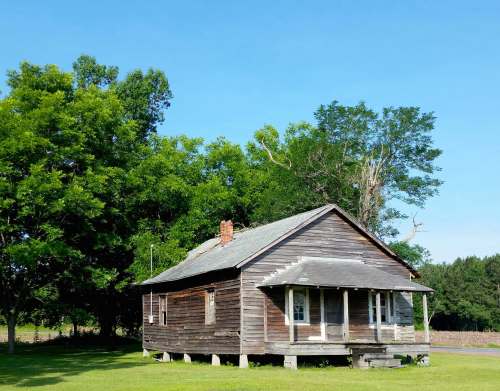
Wooden house in North Carolina

By Johna Till Johnson

Country roads, take me home
To the place I belong…
—John Denver

It was almost as if my apps were in collusion to bring me home.

It started when I turned on the Pandora station in the car last spring.

The trip ahead was long: 1200 miles, from New York to Florida, where I hoped to pick up my boat and spend a few days camping and paddling. Music would keep me from getting bored.

The Pandora algorithm isn’t complex—in fact, I could probably write the code myself. The app starts by playing the music you’ve asked for (a particular artist or genre). Then for maybe 10% of the songs, it gradually inserts other artists that are “sort of like” the artist you selected. As you indicate your likes and dislikes of the material by clicking the thumbs up/thumbs down button, it adjusts the selection it plays.

So after a while, the station reflects your favorites.

I’d expected that.

What I hadn’t expected was the way the algorithm had mixed favorites from all different times of my life, creating a kaleidoscope of memories as I drove.

While the endless gray-and-green strips of landscape unfurled outside the car, references and long-forgotten images flashed through my brain.

There was the song I played repeatedly when I went out running on the hot autumn nights in Texas when my father lay dying.

Then there was the song I associated with falling in love with Vlad. And the song that comforted me in the shattered weeks after his death.

But there were songs from earlier times, as well.

Songs from the time, years past, that I played on the car radio during my late-night and early-morning commute between New York and Connecticut to my job as a hotshot technology executive at an engineering company…

Songs from my arrival in New York, years earlier, with ripped jeans and a meager budget, in the time when I still skateboarded in Union Square, and a female skateboarder was still a novelty: “Look! It’s a chick skater!” someone yelled once…

And songs from the years before that, in Florida. As the wife of a young professor, a freelance writer, and a new homeowner, I lived out a kind of delayed adolescence, hanging out with a group of bright underachieving perennial undergraduates at punk clubs and science fiction conventions…

There were the songs I listened to at those clubs, and also the songs I played on my headphones in those years as I ran, lithe and tan, near my house on the trail through the green-and-grey Florida woods (since paved over for a shopping mall).

And farther back still, during my college and graduate school years, the songs I listened to on an aging boom box, songs that were simultaneously upbeat and cynical, or preternaturally moody and depressed.

Yes, I was prepared for the mix of favorites—but I wasn’t quite prepared for the memories they’d summon.

And it wasn’t just Pandora. Google Maps appeared to be in on the plot, because for some reason, it  ingeniously routed me past nearly every place I’d ever lived in the continental US.

Yes, it helps that many of the places I’d lived were along the I-95 corridor.  But Google went out of its way to take me right by former homes.  Instead of zooming down the relatively straight line between Baltimore (where I’d lived for my college years) and Richmond, for instance, it took me on the spur towards Annapolis, where I’d lived between the years of eight and 11.

And then past the suburban Maryland enclave, where a few years later, I’d spent time as a surly, sullen adolescent. (Apparently my parents didn’t understand me. What a surprise! )

There was also the Virginia suburb where I lived as a very young child, and the exit where my then-husband and I had lived for one of the summers he worked at NASA.

Over the hours, I realized again and again how many places I called “home”.

It got to be almost a joke: I’d get out of the car somewhere—say the rest stop just outside Baltimore where I’d stopped on trips to, from, and past that city—breathe deeply, and say out loud: “I’m home!”

And I really meant it. I was home. These were all the places I’d lived, to which my memories were attached.

Those of us—like me and like Vlad—who have lived in many places don’t have the same experience of those who have grown up in a single place, imbued and invested with all our emotions and memories.

Yes, Vlad spoke of his home in Prague—which I visited (sadly, solo) the year before his death.

But he’d left there at the age of ten, and between then and when I’d met him in New York, “home” for him had been Libya, Iraq, Scotland, London, Heidelberg, San Diego, and Los Angeles.

Just as for me there had been California, South Carolina, Hawaii, Virginia, Maryland, Rochester, New Jersey, Florida, and New York City—not to mention Norway and Italy.

I can close my eyes and summon all the “homes” where I’ve lived: The garden in Naples. The terrace in Rome. The dark trees by the house in Oslo. The majestic four-story white house on the grounds of the Naval Academy in Annapolis.

And on this trip, it seemed like the Universe was working to visit almost all of them, through memory and proximity.

The place I was traveling to—St Petersburg, Florida—was also home. Although I’ve never lived there, one of my boats now does. And it had served as the center of my kayaking existence outside New York for nearly a decade.

It was there that, much to my surprise, I managed to pass the challenging British Canoe Union (BCU) test to become a three-star paddler, as part of the Sweetwater Kayak symposium.

And it was there that served as the launch point for the Everglades Challenge Vlad and I completed in 2014, and for which we conducted multiple “shakedown” (practice) trips. Not by pure coincidence, it was also there that my company had elected to hold its annual conference for the past several years.
So when I arrived at long last at Fort De Soto campground, I stepped out of the car, took a deep breath and said (once again): “Ahh. I’m home!”

And then I had to smile at the number of times I’d said that on this trip.

Daily Post: Calling

Winter is calling!

By Johna Till Johnson
Photo by Vladimir Brezina

Today’s daily post is Calling.

Tomorrow is winter solstice. Days will begin to get longer, and it’s a good time to  reflect about the year gone by as we’re about to bid it farewell.

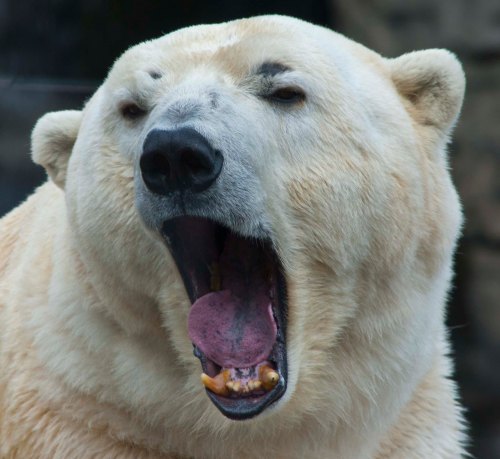
For today’s post, I decided to look for one of the many photos Vlad took of an animal with its mouth open. When I came across this one I immediately realized it had the right seasonal “feel” (even though Gus the polar bear is actually yawning.)

But the story itself calls to me, or rather the story-within-a-story: About six years ago Vlad and I went to the Central Park Zoo, along with my best friend and two of her daughters. Vlad brought the good camera and took some memorable photos. We remarked at the time what “characters” these animals were—quintessential New Yorkers!

Vlad also wrote a later blog post just about Gus, the polar bear. Apparently, like all true New Yorkers, Gus was neurotic: For no reason that anyone could understand, he took up obsessively swimming laps in the pool.

For 12 hours a day.

The zookeepers got him therapy, and eventually his symptoms tapered off (though they never disappeared entirely). He died in the summer of 2013 and was greatly mourned.

A part of old New York passed away back then, and has never been replaced. There are no longer polar bears at the Central Park Zoo, which many would say is a good thing for them, if not us.

And of course, Vlad is now gone too, and with him another small part of old New York.

So really, it’s the past that calls to me in this image.

A past of sunny spring days full of vanished polar bears and other animal “characters” vamping for the camera, and of the careful, enthusiastic eye that took the photos. A past filled with unexpected discoveries and pleasant surprises.

As Vlad himself put it in the comments, “In happier times, as they say in biographies that end badly (as they all do)…”

Later on Vlad writes, “Sorry to have lost him.”

Indeed!

Daily Post: Relate

Johna and Kevin 2017

By Johna Till Johnson

Today’s daily post is “Relate”.

This spring I went to visit a dear friend on Long Island’s North Fork (one of my favorite places in the world). I have to write up that story, for it was an adventure on many fronts.

But meantime, today’s prompt encouraged me to post this photo, which is one of my favorite pictures of myself this year.

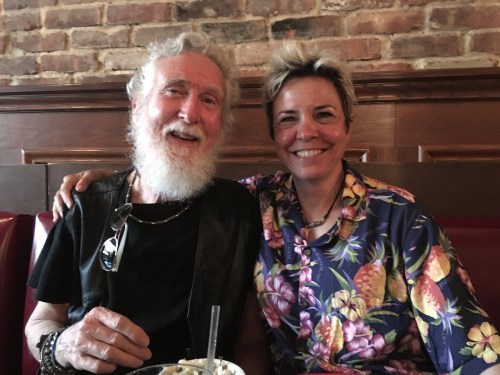
My friend is Kevin, who I’d met literally seconds before. The fun part is that we felt an almost instant connection. Right after we met, we shared a dish of vegan coleslaw. And he, my friend Christina, and I went on to spend a delightful evening of food and music.

Sometimes, when you meet someone new, you can just… relate.

An Autumn Paddle in New England

The source: Osprey Sea Kayak Adventures

By Johna Till Johnson

October 7, 2017

To me, Rhode Island is New England’s quirky little brother.

In the New England family, Massachusetts is the corporate CEO:  rich, polished, well-connected, and casually dominant.

Connecticut is the suburban matron with pearl stud earrings, perfectly pressed khakis, 2.5 blond kids and a white picket fence.

Vermont is the crunchy-granola hippie sister, with flowing locks and skirts and beads.

New Hampshire is the gruff older brother with flannel shirts, pickup truck with a gun rack, and the “live free or die” bumpersticker.

Maine… that’s the far-off cousin I’ve never properly met, distant, mysterious, and cold.

But Rhode Island is the bright, tattooed little brother with grommet earrings who’s working as a barista while waiting for his band to hit the big time.

The person I’d naturally gravitate to at Thanksgiving dinner, in other words, because he’s likely to have the most interesting stories and unusual perspectives.

So when the email arrived notifying me that the paddles I’d ordered had arrived at Osprey Sea Kayak Adventures, it was a no-brainer for me  to decide to drive up and pick them up. My weekend had come unexpectedly free, with an unusually warm and sunny Saturday forecast. A visit to Rhode Island seemed like a brilliant idea.

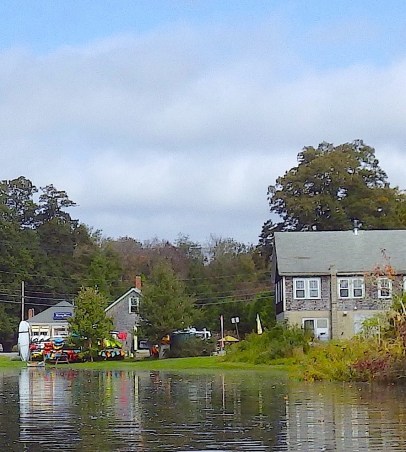
Technically, Osprey Sea Kayak isn’t in Rhode Island. It’s in southern Massachusetts, on the banks of the eastern fork of the Westport River.  But the owners, Carl and Samantha Ladd, live in Rhode Island, and it’s always seemed like a Rhode Island institution to me.

I’d never paddled the Westport before. Whenever I’d headed up to Rhode Island for past trips, the whole point had been to play in ocean surf. In fact, I’d barely noticed that the tiny “creek” behind the kayak shop was actually a river.

But it is, and like Rhode Island itself, it’s an under-appreciated gem. See for yourself: Click on any of the photos below to see the vistas from that day. And you can read about my timely discovery of the boat named “Sea Hare” here.

This slideshow requires JavaScript.

Trip 16: Hudson River, Manhattan to Ossining

By Vladimir Brezina

Winter waves (same time of year, some years later)

Saturday, 8 April 2000

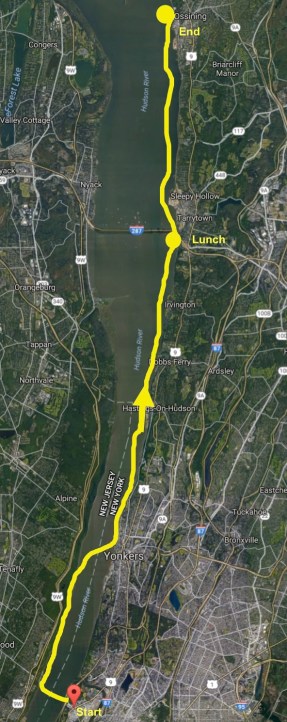
Launched at Dyckman St. just after 8 a.m. Sunny day, with some haze at first. Current still ebbing, so paddled across the river and north along the Palisades. Warm spring weather; later, air temperature in the 60s, even 70s away from the water.

First day not wearing drysuit, although water temperature (in the high 40s, perhaps around 50 in places) still marginal. First butterfly over the river. Some trees on the Palisades already putting out the first light green leaves, others still bare. Completely windless at first (although small craft advisory) but then wind progressively picking up from the south. By Irvington tail wind of about 15 knots, 1-ft following seas; smaller than otherwise with this wind as current now flooding strongly.

Lunch on the little promontory cut off by the railway just south of the Tappan Zee Bridge. Then continued through the Tappan Zee. Wind and waves building. By Ossining wind up to 20 knots with higher gusts (and forecast to get stronger still as the promised front came in) following seas 2-2 ½ feet, covered in whitecaps. Very impressive glittering against the sun.

Good practice; some difficulty keeping boat from broaching. Need much more practice with automatic braces. Around 2 p.m., rode up to the Ossining boat ramp on large, steep following waves. As conditions likely to get worse, train back to New York.

Note: To non-kayakers, this may seem like a matter-of-fact trip report. But hidden in those last few sentences—both by Vlad’s laconic delivery and his choice of nautical terms—is some real excitement. “Some difficulty keeping boat from broaching” translates to “I was about to capsize multiple times”. Vlad was using the sailing definition of broaching, which is, “”to slew around on a wave front…so as to present the ship’s side to oncoming large waves [and]… capsize and enter a “death roll”. Not exactly what you want to have happen when you’re alone on 40-degree water in a gathering storm!

And “need much more practice with automatic braces” says, in effect, “My skill level was not up to keeping the boat upright”. “Bracing” is a way that kayakers hold the paddle to prevent capsize in, among other things, high waves; as the kayaker becomes more skilled, he or she gets better at bracing automatically, to keep the boat upright.

The giveaway here is the word “much”—Vlad clearly felt the conditions were at or beyond his skill level. So, in effect, Vlad is saying here that he ran into what was for him at the time (and likely for most paddlers at any time) conditions beyond what he could paddle. He doesn’t say, but it appears from his last sentence that he’d intended to go farther than Ossining, but pulled out due to conditions (a show of good judgment I’m always happy to see).

Finally, spring is the most dangerous time for paddlers; the combination of cold water and temptingly warm air leads to underdressing, which can be fatal in the event of a capsize. And in the Hudson, there’s often snowmelt, which increases the current (though that didn’t apply here, as the current was flooding, or heading upriver).

I suspect Vlad subsequently realized he had been underdressed for the conditions; in any event, by the time we paddled together, he would not have gone out without a drysuit on a warm day in spring, as made clear in this story. Needless to say, his automatic bracing—and other paddling techniques–had also improved considerably by then!

Gallery

Sea Hare

This gallery contains 1 photos.

Text and photo by Johna Till Johnson Photo edit concept by Dan Kalman Westport River, East Branch, Westport, Massachusetts It was a sunny weekend in early autumn. The trees were just beginning to come ablaze, lit by the late morning … Continue reading