Tag Archives: Kayaking

Trip 8: Hudson River, Peekskill to Yonkers

Text and photos by Vladimir Brezina

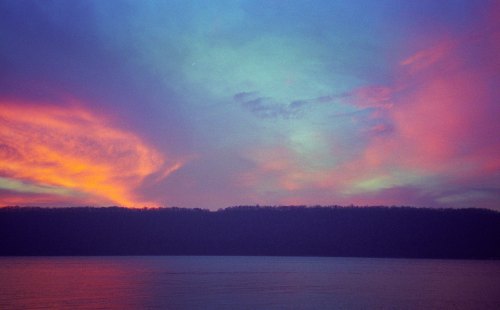
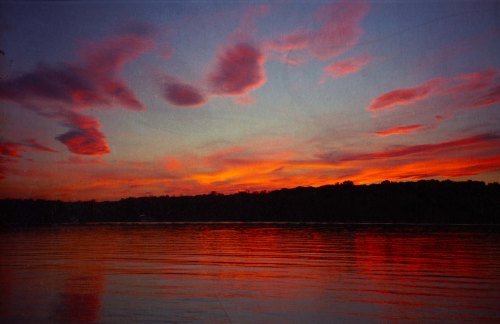
Winter sunset at Yonkers

Sunday, 5 December 1999

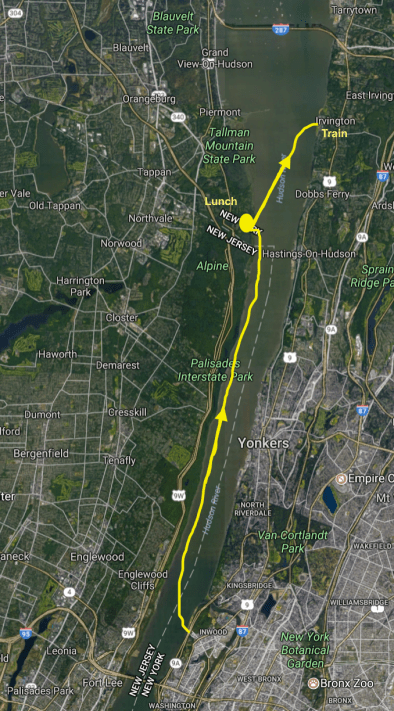
7:43 a.m. Metro-North train to Peekskill. Launched by 9:30 a.m. Hazy and windless morning; water like glass. Relatively warm for December (later in the day, temperature up to 60°F). (Note: The scientist in him, and also the world citizen, would always make a point of including units. Most Americans, and nearly all American nonscientists, would assume Fahrenheit to be understood.)

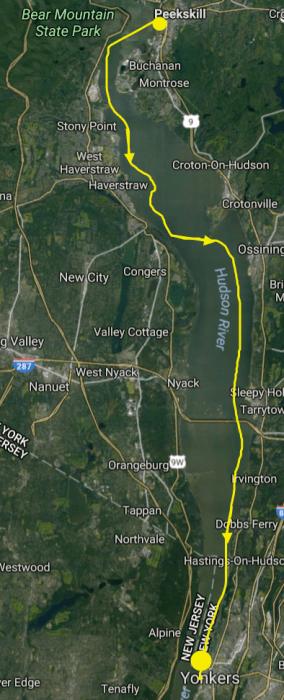
Paddled against flooding current (for first two hours) down to the entrance to Haverstraw Bay, then directly across to Croton Point. No wind at all, water like a mirror, reflecting sun struggling through banks of clouds at first, then becoming a steady diffuse bright glow in a pale blue sky, with outlines of opposite shore and Croton Point in front very hazy. Very few other boats: a few fishing motorboats and the usual tugs and barges; a couple of kayakers around Croton Point.

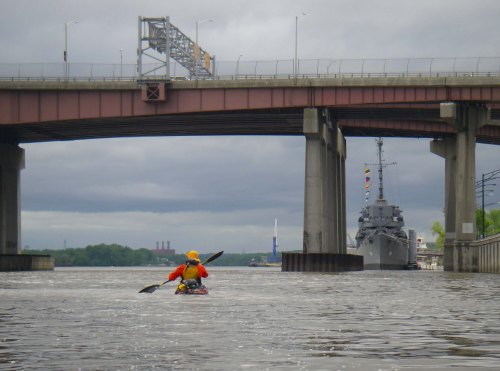
Tappan Zee in the mist

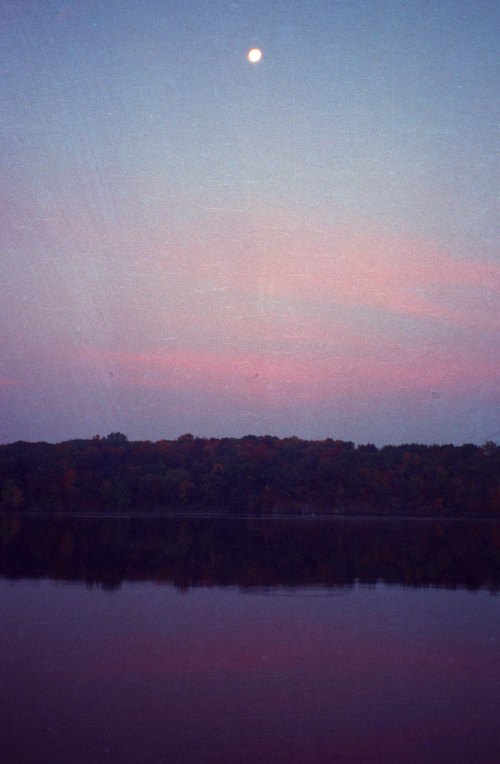
Past Croton Point around noon and south through the Tappan Zee. A mile or so north of the Tappan Zee Bridge wind suddenly picked up to 15-20 knots from the south. (Note: In later years, Vlad used to cite Murphy’s Law for paddlers, “The wind is always against you, no matter which direction you’re traveling.” It seems to be true surprisingly often. Perhaps it should be called “Brezina’s Law”?). Waves soon built up to 2 feet (wind now against ebbing current). Progress considerably slowed by the wind and waves. Stopped at Irvington around 2 p.m. to reassess situation (met another pair of kayakers, somewhat unprepared for the conditions), then down to Dobbs Ferry (another pair of kayakers). Wind gusts up to 20 knots, waves (not even in middle of channel) up to 4 feet. Larger waves much more pleasant, less bouncy, than short 2-foot chop. South to Yonkers; now (4 p.m.) sun setting behind orange and blood red clouds, soon to be dark, so took out. Train back to New York. (Note: This entry is very close to home as Brian, Vlad’s former student, and I paddled from Yonkers to Croton Point and back this past Sunday—under very different conditions. It was warm, sunny, and just enough bounce to be fun. It’s also interesting to note Vlad’s decision to take out. In later years he might well have opted to continue on, as he had no issues with paddling at night, and four-foot waves were less intimidating. That said, he clearly made the right decision for his level of expertise. That sensible quality stayed with him all his life.)

Trip 7: Hudson River, Albany to Hudson

Text by Vladimir Brezina
Photos by Vladimir Brezina and Johna Till Johnson

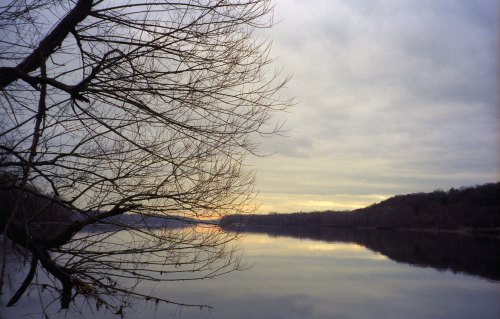
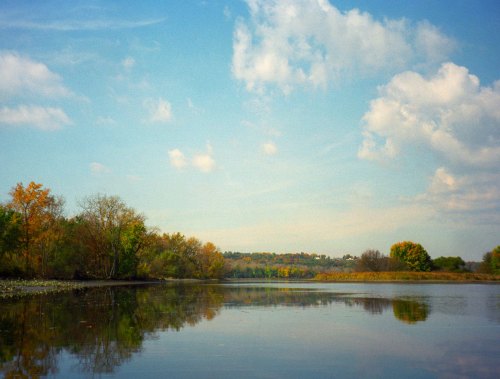
After the leaves have fallen

13-14 November 1999

Saturday, 13 November
6:10 a.m. Amtrak train to Albany. Launched by 9:30 a.m. Ebb current, little or no wind, river calm. Overcast and grey. Almost all leaves are now gone from trees. Very little color left; only here and there a solitary vine on a tree-trunk still orange.

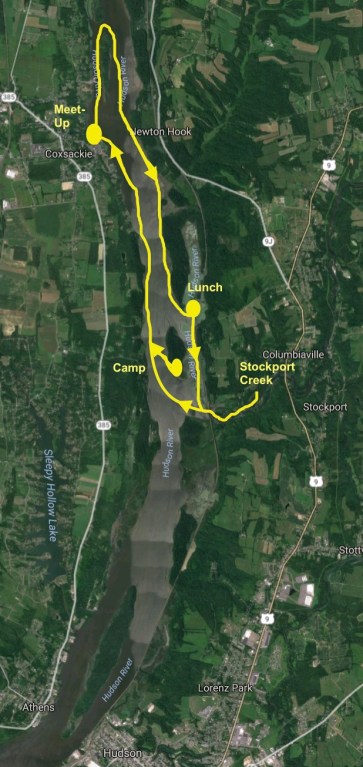
Paddles south past the Port of Albany; herd of white-tailed deer running through the waste ground between the petrochemical tank farms on the eastern bank. Eventually, lunch on the shore of Houghtaling Island. Extreme low tide; muddy along the shore line. Onward past Coxsackie. Current now starting to flood, but a slight north wind helping. Overcast beginning to break to show patches of blue sky between the banks of white and grey; streaks of sunlight on the water.

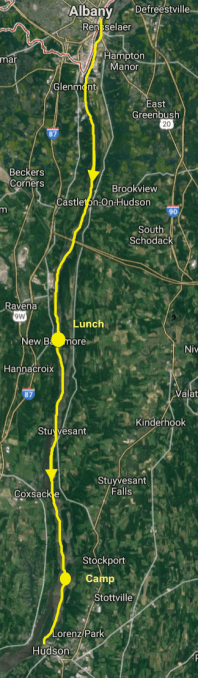
Down to the campground at Stockport Middle Ground, but a hunters’ boat anchored offshore. Back to the deluxe campground at Gays Point. Arrived around 4 p.m. First thing after landing, two hunters in camouflage outfits, with guns, drove out of the brush in a eight-wheeled armored-car-type vehicle to draw a bucket of water from the river. Many ducks and geese flying and honking overhead; occasional shots.

(Note: Another semi-comic reference to hunters–note the “camouflage outfits, with guns” and the “eight-wheeled armored-car-type vehicle”…. all that costuming and heavy equipment just to “draw a bucket of water from the river”.  Vlad’s dry sense of humor at play! As I’ve mentioned before, Vlad had many traits in common with many hunters, including a deep libertarian streak, and of course the love of the outdoors. But in his narratives hunters always seem to come across as slightly goofy. I think it’s the paramilitary costuming and equipment that he finds a bit over-the-top…)

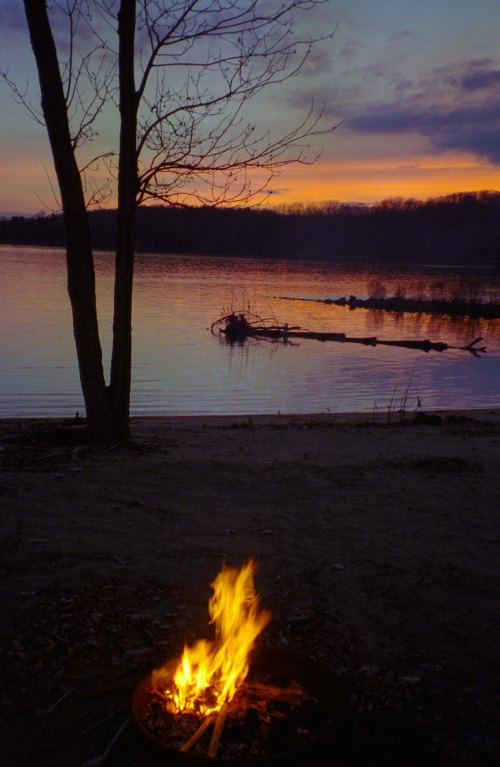
Camped right on the beach, protected from the north wind, rather than on the elevated grassy area. Drifts of dry brown leaves everywhere, and dry twigs and driftwood on the beach. Lit a fire in the ring on the beach before getting into the sleeping bag; provided pleasant warmth against the evening chill, now considerable. Brilliant brief sunset: vivid purple, red, and blue against the banks of grey cloud, reflected off the water, with a crescent moon high in the blue above, and the bright fire below.

A campfire for warmth..

Sunday 14 November

Just after midnight, awakened by gusts of wind from the south. Very soon the wind increased to what seemed like 15-20 knots, with strong gusts. Leaves and even some sand flying past, trees, even though bare of leaves, swaying prominently. Moved tarp and bivy-sack to slightly different spot, where no danger of being crushed by a falling tree. (Especially several right on the edge of the water seemed not very securely rooted in the sand. Shores around here littered with trees fallen in previous storms.) Otherwise very snug and comfortable in the bivy-sack.

(Note: It’s reassuring to me that Vlad encountered the same situation that I’ve often run into: camping under trees that might come crashing down in a high wind. I never remember until it’s too late, and then find myself moving the bivy in the middle of the night, as he did. In future years he will learn to check the weather on the maritime radio, and thus have early warning about  an oncoming front, which this was. I also like the way he hyphenates “bivy-sack”. And his joy in feeling “snug and comfortable” also resonates. Neither of us are in the slightest claustrophobic.)

Morning: wind from the south at 20-25 knots, whitecapped waves up to 3 feet in the main channel. (Current starting to ebb against the wind.) Almost exact reprise of windy day with John and Kathy in this spot a few weeks ago, except that today not sunny. Campground not well protected against a south wind. Was a little cold through breakfast (eaten while moving to keep warm) and getting into the wetsuit, etc., still slightly—but thanks to the quick-drying material, only slightly—wet from yesterday. Will be much more uncomfortable to do this when it is really cold; drysuit a lot better in this respect.

Once in the boat and on the water, however, much warmer and more enjoyable. Left around 9 a.m. Sure progress with the current, but slow against the headwind. Waves fun (but wet). (Note: Hence the genesis of the name of our blog: WindAgainstCurrent). Went through the eastern channel around Stockport Middle Ground (only very brief protection against the wind). Arrived at Hudson around 10:30 a.m. With strong headwind, forecast for strong cold front later in the day, and early winter sunset, further paddling options limited. Decided to take 12:25 p.m. Amtrak train back to New York.

Vlad in Albany: Similar day, different season

Daily Post: Savor

By Johna Till Johnson, photo by Vladimir Brezina

Today’s daily post is Savor. 

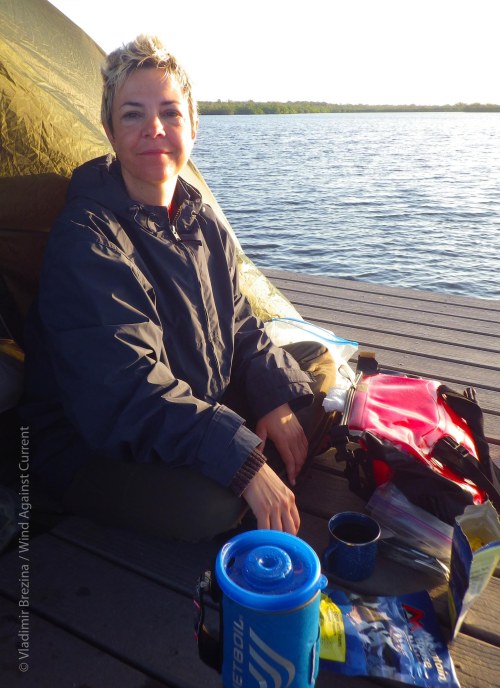
Ready for breakfast

This was the first cup of coffee when we camped on a chickee during the Everglades Challenge Shakedown in 2013. Nothing ever tastes quite as good as that first cup of coffee the morning after a long day paddling!

And we savored everything about that trip—even the parts that were challenging. In retrospect, I have to smile at our naive assumption that we’d find lodging in the Florida Keys on the weekend between Christmas and New Year, aka “the busiest week of the year”.

But we did, even if it was a bit unorthodox.  Moral of the story: Savor the good stuff. And it’s all good stuff.

Trip 6: Hudson Highlands, October 1999

Text and Photos by Vladimir Brezina

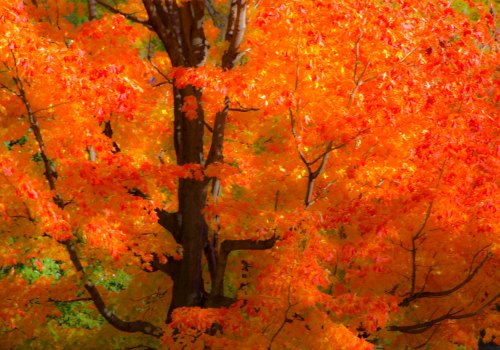
More autumn colors

Sunday, 31 October

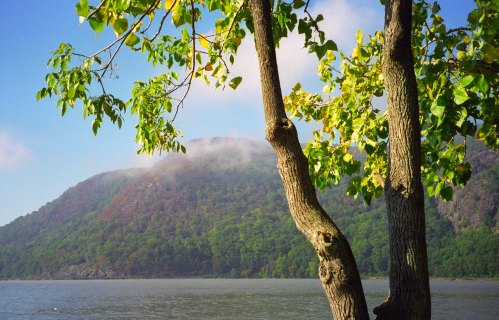
7:43 (?) a.m. Metro-North train to Beacon. Launched around 10 a.m. Sunny, but somewhat hazy all day. Ebb current in favor, but 10-knot head wind. Paddled south past Denning Point, Pollepel Island, Cold Spring, West Point, Arden Point. Foliage spectacular in this section of the river (all different colors, from flame red to bright yellow to various shades of brown), still close to its peak although a few trees here and there already bare. Leaves noticeably dropping in the wind.

Stopped for lunch and exploration at Con Hook, an island (joined to the western shore by a marsh) a mile or so south of Highland Falls. Picturesque miniature island, with varied rocky topography—miniature steep cliffs and hollows—and a great variety of tree species, now of many different colors. Even birches, pines, and wild cherries (?) but mainly oaks and aspens. On the ground, soft moss and red blueberry-type bushes. Great views through the trees across the river, and on the western side, across the marsh.

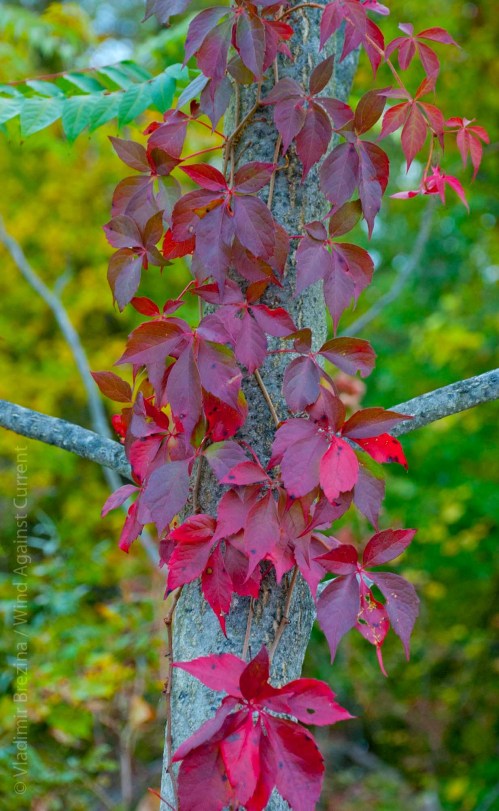
Autumn vine

Current now flooding, so back north along the same route. Spectacular embankments of yellow and orange trees on the mountainside along the eastern shore just north of Little Stony Point. Numerous solo and groups of kayakers on the water; even more so than ever in the summer. Sun setting behind thickening clouds. Back at Beacon around 4:45 PM, with last fading light (today first day back on Standard Time). Train to New York.

Note: Vlad’s scientific mind and emphasis on precision shows in those parenthetical (?)’s, which of course indicate a guess rather than confident knowledge. Those who knew Vlad well remember his often-repeated comment: “Details matter!”—in science, art, writing, and life. His emphasis on getting the details exactly right usually illuminates his writing and brings it to life. But we sometimes argued over his tendency to include too many details, which in my view slows down the narrative. (He usually agreed.) 

It’s also worth noting that this adventure happened the day after the last one—nothing made Vlad happier after a long kayaking trip than another long kayaking trip! Even on our multi-day camping excursions, he would settle into the boat each morning and exclaim, “Feels SO good to be back in the boat!”

Trip 5: Hudson River, Manhattan to Irvington, October 1999

Text and Photo by Vladimir Brezina

Autumn colors

Saturday, 30 October

Met John and Kathy at Dyckman Street. Put boats together and launched at 11:30 a.m. around the predicted beginning of flood current. Warm for late October. Fog still not burned off completely, but sun gradually appearing. At first light wind from the north, then calm.

Palisades very colorful in the thinning fog. Lunch at Alpine. Stopped at Italian Gardens (waterfall and foliage very picturesque) then crossed over to Irvington. Arrived around 4 p.m.; took out at convenient boat ramp in parking lot by the train station. Briefly saw Kathy’s show at the gallery, then Metro-North train back to New York.

(Note: It’s nice to see that Vlad sometimes went on short and sweet paddles, as well as the longer ones he was known for. And Italian Gardens site was a favored destination for us from Pier 40, though we often failed to make it that far–somehow we constantly managed to underestimate the time required!)

Trip 4: Hudson River, Hudson-Coxsackie Area, October 1999

Text and photos by Vladimir Brezina

Dawn at Stockport Middle Ground

Friday, 15 October

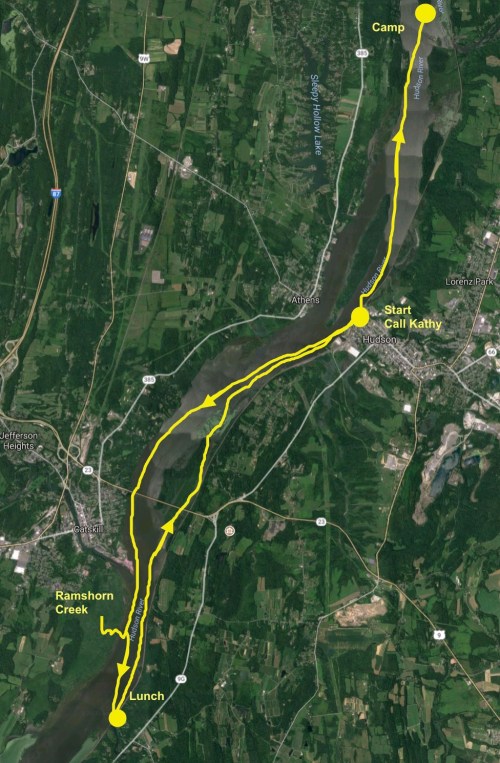
7:10 a.m. Amtrak to Hudson. Emerged from Penn Station tunnels just after sunrise; views across the Hudson with the rising sun reflected orange, against the clear blue sky, from windows on the New Jersey shore. Beautiful views of the river all the way up to Hudson: fall foliage colors spectacular particularly in the Hudson Highlands; in many places mist rising from the river, with the sun breaking through in dappled patches. Worth the $31 fare just for those two hours. Launched at Hudson around 10 a.m.

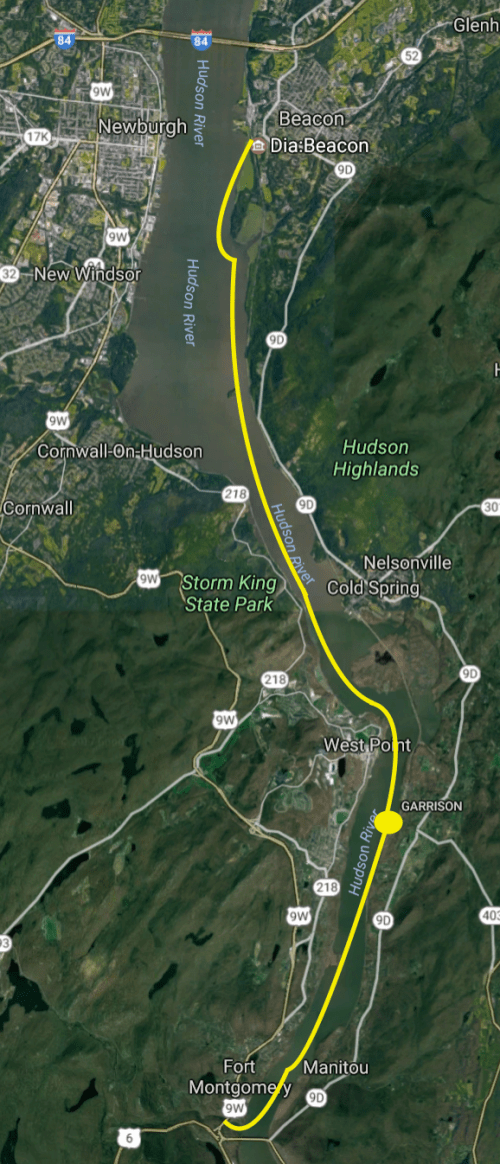
Day 1 Route

Sunny, but distinctly cooler now: crisp fall weather. Water warmer than expected: still possible, mostly, to do without gloves. Southerly wind, ebbing current, quite strong here. Decided to go south along the western shore, photographing the fall colors. Past entrance to Catskill Creek. Large, three-masted replica of an 18th-century (?) sailing ship (couldn’t read name) but with sails furled, motoring, a bit disappointingly, north against the current.

Also a fleet of canoes, probably returning to Catskill from Ramshorn Creek. Paddled slowly up Ramshorn Creek for a while. Very still, winding creek, with muddy banks at low tide; sun behind the screen of leaves, now partially bare. Leaves dropping and floating down on the current.

Then back out into the river and across to the usual lunch place at the mouth of the Roeliff Jansen Kill. South wind now around 20 knots; lots of whitecaps in the main channel. But water around lunch place too shallow just now, so retreated north to Oak Hill Landing for lunch. Fall views of the Catskills.

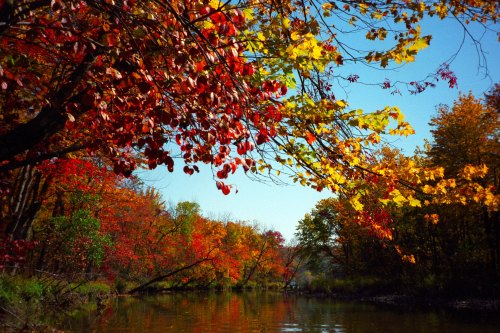
Fall colors

Then north through Hallenbeck Creek back to Hudson. Arrived at the same time as a duck hunter in camouflage outfit, with camouflaged boat, and vigorous complaints against the game laws. (Saw a few other hunters, and many duck blinds everywhere, but almost none occupied. Relieved to hear only very scattered shots.) Phoned Kathy around 4 p.m. Outlook for joining me tomorrow not good.

(Note: It’s very like Vlad to record the hunter’s “vigorous complaints against the game laws”.  He was not a hunter himself, and throughout these logs, hunters emerge as faintly comic characters, in their obsession with camouflage and other para-military gear, which Vlad found amusing. But he also had striking libertarian, if not downright anarchic, tendencies, and would have sympathized with those complaints. )

Current now turned to flood; wind still from the south, though dying down. Evening paddle up to campground at the north tip of Stockport Middle Ground. Halfway up saw, from a distance, a fox (coyote?)-like animal on shore. Arrived at campground just in time to see huge freighter move down the channel to the west against the setting sun.

Night not too cold, probably around 40°F.  New North Face sleeping bag luxuriously comfortable and warm.

Sunset at Stockport

(Note: It’s about time! The last few trips Vlad has been complaining about the inadequacy of his sleeping bag. It’s fun to watch him grow increasingly interested in kayaking and expedition gear; he was always mechanically minded, but generally appreciated gear for its effectiveness and the quality of its design rather than for the status it might convey.

By the time I knew him, he’d arrived at a gear collection that worked for him, and was less enchanted by every new item. He looked tolerantly on as I went through my own trajectory of fascination with gear.

It was very common for me to remark “I wish I had a gadget that would do (whatever)”… and for Vlad to reply, “I have one of those.” He’d rummage in his overstuffed deck bag (how he ever found anything was a mystery to me!) and pull out a rusty, but still serviceable, whatever-it-was.

Several log posts later we’ll get to read about his discovery of the GPS, and the way it can be useful in tracking one’s speed in different conditions.  That, in turn, leads to a deep understanding of the currents and how they vary—which lies at the heart of Vlad’s legendary knowledge of the NY area currents.)

Saturday, 16 October
Sunrise around 7 a.m. A little chilly, but clothes adequate. Took some pictures of the rising sun illuminating the fall colors on the western bank opposite. Left around 9 a.m., reached Coxsackie around 10 a.m. Very happy to see, from afar, John and Kathy putting their boat together. Sneaked up on them out of the rising sun, got out of the boat and came right up to them without being detected.

Coxsackie very nice launch site: the paved boat ramp (though no floating dock visible), grass, plenty of parking, portable toilets, phone.

Day 2 Route

North around Coxsackie Island, then across main channel over to eastern shore, south past Nutten Hook, into marshes on either side of Little Nutten Hook. Few herons wading in the shallows, but generally many fewer birds than a couple of weeks ago. Palisade of trees lining the river almost wintery; foliage past its peak, or it may be that the natural tree species here not very flamboyant, just yellow and grey-brown. (Oranges and reds noticeable mainly around houses, probably planted.)

Main river now ebbing but south wind intensifying to a sustained 20 knots.

Waves building to 2 feet in the main channel; we kept to the side but could not get out of the wind. Kathy complained but sticking it out. Lunch at deluxe campground at Gays Point. Dock now out of the water, but there is a sandy beach, grassy area, pagoda, picnic tables, barbecues, outhouses (open), a building (closed) which may have water in season. But all this open to the south wind, so had lunch in sunny and warm clearing in the wood beyond.

Displaced a sunning snake.

Few grasshoppers and butterflies, but insects, like birds, mostly gone. Returning to the boats, we could see wind now 25 knots, treetops swaying and whistling, waves in main channel lengthening, with prominent and very frequent whitecaps.

Continued south past the beaches at the tip of Gays Point and into the channel to the east of Stockport Middle Ground. Somewhat sheltered for a while, then back out into the headwind for the last stretch across the flats to the entrance to Stockport Creek. Here very shallow; ran aground before found proper channel. Four other kayakers, disappearing into the creek. Creek sheltered, but shallow, and with strong current flowing out of it.

Finally, back the same way past Stockport Middle Ground, across the main channel and along the western shore back to Coxsackie. Current now turning to flood; wind dying down somewhat but still strong. Not as rough as it would have been before; waves no more than 2 feet. Moving very fast with the tail wind and current, surfing on the waves. Back at Coxsackie around 4:30 p.m. Car to New York.

Stockport Creek

Trip 2: Hudson Highlands, September 1999

Ardent Point looking south

Text and photos by Vladimir Brezina

Saturday, 25 September 1999

Metro-North train to Beacon. Launched around 2:15 p.m. Sunny, temperature in the 70s. Ebb just starting (spring-tide currents this weekend), light north wind in favor. Water still warm-ish especially in certain places, but clearly cooling. Some floating debris still left from Hurricane Floyd ten days ago, but water generally back to its normal degree of green-gray murkiness; coffee color gone.

Out and back from Beacon, camping at Arden Point

Paddled south along the eastern shore, past Denning Point and Bannerman’s Island, then crossed over to western shore. Ebb current now seemingly 2-3 knots, tail wind intensifying to 15 knots. Moderate following sea.

Paddled into lagoon behind railway under Storm King Mt. Then south past Cold Spring, crossed back east into Foundry Cove and Constitution Marsh. Miniature rapids under the railway on stream ebbing out of the marsh. (The same elsewhere: the strongest currents on the whole river may be those sweeping in and out of these marshes and lagoons with every flood and ebb.) Finally south past West Point and Garrison to Arden Point campground.

The view from Arden Point

Everywhere trees mostly still green, but some kinds already yellowing, noticeably more than last weekend. beautiful contrasts of yellow and occasionally orange or red foliage picked out by the sunshine from the green, against the blue sky. Took pictures. Many orange and black monarch butterflies fluttering over the water on their migration south.

Arrived at Arden Point about 6 p. m, just as sun disappeared behind hills on western side of river. The campsite (south end of Arden Point) has every natural amenity (no man-made ones). Stony beaches either side of a group of rocks elevated over the river with views both south to Bear Mt. Bridge and north to West Point; flat areas, some with moss, on several levels under tall trees just behind. West-facing: great location to view sunset and moon over the river, though cold in the morning as sun does not reach the campsite until some time after sunrise.

At midnight woken by full moon shining brightly right in my face. Somewhat cold in old sleeping bag toward the morning: now definitely need warmer sleeping bag, and warm, dry camp clothes and shoes. A little stove to make coffee or chocolate on a cold morning?

(Johna: By the time I knew him, Vlad never camped anywhere without his trusty stove. We had a mixed relationship: I swore by the Jetboil, and he tolerated it, but secretly held the stove in reserve should the Jetboil fail. However, he really did enjoy coffee in the morning and hot chocolate at night, which I was happy to make. So it makes me smile to see his musings about the “little stove to make coffee… on a cold morning?” )

Eagle alights!

Sunday, 26 September
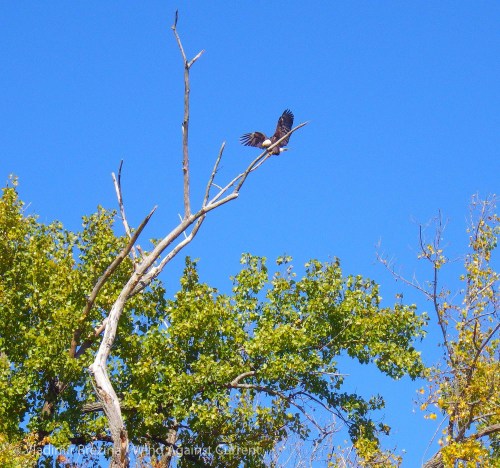
Left around 8:15 a.m. Sunny at first, then broken overcast. Paddled south with the waning ebb, and moderate tail wind, almost to Bear Mt. Bridge. Went into Popolopen Creek (steep wooded sides above still water, very picturesque) , then into the marsh just north of Iona Island. Many hawks (?) circling overhead everywhere (Johna: Could also have been eagles; the photo here was taken not too far away, over ten years later. ) especially along edge of woods; later saw one capture a pigeon-sized bird in flight, with much squawking. Current now starting to flood. Becoming sunny once more. North back to Arden Point (lunch around 12 noon) then through World’s End. Just before, heard two deep hoots, and an enormous red-yellow ship, followed by a tug, emerged very slowly to turn downriver past West Point. North past Cold Spring, then hugging shore all the way back to Beacon. Now wind from the south, moderate following seas. Shore-line woods very colorful; took many pictures. Many kayakers and canoeists, mostly solo or in pairs, on the water. Beacon around 3:30 p.m.

Trip 1: Hudson River, Rhinecliff to Ossining, September 1999

Text and Photos by Vladimir Brezina

Early morning colors on the river

Note: After Vlad died, I was astonished to discover that he’d meticulously maintained logs of nearly 300 kayak excursions he made, alone and with others, from 1999 to 2011. He only stopped when this blog became the official chronicle of our journeys.

Although they are true nautical logs, with observations on the weather, conditions, and mileage, they are also written in his characteristic style, with whimsical musings and droll asides sprinkled throughout, so they make for surprisingly lively reading.

Best of all, he also worked in the last months of his life to preserve his vast collection of photographs, so I’m able to pair the logs with photographic illustrations of the same areas. They are not necessarily from the same trips (though some almost certainly are). Wherever possible, I’ve attempted to match for season and conditions.

I plan to publish one each Thursday for the next year or so (not all logs are long enough to make into standalone blog posts). I’ve edited the logs minimally; you’re reading almost exactly what Vlad wrote.  —Johna Till Johnson

18-19 September, Rhinecliff to Ossining
Saturday, 18 September

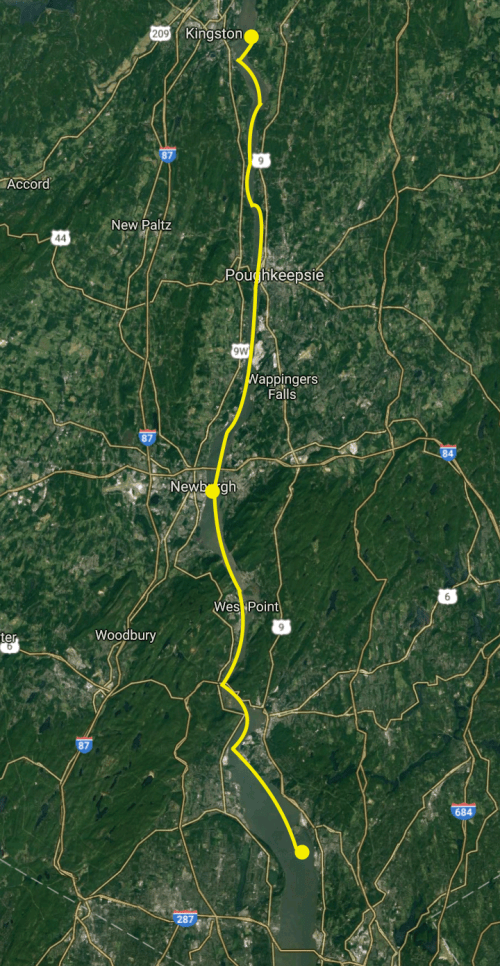
(Editor’s note: Vlad traveled south from Rhinecliff, which is the starting point roughly in Kingston. The Denning Point campsite is marked, as is his destination at Ossining, a bit north of Rt 287 on the map.)

7:10 Amtrak train to Rhinecliff. The train was delayed by the possibility of water and downed trees on the tracks—Hurricane Floyd hit the area on Thursday night—and I was able to launch only around 11 a.m. Sunny, temperature in the 70s, light north wind, calm water. Water very muddy, with swirls of mud, like light unstirred coffee. Visibility only a few inches. Other signs of hurricane: in some places accumulated masses of floating debris, mainly old driftwood and dead branches presumably swept off beaches. Later I saw some downed trees and numerous beached boats.

Just north of Middle Hudson River (Esopus) Lighthouse, I saw a seal. (Although this far up the river the water is completely fresh.) First it was following in the wake of a sailboat motoring in the other direction, then a few minutes later I saw that it had turned and was following me.

I stopped paddling and watched. The seal kept diving and surfacing, poking its head out of the water. Once it arched its back out of the water like a dolphin. It kept to a distance of about 10 yards. I started slowly paddling twards its position while it was submerged to get closer for a picture. I got slightly closer, but then the seal (apparently unable to see underwater because of the mud) surfaced by chance about two feet off the port side. It must have panicked and gone into an emergency dive; all I saw was an enormous splash, like a huge fish jumping, and was soaked with spray. (Another argument for a waterproof camera.) After that the seal did not surface for a while, and then kept to about 30 yards.

Camp at Denning Point

Good ebb current (1-2 knots?) plus tail wind (10 knots?) in favor. Keeping in the middle of the river, I reached Pougheepsie about 2 p.m. Then the current slacked off. I was hoping that with the runoff water the ebb would be prolonged and the flood abbreviated. This was probably the case to some extent, but nevertheless soon when I stopped I found myself unmistakably drifting backward, despite the tail wind. So I continued along the shore.

I reached Beacon about 6:30 PM, then continued to the camp at the southern tip of Denning Island, arriving around 7 p. m., just before sunset. I briefly explored the trails inland, but could not find the grassy area near ruins described in the HRWA guide. So I camped on a level sandy spot, under trees and behind big driftwood logs, just on the point, with good visibility both west across the river and south to Bannerman’s Island. It got dark, lights came up across the river and a quarter moon: bright moonlight, sharp moon shadows, I could almost read.

Outdoor Research bivy sack with Thermarest inflatable pad, on flat, level ground, very comfortable. Good ventilation, quick and easy to set up. (Editor’s note: I have what I believe is that original OR bivy sack, though I’ve upgraded to a newer model for my own use. I very much agree with Vlad’s assessment!)  Old sleeping bag still adequate this time, but probably too light for any significantly colder temperatures. Also too small—need to get larger, mummy-style bag with hood. Need tarp that I can spread out, too, otherwise sand gets into everything.

Morning fog

Sunday, 19 September

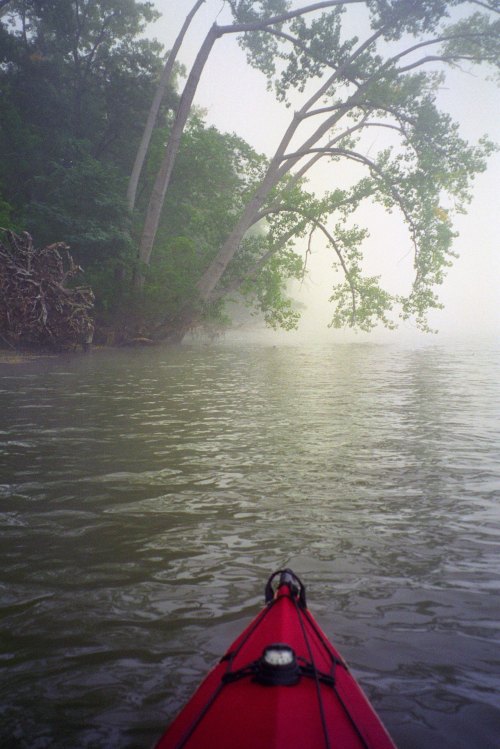
Morning somewhat brisk—fall is definitely coming. Mist rising from the river, drifting over with the north wind, but now and again glimpse some blue sky. Took a number of pictures of trees in the mist around the campsite. Left about 8 a. am. Across the Fishkill Creek estuary south from Denning Point, paddled completely surrounded in fog. Took pictures while paddling along the opposite shore: trees emerging from the fog. Bannerman’s Castle.

Cold Spring

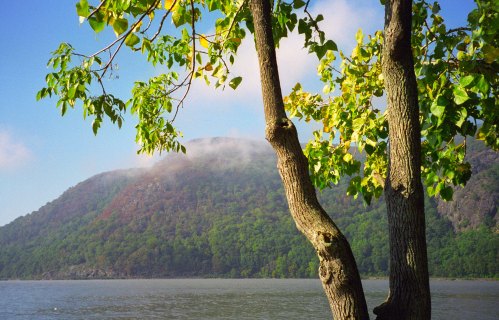
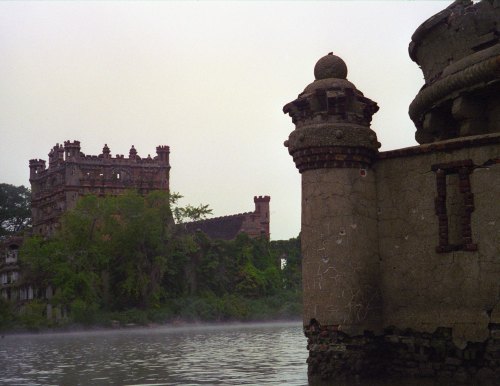
South toward Cold Spring, the fog began to lift. Mist and clouds, but now also sunshine and increasing patches of blue sky, dramatic views of the Highlands. Trees still for the most part green, although here and there one already turning. With Bannerman’s Castle, could almost have been Scotland. (Editor’s note: As some readers are aware, Vlad spent several years as an adolescent in Scotland.)

Bannerman’s Castle

Gusts of stronger north wind (15 knots?), some following seas building as always here. Past Cold Spring, West Point with increasing current in favor. Peekskill at about 11 a. m. White beaches of Verplanck (lunch in someone’s homemade hammock overlooking the beach). Across Haverstraw Bay. Lots of motorboats and sailboats criss-crossing the bay.

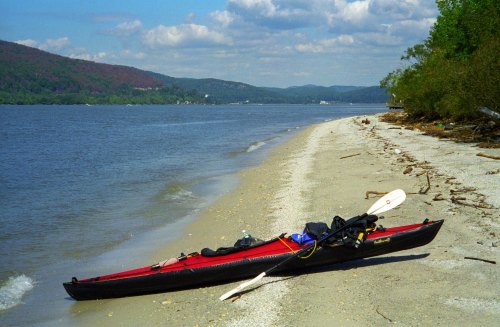
White beaches of Verplanck

(Editor’s note: The other photos may or may not have been from this exact trip; at least one is not, because it’s a later boat model. However, this photo is almost certainly from this trip; it’s Vlad’s first boat and paddle, and its album caption is “White beaches of Verplanck”—a phrase that appears to be unique to him, and that he seemed to have coined on this trip. )

Now good sailing breeze: onshore breeze building from the south, waves negligible at first but by Croton Point 1-1.5 feet. Ebb current fading too. Making relatively slow progress into the wind. Significant area of higher breaking waves (2 feet) south of Teller’s Point. Boat filling up on water. Effects on handling quite noticeable: boat wallows with and through the waves rather than bouncing over them as usual. Made for the south shore of Croton Point to bail out the water, then across Croton Bay to Ossining. Arrived about 4 p.m. 5:30 train to New York City.

Must seam-seal and Scotchguard deck, shorten paddle-leash and eliminate Velcro paddle attachment.

Whole trip about 50 nm, paddling time about 16 hours.

Freepaddling in the Ten Thousand Islands: Part Three

By Johna Till Johnson
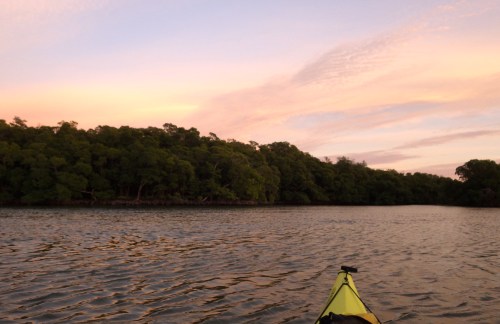
Faka Union Canal Sunset

Sunset on Faka Union Canal

I awoke to the sound of…not very much at all. A few birds piping, and the rustle of air high up in the leaves.

The front had passed through, but other than the droplets remaining after a late-night shower and a smattering of branches caught in the mosquito netting above, there was little to show for it. The sun was up in a cloudless sky. There was a gentle breeze, and a few whitecaps out in the Gulf.

Nonetheless, it would probably be wisest for me to stay on the “inside” today. If the wind picked up (as predicted), I’d be better off sheltered. Besides, I wanted to explore the marina at the end of the Faka Union Canal.  I’d plotted out the trip the day before.   I’d be traveling with the current if I left before noon and returned by sunset.

I decided to leave the campsite set up, and make this a day trip. I launched late morning, arriving at the marina in early afternoon. After dragging the kayak up the boat ramp and depositing it on a patch of grass,  I explored. There was a small convenience store that sold ice cream and other goodies. There was also a restaurant, which tempted my empty stomach, but it seemed too highbrow for a damp paddler with salt-encrusted clothing. And there was a large hotel-apartment complex overlooking the water.

I returned to the convenience store, had some ice cream, then decided to take a selfie to share with my best friend and business partner. For most of the trip I’d been out of cell phone range, and I knew she was worried about me. This would be a good way to let her know I was fine.

I posed with the boat ramp behind me, and smiled that awkward rictus selfie grin.

“Did you get it?” asked a bystander.

Gator selfie Edited

Gator? What gator? 

I shot him a puzzled look. What’s to “get” in a selfie?

“I mean the gator! There’s a twelve-foot gator on the boat ramp behind you! I thought that’s why you were taking a picture!”

I spun around and saw… nothing. The boat ramp was empty.

I’d almost convinced myself he was making it up when a group of teenage boys came over, chattering excitedly. Yes, there had been a gator. Yes, it had disappeared into the water just seconds ago…

Well, dang! My first encounter with a gator on the trip thus far, and I’d missed it! And I was about to get into the water where it likely lurked.

I forwarded the selfie to my friend,  packed up the phone, and launched.

The paddle back was long and leisurely, as the sun made its way down the western arc of sky. I was still about 45 minutes from home when it set, but I wasn’t worried—I had headlamps, and the campsite was already set up. I paddled through the deepening scarlet and purple skies, and landed just as the first stars were peeking out.

It was while preparing dinner that I first heard the unearthly sound: a bone-chilling screech from the other end of the island, trailing off into angry jabbering. What was it? Not a panther—everyone described a panther’s cry as sounding “like a woman’s scream”. This was harsher, and angrier.

I turned the headlamps on bright and scanned the wall of vegetation at the end of the island. At first, nothing.

Then I saw it: Eyes.

Twin green glittery reflections, low to the ground. An angry screech followed.

Great. Whatever it was now knew exactly where I was.

I banged a couple of pots together and shouted into the darkness: “Go away and leave me alone!”

The screeching ceased—for a few minutes. Then it started up again. I scanned the forest with my headlamp. Was that another set of eyes? Two of them?

My mind raced with the possibilities. What could it be? I kept coming back to one theory: a rabid raccoon. Yesterday, Carolyn had mentioned she’d seen a “sick” raccoon. Would it come over to the campsite in the middle of the night and attack?

But what about the second set of eyes? And the snarling sounded distinctly angry, not sick.  I finally decided it must be two raccoons arguing over food, perhaps a fish. In which case, they were unlikely to bother me.

If I were wrong, it could be unpleasant. But since there wasn’t anything else to do,  I decided to assume I was right. I finished preparing dinner, ate, cleaned up, and went to bed. At some point the snarling ceased, and I drifted off to sleep.

The next morning dawned bright and clear. Thankfully, no crazed raccoons had attacked me in the night (though several lines of fresh tracks passed remarkably close to the boat).

I packed up briskly,  because today’s plan called for a long-ish paddle: I had decided to venture into the Everglades. That meant checking in with the ranger station at Everglades City, and continuing on to the nearest available campground. In the Everglades, permits are required, and the rangers limit the permits by campsite to avoid overcrowding. This was “high season”, so my choices were likely limited.

It was a near-perfect paddle: Warm (but not too warm) sun, light chop, and the never-ending panorama of keys to my left. When I reached Indian Key I decided to circumnavigate it and find the campsite Vlad and I had missed in the night during the Everglades Challenge.

To my delight, the sandbar at the inside end of the key held a stunning flock of white pelicans, which I was able to capture on camera.
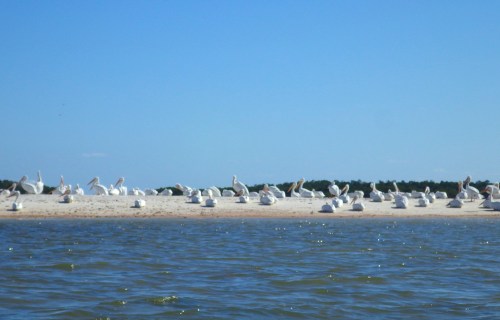
Indian Key White Pelicans

White pelicans on Indian Key

Continuing on down Indian Key pass to the ranger station, I pleased myself by managing to recall its exact location.  I landed, stripped off my spray skirt, and tromped proudly inside.  My salt-encrusted jacket and squelchy paddle shoes garnered nary a glance from the uninterested tourists. And the rangers were pleasantly accommodating of  the damp footprints.

Their news wasn’t so welcome, however: Apparently the only available campsite was the Lopez River campsite, about five miles away. That wasn’t so bad—the current was with me, and if all went well, I’d arrive by sunset. And I was briefly excited at the thought of camping on a riverbank, rather than a beach.

But then I remembered Lopez River: Vlad and I had attempted to have a picnic lunch there on one of our shakedown cruises, and we’d been driven away by the sulfurous mud and clouds of mosquitos (even at midday). My memories of it were unpleasant enough, and in the evening, it would surely be worse.

Oh well. It was the only option, so I’d take it. As I set off towards Lopez River, I decided I’d plan to spend the least amount of time there I could. I’d sleep in my paddling gear, and launch early in the morning with the current.

True to prediction, I arrived at the campsite just as the sun was setting. There was already a large group at one end of the campsite, with eight or ten kayaks covering the beach, making it impossible to land.
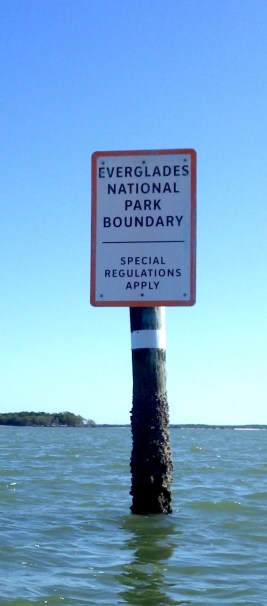
Everglades Park Sign

Special regulations apply…

The only option was the other end, which was occupied by two picnic tables and a lone kayaker, a lean man with long graying hair and an appearance that made me think he was native American. By the looks of his gear, he was also a seasoned camper.

“You have a neighbor!” I announced.

Unsurprisingly, he didn’t seem too happy: “There’s no room,” he replied. I explained that the rangers had sent me here, and assured him I’d respect his privacy and do my best to stay out of the way.

As he watched the sunset, I pulled the boat up and decided to pitch my bivy sack in the only available spot, a muddy patch of land between the two picnic tables. His gear was spread out on one, so I used the other.

We chatted briefly as I prepared and ate dinner. He was an artist from the West Coast, at the tail end of a 10-day trip (so my guess about being a seasoned camper was correct).

He seemed nice enough. And he was happy to listen to the weather report on my radio, which called for a mild enough night that I decided to eschew a sleeping bag. Maybe this campsite wouldn’t be so bad after all!

Wrong on all fronts, as I found out over the next few hours.

At first, things were fine.  Yes, the site was buggy, but I’d expected that. The head net kept the skeeters away from my face, and the jacket and waterproof pants protected me to the ankles and wrists.

And yes, the ground was hard and muddy, with just enough mangrove fingers poking up to make it impossible to find a comfortable position. And yes, there was the sulfurous smell I’d remembered.

Mud, bugs, bad smell: It wasn’t perfect, but nothing worse than expected—and I reminded myself again that I’d be launching early, ideally before dawn.

How bad could one night be? I was about to find out.

The first inkling came about 45 minutes after we’d retired to our respective tents. I was just drifting off to sleep when there was a loud, resonant rumble from his tent, so long and loud that it took me a few seconds to figure out what it was.

My neighbor had farted, the loudest, longest fart I’d ever heard.

It took a few seconds for me to realize that with a sound like that, there would also be…

…the smell reached me a moment later, the stench overwhelming the sulfurous mud. Whatever my neighbor had had for dinner obviously disagreed with him. And was now disagreeing with me. A few minutes later, there was another one, long enough that I could count the beats like a freight train.

I turned away and sunk my head as deeply as I could into the collar of my jacket, trying to avoid the fumes.

It was obviously going to be a long night.

But it was only getting started. After my neighbor’s stomach rumblings had subsided, a loud, unearthly moan issued from his tent, startling me. Apparently he was having a nightmare. Over the next few minutes, he thrashed and moaned, sometimes muttering unintelligibly.

I was wide awake, nerves tingling from the adrenaline rush.

After a while, the silences between the moans grew longer, and I relaxed. Maybe the show was over, and I could get some sleep.

I was just drifting off again when he shouted, in a voice full of menace, “You want more? I’ll give you more!”

Now I was actually afraid. There was no possible scenario in which those words, uttered in that tone of voice, could be benign. But he was clearly asleep, I reminded myself. People aren’t responsible for what they dream.

No matter, I wasn’t falling asleep for a long while. Because after the noises subsided, the cold began. Contrary to the predictions, the night got colder… and colder.. and colder. I could tuck my legs up inside my jacket and be warm enough, but after 20 minutes of sleep I was stiff and aching, and had to change position. I could always go get my sleeping bag from the boat, but it would take a while and subject me to the clouds of mosquitos that still whined incessantly outside, despite the chill. Plus, repacking the sleeping bag would delay the morning departure—which I was now awaiting with a mounting crescendo of desperation.

The night stretched on, and on.  Every few minutes I checked my watch to see if it was close enough to morning, and the current’s change, to launch. Then I’d doze for a few more minutes, the mangroves poking into me, my limbs stiff and cramped.. and wake again, to repeat the cycle.

The current was supposed to change around 5 AM. Perversely, when that hour rolled around, I couldn’t bring myself to face the cold outside. As uncomfortable as it was inside the bivy sack, it would be worse outside.

It wasn’t until after six that I hit on the one strategy that forced me out : I let the air out of the air mattress. As my body touched the hard, muddy ground, I suddenly decided the cold outside was preferable to remaining in the bivy sack.

Thankfully, it took very little time to pack and launch. I was on my way in the pre-dawn twilight, never so happy to be back on the water as I was then, despite the exhaustion pounding inside my skull.

Before me, the river was calm as glass. Behind me, the horizon slowly brightened. As I paddled, I thought about the ghastly night I’d just endured.

And then I looked over my shoulder… to the most beautiful sunrise I’d seen in a long time, maybe ever.

It wasn’t until then that I realized what day it was: January 1, 2017.

If the difference between the last night of the old year and the new dawn of this one was any indication of the future, my life was about to take a marked turn for the better.

I paddled onward, my spirits lightening as the sun rose.  I’d survived hidden alligators, crazed raccoons, and Deranged Fart Man…but today was a new day—and the dawn of a whole new year.
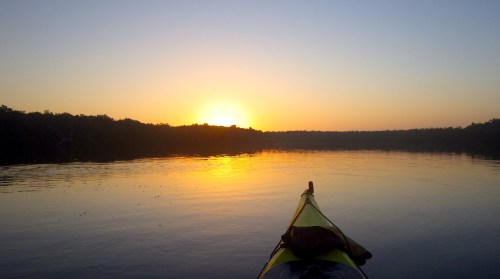
Lopez River Jan 1 Sunrise

Sunrise on Lopez River: Jan 1, 2017


Freepaddling in the Ten Thousand Island: Part Two

By Johna Till Johnson

panther-key-everything-tree

The “Everything Tree” on Panther Key

In the bright light of full morning, I sat down to make coffee and breakfast… and had a rude shock. The Jetboil, which had worked perfectly well last night (and in pre-trip tests), now would no longer start.

This wasn’t catastrophic, but it was somewhat serious. You can start a Jetboil with a match.. but I’d brought just a handful of stormproof matches with me.  And I only had freezedried food, which required hot water to cook.  So I’d either have to cut short my trip, or curtail my eating—neither of which seemed ideal.

Normally I’d have been panicky. Well, actually, normally we would have fallen back on Vlad’s rickety stove, which he always packed even after we converted to the Jetboil. But there was no longer a “we”, and Vlad’s stove was somewhere back in New York. So that wasn’t an option.

days-2-to-6

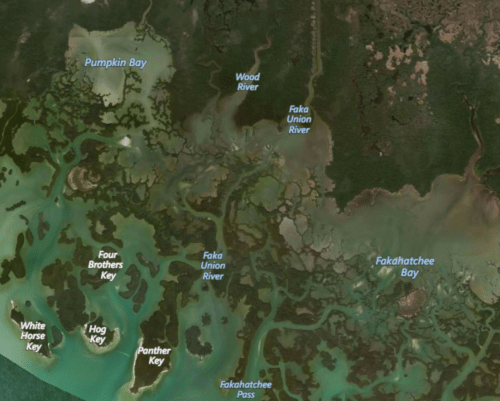
From Pumpkin Bay to Fakahatchee and back

Instead of panicking, I took a close look at the mechanism. It basically works by placing a voltage across the gap between two pieces of wire. Current arcs across, and generates a spark. Close inspection revealed that one of the pieces of wire was encrusted with something, which would preclude any sparking.  I carefully filed it off with my knife, and tested.

It worked!

I sat back on my heels and smiled with satisfaction.  Perhaps it was my imagination, I but I could feel Vlad smiling, too.  I would have morning coffee—and a hot breakfast!

And then…what?

As the water for the coffee boiled, I savored a totally unfamiliar sensation: Complete freedom, with no deadlines or constraints.  I could paddle wherever took my fancy, go for as great or small a distance as I chose.

I could… freepaddle.

pumpkin-bay-edited

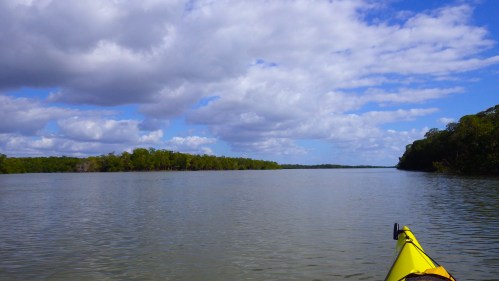
Paddling on the “inside”: Calm, clear, quiet

Russell had mentioned an Indian shell mound up by Pumpkin Bay, and said you could camp there. After inspecting the charts, I decided that would make a nice excursion for today. If I could find the shell mound (and it was indeed camp-able), I’d spend the night there. En route, I’d check out the other keys to see if they held attractive campsites, in case the shell mound didn’t work out.

I had a plan! And options.

I finished breakfast, packed up, and launched.

Paddling “inside” the Ten Thousand Islands is very different from paddling in the Gulf. The water is quieter, and it can feel almost dreamy at times, as you glide along under the mangroves.  Today was warm and calm, and I arrived at the Indian shell mound earlier than anticipated, in the early afternoon.

More accurately, I overshot the shell mound, going far enough up the Pumpkin River to get tangled in overhead branches before turning around, and ultimately sighting the (very narrow) landing spot. After securely tethering the boat to a mangrove, I scrambled up a short rise and into…

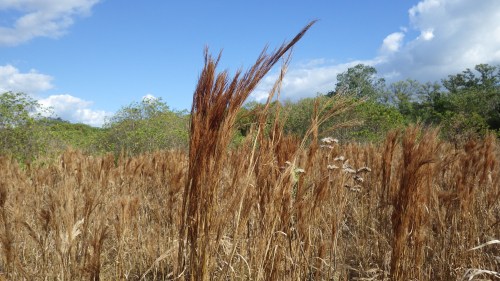
…a field of golden reeds, drying in the sun.

It was eerily quiet.

indian-mound-sea-grass

Reeds at the Pumpkin Bay Indian mound

Not that it’s exactly noisy out among the mangroves, aside from the occasional boat motor or croaking sea bird—but this was a special kind of quietness, charged with a low-key, but very real energy.  It was beautiful, and sad, and…not precisely hostile, but not welcoming.

I wandered around taking pictures, trying to decide if I wanted to camp there, and thinking  about the Calusa Indians who had inhabited the area until the mid-1700s. They were by all accounts quite fierce.  I suspected they would not have appreciated my presence overnight.

It was almost as if they were saying to me, “Thank you for appreciating our space, now go home.” Moreover, Russell had told me about hearing a Florida panther scream one night when he had camped there. I was prepared to deal with sharks and gators… but panthers?

Beautiful  as the place was, I wanted to return to the outer islands.  I decided to return to White Horse Key.

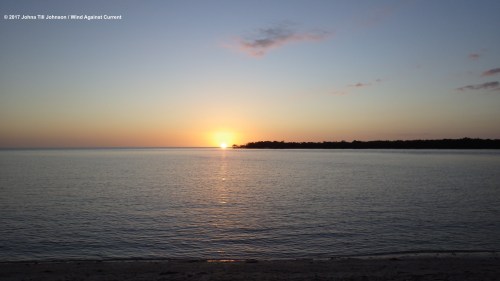
I had no trouble finding my way out of Pumpkin Bay  and arrived at White Horse Key by late afternoon, with plenty of time to make camp, cook dinner, and watch the sun set over my former campsite.

sunset-over-gullivan

Sunset over Gullivan Key

I fell asleep watching Venus glimmering brightly beside the tiny sliver of the waning moon.

The morning dawned clear and beautiful—and noisy! There was the splash of pelicans striking the water as they fished, oblivious to the presence of the kayaker on the beach. That was complemented by the hoarse sound of dolphins breathing, as they arced above the nearly still water.

Once again there was the question of where to go next. This time, there was a complicating factor: a front was predicted to roll down from the north in two or three days, bringing with it rain, and more critically, wind. I’d need to find someplace where I could shelter—not right away, but soon.

I sipped my third cup of coffee and scrutinized the charts. Today’s trip would involve scoping out the only official “inland” campsite, at Fakahatchee Bay. If it turned out to be a good site, I’d shelter there for a couple of nights. If not, I’d continue on.

Satisfied with my vague plans, I prepared to launch.

A small motor boat had landed on the beach, disgorging a handful of people, clearly day-trippers in short and T shirts. One of them approached me.  He asked how far I was headed, and when I told him I had no idea, he was apparently stunned.

I smiled. Then I pushed my boat out into the waves.

There was a light breeze and satisfying chop. The keys drifted by to the left, first the length of White Horse, then Hog Key, and finally Panther Key.

pumpkin-bay-2-edited

Cloud, sky, mangroves…

As I paddled by Panther Key, I felt a pang of disappointment. It looked like a lovely place to camp, with a series of long, low, beaches facing the Gulf. But it was already quite evidently inhabited: tents (some quite large) were up in most of the campsites, and someone had hung a set of Spongebob Squarepants towels out to dry. Camping there didn’t seem to be an option for later that night, not if I wanted solitude.

There were a few empty spaces, though… and anyone who packed Spongebob Squarepants couldn’t be all bad! Maybe having neighbors wouldn’t be a bad thing.

The day passed lazily.  I located the inland campsite with no trouble, but it was clearly an “emergency only” site, at least for kayakers. Instead of a wide swath of beach, there was a short, steep cliff (too high to bring a kayak up, so the boat would have to be tethered on the water, and gear unloaded). And it was covered with vegetation, with no breeze and the persistent hum of mosquitos, even at midday.

Paddling back towards the Gulf, I once again passed Panther Key, with its strip of inhabited campsites.

There was a small fishing boat out front. I swerved out to sea to avoid its fishing lines. “I’ll try to stay clear,” I shouted to the captain, a wild-haired man of indeterminate age. “Oh I’d love to land a kayak,” he replied jovially. “I could mount it on my wall.”

Chuckling to myself I continued along my way, pulling closer to the shore to inspect the campsites. A little further on I encountered a couple of guys, one heavily sunburned and wearing what appeared to be billowing blue Bermuda shorts. He introduced himself as Mark, and we chatted. It turned out the campsites were part of a group of extended family and friends. The group spent a week here every year, relaxing and fishing. “Come join us for dinner!” Mark said. “We’ve caught lots of fish, more than we can eat!” With that, they ambled off down the beach.

I had to admit, the invitation sounded tempting, especially after nearly three days of freeze-dried food. I pulled the boat up on land and started looking for a suitable campsite.

A few minutes later, two women came by and introduced themselves as Carolyn and Eileen. They, too, invited me to stay for dinner—and suddenly, I was decided. I would-why not?

panther-key-first-campsite

The kayak has landed! First campsite on Panther Key

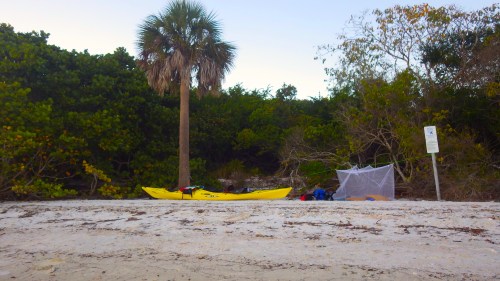
I dragged the boat further up on land and tethered it to a palm tree. There was a nice snug campsite next to the tree, comfortably large enough for a bivy sack. And a nearby sign would provide just the support I needed to string up the mosquito netting I’d brought with me.

As I unpacked, I listened to the marine radio to monitor the progress of the storm front. The prediction had become considerably more dramatic: from 15 knot winds with 20 knot gusts (which I regularly paddled in), it had leapt to 25-knot winds with 30-knot gusts, which I (and most paddlers) didn’t want to get caught in.

Worse, the front was supposed to hit earlier than expected, by tomorrow night—which meant I needed to be holed up someplace safe by then.

One option was to stay where I was. It was actually ideally situated: facing south (the winds were predicted from the north) with a forest behind me. I mentally stored that idea, then finished setting up camp.

panther-key-friends-and-campfire

Panther Key friends

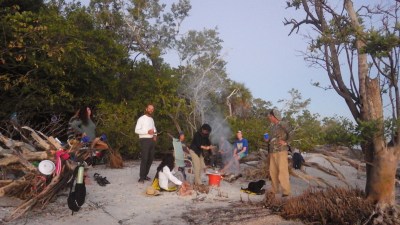
As the sun fell, I made my way over to the campfire that my new friends had started. It was next to the root ball of a gigantic overturned tree, which they used as a kind of ad-hoc storage closet. Hanging from the roots of the “everything tree”, or tucked between them, were plates, cups, cutlery, and various random articles of clothing (sunglasses, hats, flip-flops).

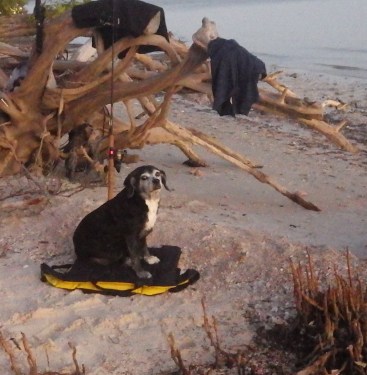
There were around a dozen people: a husband-and-wife couple (Carolyn and Mark), their friend Rob, Carolyn’s friend Eileen, the wild-haired fisherman (Dave),  his partner,  Carolyn and Mark’s 16-year-old daughter Rachel, Rob’s similarly-aged daughter, their boyfriends (who had brought the Spongebob towels), and confusingly, the boyfriend of Rob’s other daughter, who wasn’t there herself. There was also Rob’s dog, Wolfie, and Mark and Carolyn’s dog Bella.

panther-key-bella

Bella in the seat of honor

Rob offered me a beer, which I accepted gratefully. Even more welcome was Carolyn’s homemade smoked mullet chowder, with freshly caught and smoked mullet and made with potatoes, carrots, and peas. There was also fresh-caught shark, grilled over an open fire.

Warmed by the fire, and delighted by the conversation, I couldn’t believe how happy I was. It had been another entirely unexpected day.

A bit later I said goodnight and headed back to my campsite. Cocooned in my bivvy sack and draped in mosquito netting, I was perfectly at peace. Waves lapped the beach close by, and from farther off came the strains of the guitar music and the faint scent of woodsmoke.  Overhead the stars blazed, and I fell asleep under their benign light.

panther-key-sunrise-wolfie

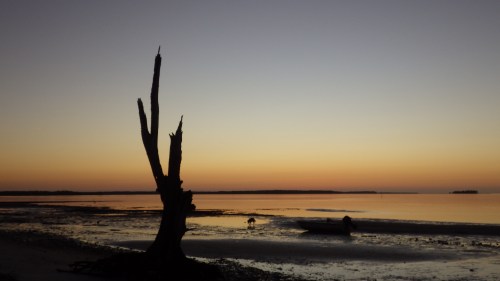
Sunrise on Panther Key (Wolfie and tree)

The next morning I awoke early to take pictures. I’d already decided it would be a “rest day”: Mark had advised that he and the rest of the crew would be heading out about noon, and I could have one of their campsites. It was perfect for riding out the storm front: I’d move to high ground,under the protective forest, out of the wind and any waves that resulted.

panther-key-second-campsite

Second campsite: Snug under trees!

After helping my friends pack and saying goodbye, I moved camp, battening down the hatches (quite literally!) in preparation for the high winds that were supposed to hit that night.

Instead of paddling, I went for a leisurely swim, then napped in the late-afternoon sun.

After an early dinner, I tucked myself in to await the storm.