Author Archives: Johna Till Johnson

A Kayayer’s Guide to Hitchhikers

By Johna Till Johnson and Vladimir Brezina

HitchhikerKayaking is often a solitary sport. Although paddlers sometimes go out in pairs and groups, the quintessential kayaker is a bit of a loner. Many of us make long trips alone, and prize the time we spend by ourselves.

But sometimes we inadvertently end up with fellow travelers. When Vlad and I were training for the Everglades Challenge, we found ourselves navigating the Florida Bay in pitch darkness—when all of a sudden, a fish jumped out of the water and into my lap. A few months later, one of our fellow Everglades Challengers, Clewless, topped that one when a shark jumped into his boat—during the race!  There’s also the recent story of a 6-foot alligator jumping into a canoe. And of course many stories of cute, or sometimes not so cute, seals and sea lions hopping onto kayaks to hitch a ride.

The typical hitchhiker is less threatening. While weaving through the mangrove tunnel of the ironically named Broad Creek during the Everglades Challenge, a tree crab landed on the nose of my boat. Tree crabs are small—an inch or two—with shiny, mottled brown or green shells. This one was content to be my mascot for several minutes—until he started to crawl slowly towards the cockpit.

I debated knocking him off with the paddle—but that seemed unfair, and might have hurt him. So I gently nosed up to a mangrove root—and he hopped off.

He wasn’t the only crab who hitched a ride, though. Returning from a recent trip to Sandy Hook, I felt something skittering around in my cockpit. When I stripped off the spray skirt I saw a small gray sea crab, about the size of a quarter. I tried to pick him up, but he was too quick for me—and I didn’t want to risk crushing him. So we made the trip home from Sandy Hook together, with him occasionally reminding me of his presence with a tiny “nip”.  (Every time he nipped I yelped, which amused Vlad.)

When I got back to Pier 40 I rinsed him out of the boat with sea water—I don’t know whether he survived in the Hudson, but I like to think he did.

But the best hitchhiker story of all is one that happened to Vlad.

I’ll let him tell it.

Vlad writes:

Once upon a time, when I was just a little kayaker, I went for a paddle with my friends Kathy and John. Like me, they were big-city paddlers, with a folding kayak in their closet. Theirs was a formidable double Klepper, whose parts came in three heavy-duty canvas bags.

We got to the river, assembled our boats, and cruised with the current for a few miles to our destination—a grassy meadow where we planned to have a picnic lunch before packing the boats up again and taking a train back to the city.

Everything worked out as planned. As usual, Kathy had brought a lovely lunch, which she laid out on the grass. And in preparation for taking the Klepper apart, John carefully laid out its three bags.

As he did so, out of the largest bag there stalked a huge brown cockroach. He stood at the mouth of the bag, surveying the meadow around, antennae twitching. Obviously, he’d been living in the bag back in John and Kathy’s closet, and we’d brought him along for the ride!

We just stood there. He descended regally from the bag and was soon lost from sight in the tall grass.

We didn’t think much about it. We had our lunch, then started disassembling the boats.

An hour or two later—we were feeling drowsy in the post-prandial sunshine—we were almost done. John had packed most of the Klepper’s parts in the bags; he was about to add the last parts and close up the bags.

And what did we then see come out of the tall grass, heading straight towards the bags? A huge brown cockroach!

This time we made a move. All three of us tried to block him, like football players. But he zig-zagged nimbly between our feet and took a leap into the open bag.

The bag was already carefully packed with parts—we couldn’t face taking them all out again.

And so the smart old cockroach rode back to the city, back to his closet, doubtless to tell his young cousins about his lovely Sunday excursion to the country…
Tugboat Races, Take Three

By Johna Till Johnson
Photos by Johna Till Johnson

Tugboat Races 2014

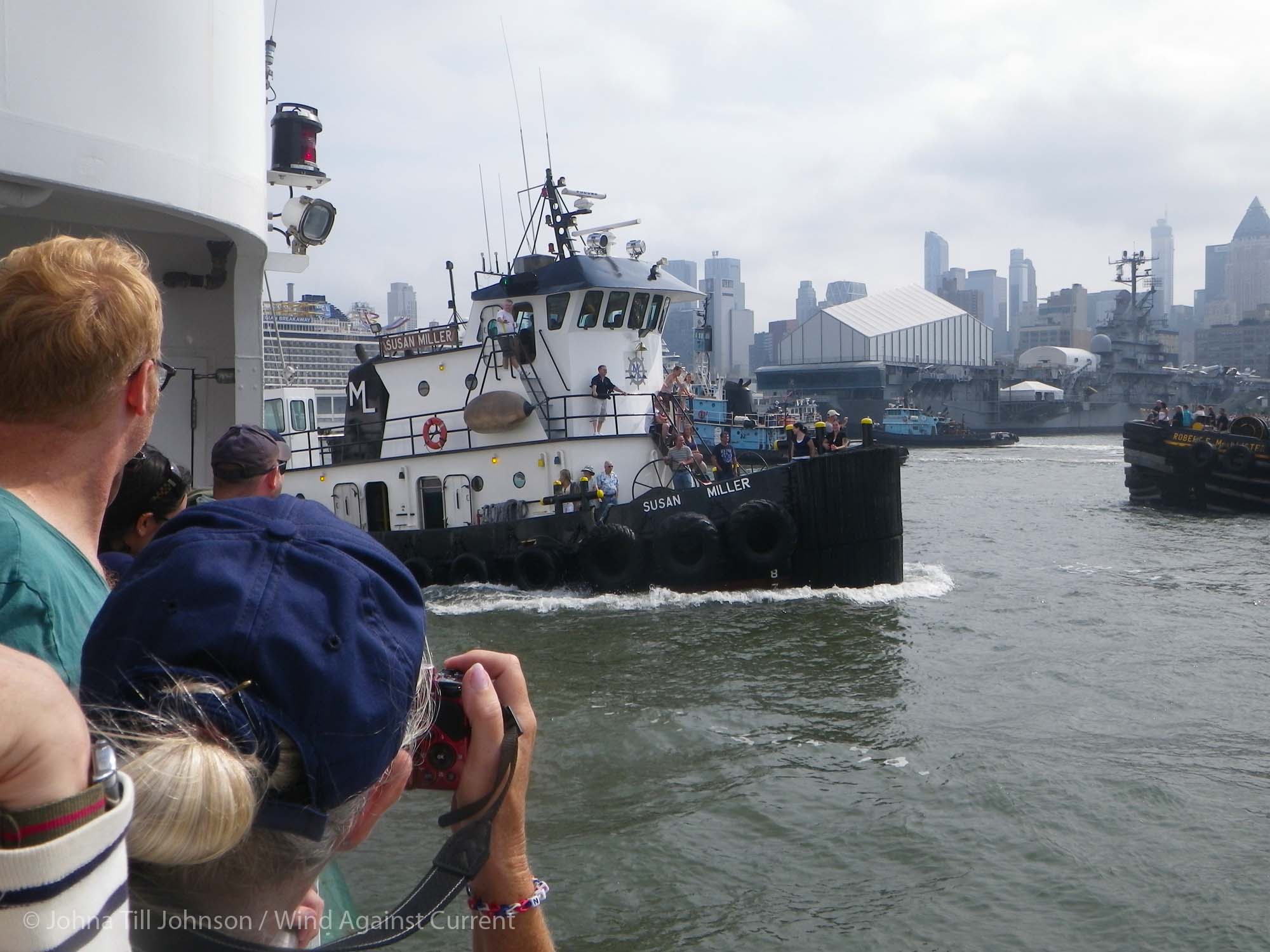
Photogenic tug

The day wasn’t looking good.

This was the third year we’d planned to go to the Great North River Tugboat Race & Competition, but the day didn’t start well. It dawned dark and gloomy, with the threat of rain—the kind of day on which, despite your best intentions, you struggle to get out of bed.

Worse, Vlad, who’d been under the weather for a few days, couldn’t go.

So even though we’d already purchased tickets, I wasn’t enthusiastic about attending the race.  I had so many chores to do… not to mention work… and steaming coffee and a comfortable couch beckoned.

At the last minute, though, I threw my maritime radio and camera into a backpack, poured some coffee into a thermos, and set off downtown.

Continue reading

A Picture-Perfect Ederle Swim

By Johna Till Johnson
Photos by Vladimir Brezina

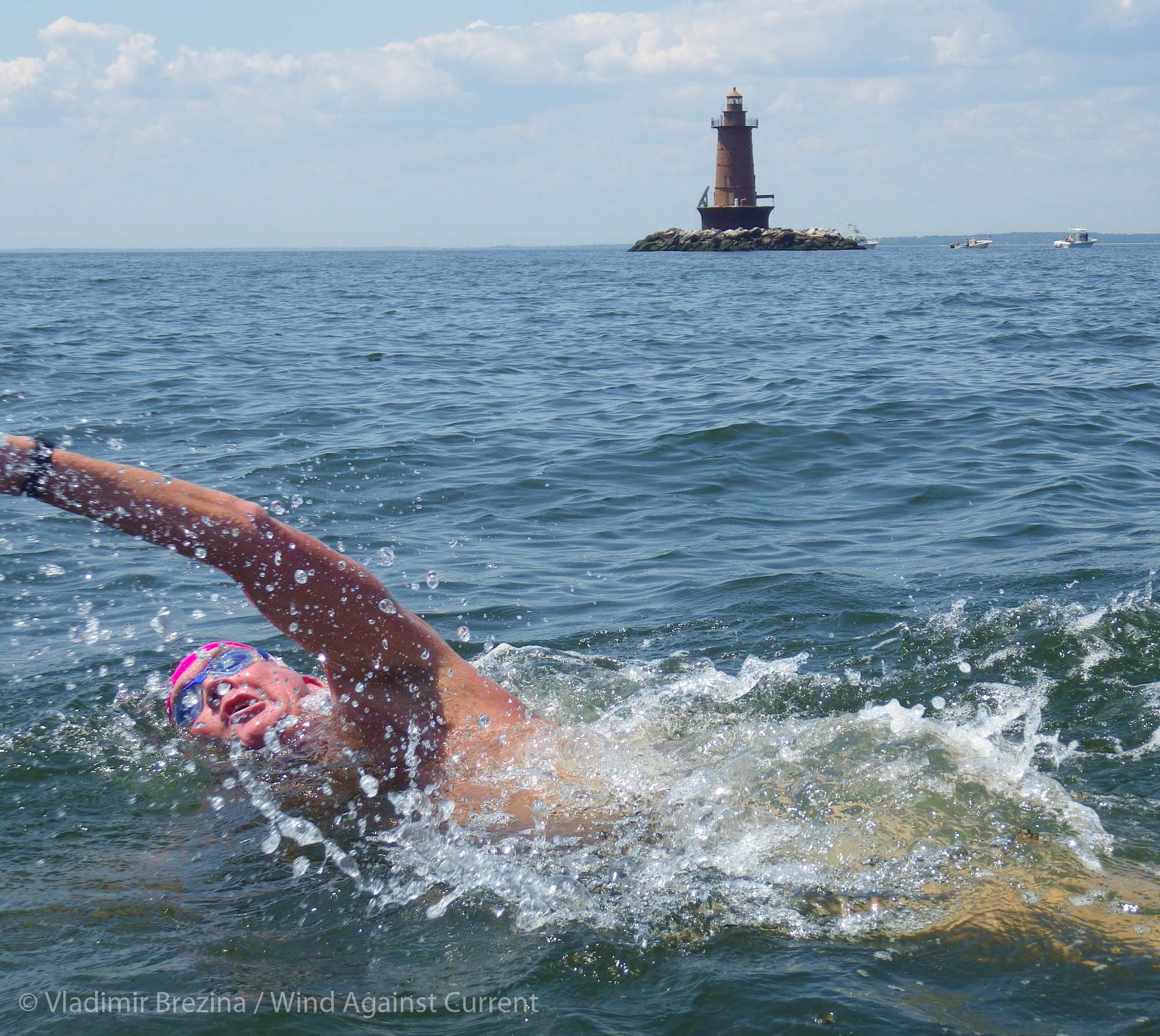
Ederle Swim 2014 39

Maybe the magic was in the pasta.

This year, Vlad and I signed up to provide kayak support for the Ederle Swim, a 17.5-mile open-water swim from Manhattan to Sandy Hook, New Jersey. Vlad has done it several times, but this was my first time accompanying swimmers to Sandy Hook (though we’ve paddled there many times).

We’d each been assigned a swimmer, and the day before the swim, the organizers, NYC Swim, sent us the swimmers’ email addresses. So I reached out to “my” swimmer, Andrea Varalli, mentioned that I’d done the paddle many times, and offered what advice I could, including the detailed blogs Vlad has posted on Wind Against Current about his previous Ederle Swims (here, here, here, and here).

Next thing I knew, Vlad and I agreed to meet Andrea and his support team for dinner at a “real Italian restaurant” (as Andrea called it), Piacere. (Pleasure, in Italian.) We had guessed (correctly as it turned out) that Andrea was “real Italian”—not merely of Italian descent. So the “real Italian” restaurant was sure to be a treat!

Continue reading

I Did It!

By Johna Till Johnson
Photos by Vladimir Brezina

On the beach after the race

This was the fifth year that Vlad and I raced in the Blackburn Challenge, the 20-mile circumnavigation of Cape Ann, Massachusetts. The race is named for Howard Blackburn, a 19th-century mariner of uncommon grit. (You can read about him here.) Any human-powered watercraft can participate, and there is usually a wide range, from paddleboards to rowing shells, dories, and dragonboats—plus several flavors of kayaks.

Thus far, I’d placed every time, helped out by the relative smallness of the field of women sea kayakers—there are typically only half a dozen or so in my class.

After collecting two third-place and two second-place finishes, I yearned for a first. Last year I missed it by a mere six minutes. And I just knew I’d gotten faster this year. I’d trained hard—though not as consistently as I’d liked—and still had some stamina left over from completing the Everglades Challenge earlier this year.

So I was pretty sure that this would be my year.

Continue reading

Cardboard Kayak Race, Redux

By Johna Till Johnson
Photos by Vladimir Brezina

Cardboard-kayak-race-100

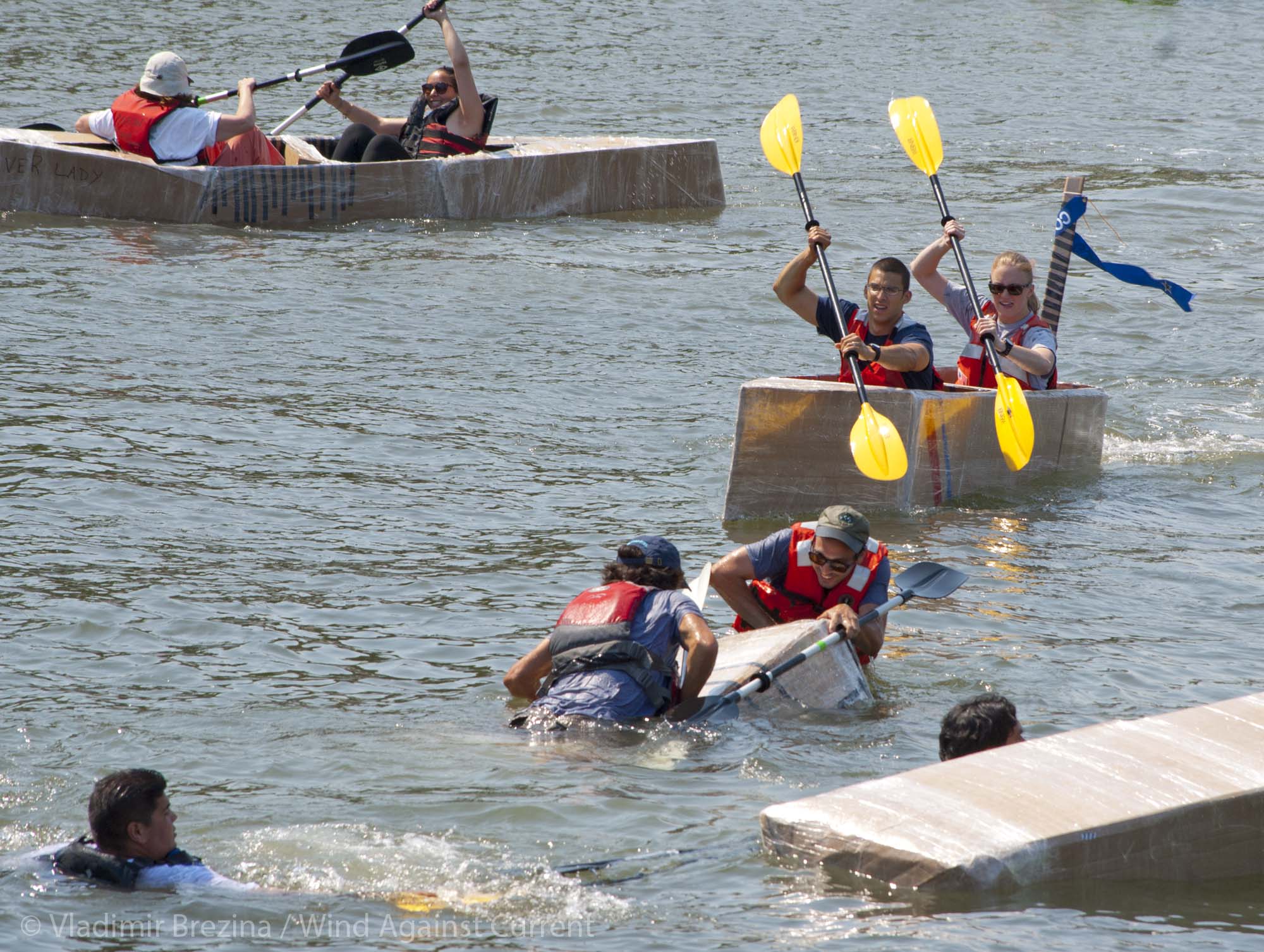
Last year, I wrote about the first annual Cardboard Kayak Race, held on City of Water Day at Governors Island.  This year, I was in it!

No, it’s not what you’re thinking. We didn’t build a boat out of cardboard and then race it. But others did! And I was part of a fleet of “safety kayaks” whose job it was to rescue paddlers whose cardboard boats sank (and fish out the sodden detritus).

Continue reading

Celebrity Sun

By Johna Till Johnson
Photos by Vladimir Brezina

Manhattanhenge 17

In Manhattan we get our share of celebrities. Some live here year-round. Many zoom by in a blaze of flashbulbs and applause.

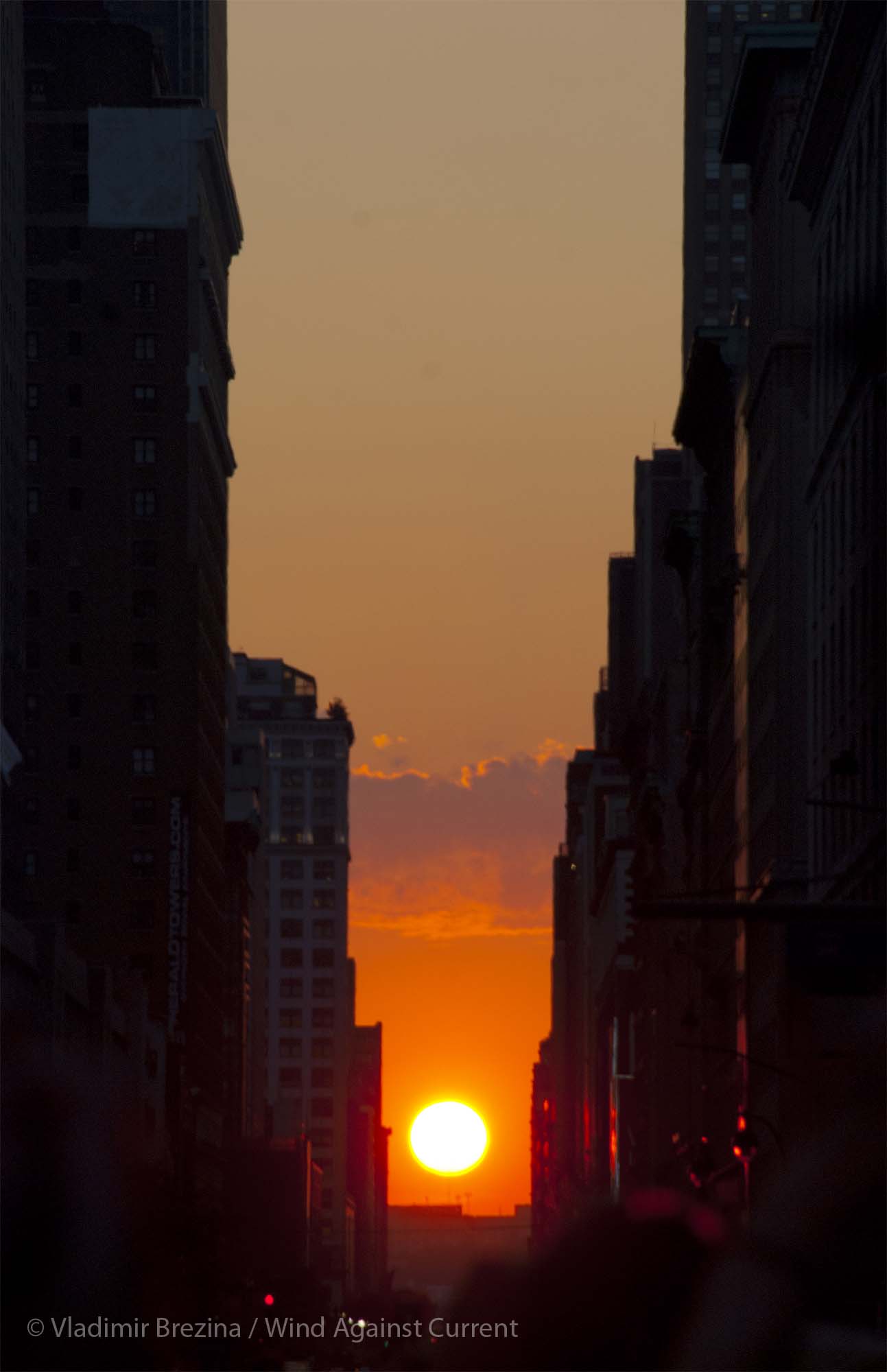
And some show up reliably every day, unapplauded, but make a celebrity entrance a few minutes out of the year. That’s what happens at Manhattanhenge. Twice a year, roughly three weeks before and after the summer solstice, the setting sun lines up precisely with the east-west streets of Manhattan’s street grid.

It’s  a well-known phenomenon, and has become more so with each passing year. Photographers gather at major intersections, awaiting that perfect moment when the sun touches the horizon, framed precisely between buildings on either side. For a moment or two, the sun is a celebrity.

I’ve heard about it, and Vlad has taken pictures of it many times. But this year was the first time I’d actually experienced it.

Continue reading

Halsey: The Unstoppable

By Johna Till Johnson

halsey_williamf_victory

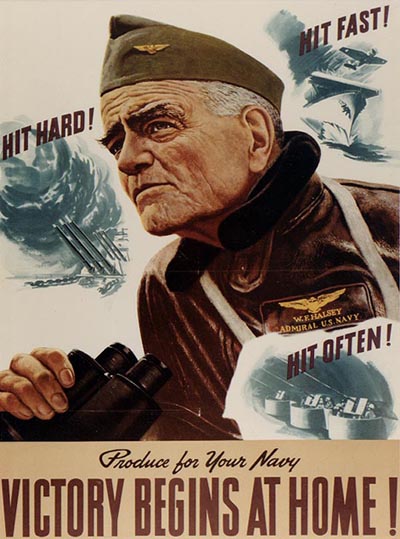
Admiral Halsey in a WWII poster (from Naval History & Heritage Command)

.

.

.

.

.

.

.

.

.

.

.

.

.

There are no extraordinary men, just extraordinary circumstances that ordinary men are forced to deal with.

—Admiral William (“Bull”) Frederick Halsey, Jr.

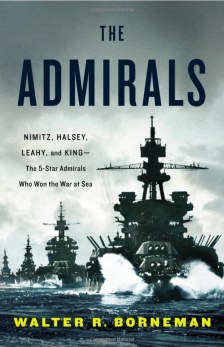
This sketch is one of several inspired by the book, The Admirals: The Five-Star Admirals Who Won the War at Sea, by Walter R. Borneman. It’s about Admirals Halsey, Nimitz, King, and Leahy, each of whom played critical roles in World War II, and were the only admirals to earn five stars in all of American history. (For the other sketches in the series, see Triptych: Three Admirals.)

More than that, the book is about leadership, character, and how a flawed individual can rise to greatness—not in spite of, but often even precisely because of, those flaws.

Halsey was a pugnacious fighter, wisecracking and hotheaded, whose passion was winning the game (or battle). His courage and determination helped re-energize and inspire a Navy demoralized and depleted by the hideous surprise of Pearl Harbor. Yet his appetite for the fight paradoxically cost him participation in some of the defining battles of the Pacific, and could have cost the war. But anything he did, he did wholeheartedly—and there was never any question of stopping him.

Continue reading

Triptych: Three Admirals

By Johna Till Johnson

Sailors preparing for the funeral

Sailors preparing for the funeral, May 2014 (photo provided by Steve Hannifin)

Medicine, the ministry, and the military. Those were the “three Ms” that—according to my mother—defined the callings of our family, dating back to before the American Revolution. Each is characterized by a commitment to a greater good than self, or even family: Healing, God, country.

That sense of commitment is likely one reason my mother came to marry my father, a naval officer, and it permeated my life growing up.

When we uprooted ourselves to move across the country or around the world for the fifth (or the seventeenth) time, it wasn’t for personal gain. It was because the Navy needed us there to protect our country. That’s what my parents said, and that’s what we believed. When our country called, we came—particularly my father, who spent years underwater in a nuclear submarine.

Some day I’ll write about my father. But meantime, this is enough to explain how I came to spend a recent Friday in Annapolis, at the Naval Academy cemetery, where the ashes of my father’s former commanding officer, Vice Admiral Patrick J. Hannifin, were laid to rest.

It was an uncharacteristically gray, cold, and drizzly day in late spring. I’d gotten up at 3:30 AM to make the four-hour drive to Annapolis. I arrived an hour and a half early, giving me plenty of time to think, and to remember.

As I sat in the white marble open-air “columbarium” overlooking the gray-green water of College Creek, the memories came flooding back. I’d spent three years living on the Naval Academy grounds from ages 8 to 11, while my father was head of the division of Math and Science.

Like many children, I was oblivious to the weight of history. To me, the Academy was a delightful, safe, and well-tended park. I never thought about the fact that the green torpedoes I loved to play on (just the size for an 8-year-old to ride!) were taken from Japan during World War II. Or that I practiced gymnastics, fencing, and swimming in MacDonough Hall (named after a remote ancestor on my mother’s side, Admiral Thomas MacDonough). Though from time to time I passed by Nimitz Library, the Halsey Field House, and the King Hall dining facility, these were all just names to me.

yardair2

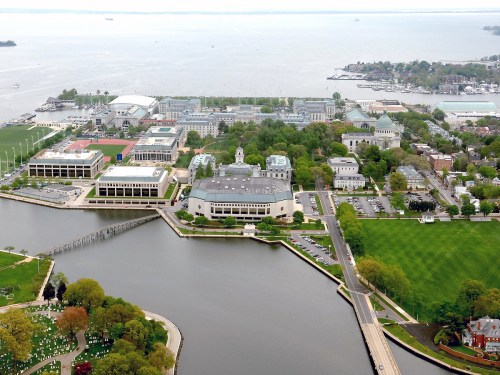
Nimitz Library from the air (photo by United States Naval Academy)

Even this May, as I looked out at the flowing water and the campus beyond, I didn’t think about history. I thought about my father, who died in 2008. I thought about Admiral Hannifin. I thought about all the men I’d known who shared my father’s commitment—and what they had exemplified as leaders, and as human beings.

The AdmiralsMaybe that’s why, walking through an airport on a business trip a few days later, I was inspired to pick up a book called “The Admirals”, by Walter R. Borneman.

It’s subtitled, “The Five-Star Admirals Who Won the War at Sea”, which pretty much says it all. It’s about Admirals Nimitz, Halsey, King, and Leahy, each of whom played critical roles in World War II (and who were the only admirals to earn five stars in all of American history).

The book is fantastic. It’s about more than just the people, or the events. It’s about leadership. And it’s about character, and how a flawed individual can rise to greatness—not in spite of, but often even precisely because of, those flaws.

Of the four men profiled by Borneman, three really resonated with me: Nimitz, Halsey, and King.

Nimitz was even-tempered and genial, a consummate engineer who threw himself into every project that was handed to him, and whose supreme satisfaction was a job well done. Halsey was a pugnacious fighter, wisecracking and hotheaded, whose passion was winning the game (or battle). And King was a brilliant careerist, convinced (usually correctly) that he was smarter than anyone else, and determined to win the accolades to which he felt entitled.

Their individual responses to learning of the war’s end sum each up perfectly. In each case, an aide burst into the Admiral’s office with the news that the goal of four years’ uncompromising and exhausting effort had been achieved: the Japanese had surrendered unconditionally.

Halsey’s response was to leap to his feet and begin pounding the aide’s shoulders in joy.

King reportedly looked stricken, and said, “But what am I going to do now?”

And Nimitz? He said nothing, just allowed himself a small, perfectly satisfied smile.

In three following posts, I will post a short sketch of each of these unique leaders, drawn largely from Borneman’s book (which again, I highly recommend) with some additional research:

Halsey: The Unstoppable
Nimitz: The Unflappable
King: The Impossible

So There I Was… In Maine

By Johna Till Johnson

Freshly Pressed on the WordPress.com home page!

Every good kayaking story starts with “So there I was,” according to Carl Ladd (of Osprey Sea Kayak fame). In keeping with that adage, here goes:

IMGP8650 cropped small

Setting off along the Maine coast

So there I was, bobbing up and down on the frigid waves crashing into the rocky coastline of Maine’s Sheepscot Bay.  The swells were substantial—four to six feet, big enough to rip someone from her kayak and deposit her and the boat on separate rocks.

That exact thing had recently happened, in fact, to another paddler.

Fortunately neither she nor her boat sustained damage, but it was a strikingly close call. One moment she was riding the surf, high over our heads, after a larger-than-usual wave broke suddenly. The next moment she was struggling in the water, and we all winced as we heard the hollow sound of her fiberglass boat crunch into the rocky shore.

Continue reading

Everglades Challenge, Reflections: What Worked, What Didn’t

By Johna Till Johnson and Vladimir Brezina
Photos by Vladimir Brezina

← Previous in Everglades Challenge

IMGP0075 cropped small

The day after: Johna and Cynthia trying to take apart Johna’s stuck paddle…

“You should write down what worked, and what didn’t,” DolphinGal advised us when she was doing our gear check the day before the start of the Everglades Challenge. So, a tip of the hat to DolphinGal (who has a pretty impressive story of her own to tell about what worked, and what didn’t, in her Everglades Challenge, some years back).

Here’s what we wrote down…

Continue reading