By Vladimir Brezina
Queens is hot.
And so are Brooklyn, Manhattan, and the Bronx.
Staten Island? Not so much…
This post is about temperature. (Why, what did you think it was about?) Many years ago, I lived for a year in Libya, not far from a place called El Azizia. There, on September 13, 1922, a weather station recorded a temperature of 58.0°C (136.4°F). According to the World Meteorological Organization, that is the highest temperature ever measured by a weather station.
But is that really the hottest place on Earth? The hottest regions of the Earth are expected to be the deserts. (El Azizia, marked on the map below, is on the edge of the Sahara Desert.) But in deserts, weather stations (black dots on the map) are sparse. According to scientists quoted in a recent NASA Earth Observatory article, “most of the places that call themselves the hottest on Earth are not even serious contenders… The Earth’s hot deserts—such as the Sahara, the Gobi, the Sonoran, and the Lut—are climatically harsh and so remote that access for routine measurements and maintenance of a weather station is impractical. The majority of Earth’s hottest spots are simply not being directly measured by ground-based instruments.”
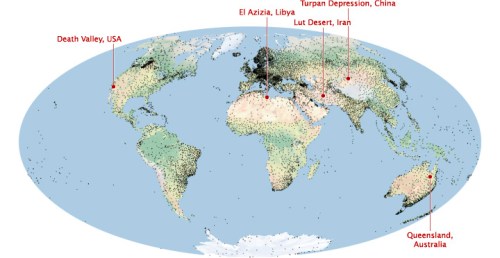
“In the remote, sparsely populated areas that are likely to be the world’s hottest, weather stations (black dots) are widely spaced.” (NASA Earth Observatory)
That’s where satellites come in. NASA operates two satellite-mounted Moderate Resolution Imaging Spectroradiometers (MODIS), instruments that (among many other things) measure the thermal radiance, the amount of infrared energy emitted by the land surface. “Since the two MODIS instruments scan the entire surface each day, they can provide a complete picture of earthly temperatures and fill in the gaps between the weather stations,” according to NASA.
One wrinkle: the traditional weather stations measure the air temperature, 1.2-2 meters above the ground and shielded from direct sun. In contrast, MODIS measures the “land skin temperature” (LST)—the temperature of the exposed ground surface. As anyone who has walked barefoot on hot sand at the beach or a hot parking lot on a sunny summer day will know, the LST can be considerably higher than the air temperature.
As expected, the regions with the highest LST readings (dark red color in the map below) are the Earth’s deserts.
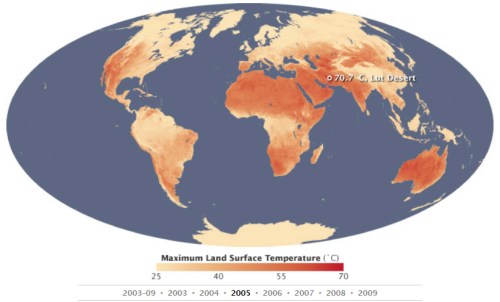
“Seven years of satellite temperature data … The Lut Desert was hottest during 5 of the 7 years, and had the highest temperature overall: 70.7°C (159.3°F) in 2005.” (NASA Earth Observatory)
Within the desert regions, the very highest readings are consistently obtained in such spots (marked on the first map) as the badlands of Queensland, Australia; the Turpan Basin of the Taklimakan Desert in China; and the Lut Desert of Iran, which had the highest annual LST reading in 5 of the 7 years 2003-2009 and, in 2005, recorded the single highest LST value ever measured, of 70.7°C (159.3°F)—more than 12°C (22°F) warmer than the official world record air temperature from Libya. What these spots have in common is that they are dry, rocky, bare of vegetation, and dark, so that they absorb, rather than reflect, the incoming sunlight.
So is one of these places now the hottest place on Earth? Not so fast. It turns out you don’t have to go to the ends of the Earth to find the hottest places. The dry, rocky, bare, and dark conditions are found, often to an even greater degree, in many urban areas with dark asphalt- or tar-covered roofs, streets, and parking lots. Consequently, as one scientist notes: “I see surface temperatures in the city that routinely exceed what you might find in the desert.”
Take the “urban desert” of our very own Queens, New York City.

Queens urban desert (NASA Earth Observatory)
Using portable infrared radiometers (for better spatial resolution than that available from the satellite images), scientists have been measuring LST values in New York City, including at the Con Edison building in Queens (indicated above). On such black rooftops in mid-summer—as shown below for a few days in August 2010—they have observed temperatures as high as 77 to 82°C (170 to 180°F), more than 10°C higher than ever recorded in the Lut Desert.

“Temperatures in cities can rival the hottest desert. Using sensors installed at the Con Edison building in Queens, NY, scientists compare the surface temperature of black, white, and “green” (vegetated) roofs. The black roof can be up to 30°C (54°F) hotter than a green or white roof.” (NASA Earth Observatory)
These high temperatures contribute to the city’s heat island effect and to the oppressiveness of summer days and nights that is only too well known to urban residents.
How can these high temperatures be reduced? As the graph above shows, a black roof is much hotter than a green or white roof, or, best of all, a vegetation-covered roof.
“Installing a plant-covered roof is the ultimate technique to combat urban heat because it adds a combination of slight shading and a lot of cooling moisture. …But even a simple step like painting black roofs white—increasing the albedo, or reflection of light—can reduce temperatures dramatically. …White synthetic surfaces and paints were found to reduce peak rooftop temperatures by 24°C (43°F) compared to typical black rooftops.”
So, “widespread installation of white roofs, like New York City is attempting through the NYC CoolRoofs program, could reduce city temperatures while cutting down on energy usage and resulting greenhouse gas emissions.”
But in the meantime, Queens is super-hot!
______________________________________________________
Take a look at the NASA Earth Observatory articles on which I’ve based this post (a three-part article beginning here, and another post here) for additional information.
Update May 9, 2012: Looks like Toronto is way ahead of New York City in green roof installation!


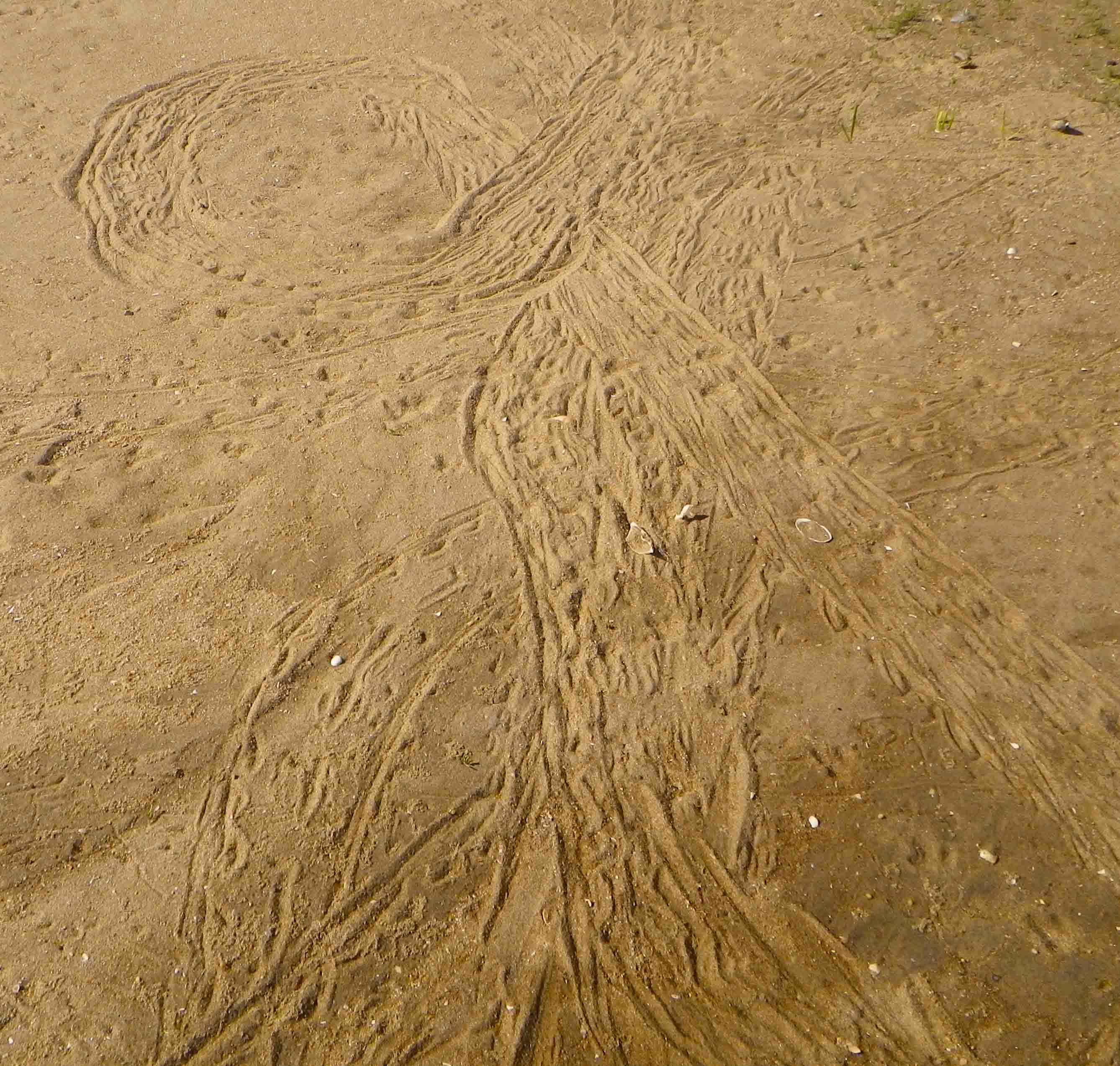

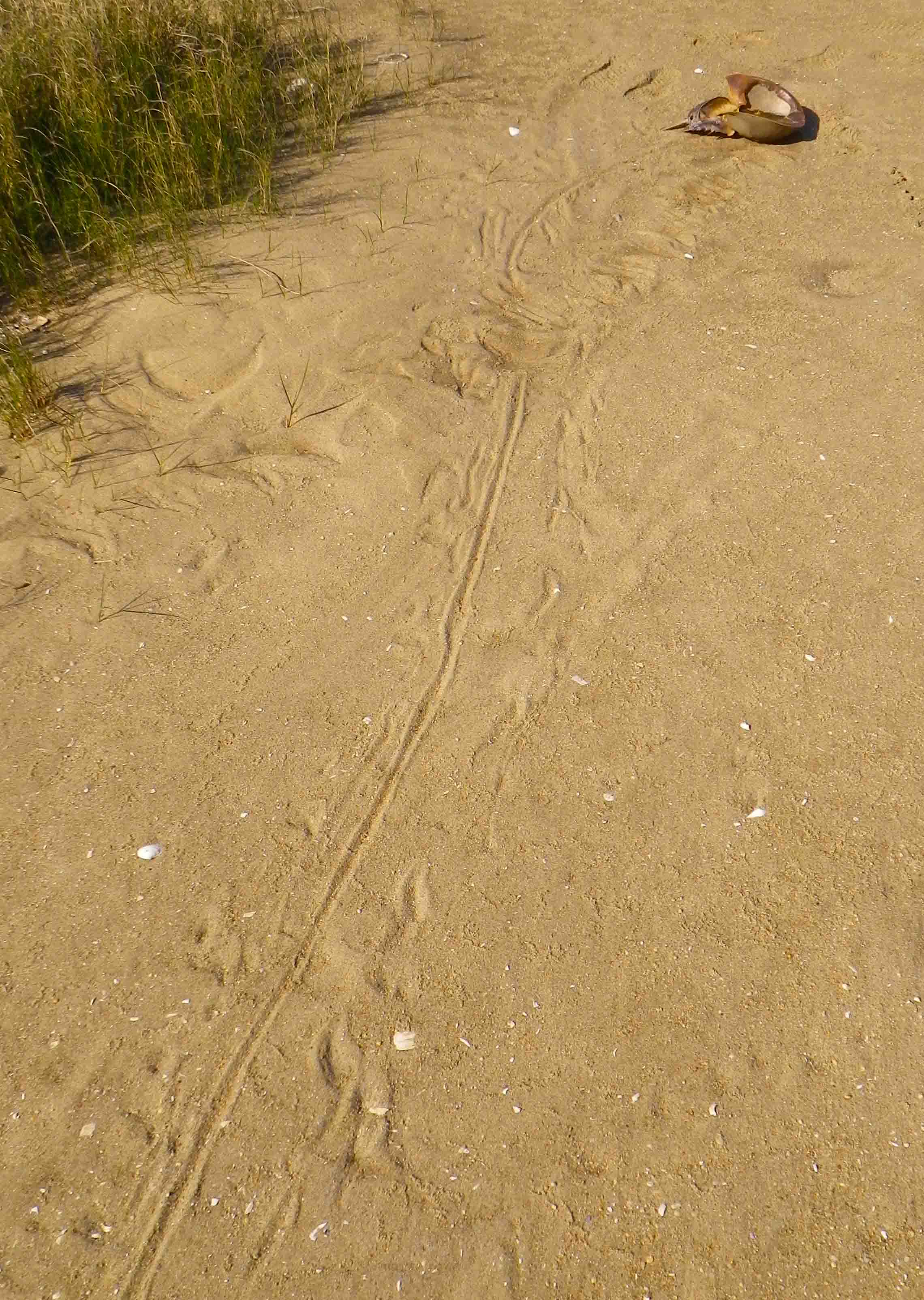 #2. This actually is one we had a pretty good idea about as soon as we saw it. And a number of our readers have come to the same conclusion. These are classic horseshoe crab tracks. Part of that beach consists of shallow basins that obviously fill up with water at high tide (possibly only an usually high tide) and drain again at low tide. And in these basins the horseshoe crabs clearly had a killer party! Their tracks were all over the place, some with dead crabs lying at the ends of them…














 Vladimir Brezina (RIP)
  Johna Till Johnson


 Wind Against Current