Category Archives: Science and Technology

Queens, the Hottest Place on Earth?

By Vladimir Brezina

Queens is hot.

And so are Brooklyn, Manhattan, and the Bronx.

Staten Island? Not so much…

This post is about temperature. (Why, what did you think it was about?) Many years ago, I lived for a year in Libya, not far from a place called El Azizia. There, on September 13, 1922, a weather station recorded a temperature of 58.0°C (136.4°F). According to the World Meteorological Organization, that is the highest temperature ever measured by a weather station.

But is that really the hottest place on Earth? The hottest regions of the Earth are expected to be the deserts. (El Azizia, marked on the map below, is on the edge of the Sahara Desert.) But in deserts, weather stations (black dots on the map) are sparse. According to scientists quoted in a recent NASA Earth Observatory article, “most of the places that call themselves the hottest on Earth are not even serious contenders… The Earth’s hot deserts—such as the Sahara, the Gobi, the Sonoran, and the Lut—are climatically harsh and so remote that access for routine measurements and maintenance of a weather station is impractical. The majority of Earth’s hottest spots are simply not being directly measured by ground-based instruments.”
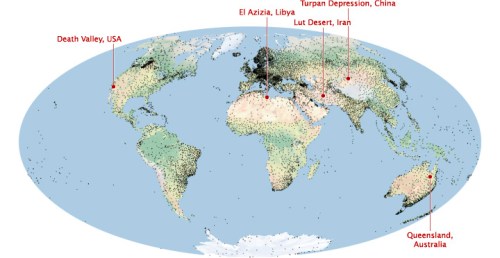
“In the remote, sparsely populated areas that are likely to be the world’s hottest, weather stations (black dots) are widely spaced.” (NASA Earth Observatory)

That’s where satellites come in. NASA operates two satellite-mounted Moderate Resolution Imaging Spectroradiometers (MODIS), instruments that (among many other things) measure the thermal radiance, the amount of infrared energy emitted by the land surface. “Since the two MODIS instruments scan the entire surface each day, they can provide a complete picture of earthly temperatures and fill in the gaps between the weather stations,” according to NASA.

One wrinkle: the traditional weather stations measure the air temperature, 1.2-2 meters above the ground and shielded from direct sun. In contrast, MODIS measures the “land skin temperature” (LST)—the temperature of the exposed ground surface. As anyone who has walked barefoot on hot sand at the beach or a hot parking lot on a sunny summer day will know, the LST can be considerably higher than the air temperature.

As expected, the regions with the highest LST readings (dark red color in the map below) are the Earth’s deserts.
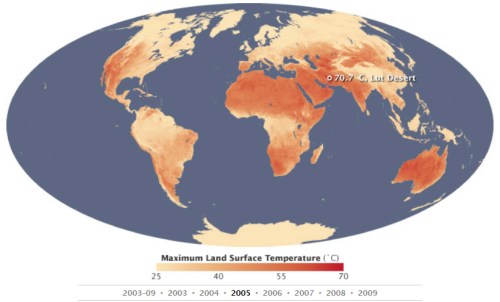
“Seven years of satellite temperature data … The Lut Desert was hottest during 5 of the 7 years, and had the highest temperature overall: 70.7°C (159.3°F) in 2005.” (NASA Earth Observatory)

Within the desert regions, the very highest readings are consistently obtained in such spots (marked on the first map) as the badlands of Queensland, Australia; the Turpan Basin of the Taklimakan Desert in China; and the Lut Desert of Iran, which had the highest annual LST reading in 5 of the 7 years 2003-2009 and, in 2005, recorded the single highest LST value ever measured, of 70.7°C (159.3°F)—more than 12°C (22°F) warmer than the official world record air temperature from Libya. What these spots have in common is that they are dry, rocky, bare of vegetation, and dark, so that they absorb, rather than reflect, the incoming sunlight.

So is one of these places now the hottest place on Earth? Not so fast. It turns out you don’t have to go to the ends of the Earth to find the hottest places. The dry, rocky, bare, and dark conditions are found, often to an even greater degree, in many urban areas with dark asphalt- or tar-covered roofs, streets, and parking lots. Consequently, as one scientist notes: “I see surface temperatures in the city that routinely exceed what you might find in the desert.”

Take the “urban desert” of our very own Queens, New York City.

Queens urban desert (NASA Earth Observatory)

Using portable infrared radiometers (for better spatial resolution than that available from the satellite images), scientists have been measuring LST values in New York City, including at the Con Edison building in Queens (indicated above). On such black rooftops in mid-summer—as shown below for a few days in August 2010—they have observed temperatures as high as 77 to 82°C (170 to 180°F), more than 10°C higher than ever recorded in the Lut Desert.

“Temperatures in cities can rival the hottest desert. Using sensors installed at the Con Edison building in Queens, NY, scientists compare the surface temperature of black, white, and “green” (vegetated) roofs. The black roof can be up to 30°C (54°F) hotter than a green or white roof.” (NASA Earth Observatory)

These high temperatures contribute to the city’s heat island effect and to the oppressiveness of summer days and nights that is only too well known to urban residents.

How can these high temperatures be reduced? As the graph above shows, a black roof is much hotter than a green or white roof, or, best of all, a vegetation-covered roof.

Installing a plant-covered roof is the ultimate technique to combat urban heat because it adds a combination of slight shading and a lot of cooling moisture. …But even a simple step like painting black roofs white—increasing the albedo, or reflection of light—can reduce temperatures dramatically. …White synthetic surfaces and paints were found to reduce peak rooftop temperatures by 24°C (43°F) compared to typical black rooftops.”

So, “widespread installation of white roofs, like New York City is attempting through the NYC CoolRoofs program, could reduce city temperatures while cutting down on energy usage and resulting greenhouse gas emissions.”

But in the meantime, Queens is super-hot!

______________________________________________________

Take a look at the NASA Earth Observatory articles on which I’ve based this post (a three-part article beginning here, and another post here) for additional information.

Update May 9, 2012: Looks like Toronto is way ahead of New York City in green roof installation!

The Bright Lights of the Big City from Space

By Vladimir Brezina

.

[For best viewing, click on the HD icon in the top right corner, then expand to full screen by clicking on the icon in the bottom right corner]

Video courtesy of the Image Science & Analysis Laboratory, NASA Johnson Space Center:

This video was taken by the crew of Expedition 30 on board the International Space Station. The sequence of shots was taken January 29, 2012 from 05:33:11 to 05:48:10 GMT, on a pass from just southwest of Mexico to the North Atlantic Ocean, northeast of Newfoundland. This pass begins looking over Central America towards the Gulf of Mexico and the southeastern United States. As the ISS travels northeast over the gulf, some southeastern United States cities can be distinguished, like New Orleans, Mobile, Jacksonville, and Atlanta. Continuing up the east coast, some northeastern states, like Washington, D.C., Baltimore, Philadelphia, and New York City stand out brightly along the coastline. The Aurora Borealis shines in the background as the pass finishes near Newfoundland.

And notice the firmament of fixed stars unchanging above…

This is just one of the many amazing videos at this site.

The Blue Marble

By Vladimir Brezina

Manned missions to Mars and colonies on the moon seize the imagination, at least of Presidents and would-be Presidents :-). Everyone else knows that these are dreams, half-baked, arguably pointless, and certainly unrealizable any time soon (unless it be by the Chinese).

But, in the meantime, NASA has been steadily adding to, perfecting, and using for a huge variety of scientific missions its workaday tools, its fleet of unmanned satellites. Some of these look outward into space.  But many orbit and look down on the Earth itself—and generate all kinds of fascinating and beautiful images.

This past week, NASA released two new images of the Earth as the iconic Blue Marble—the blue planet, seen in its entirety, against the vast blackness of space.

These images were each stitched together from a number of partial images taken during multiple orbits of the Suomi National Polar-orbiting Partnership (NPP) satellite. While the satellite was orbiting the Earth at an altitude of only 512 miles, the composite images appear to originate from an altitude of 7,918 miles. At the same time, they have very high resolution—the original images, with 8,000 x 8,000 and 11,500 x 11,500 pixels respectively, can be downloaded here and here.

As of February 2, 2012, the Western Hemisphere image had been viewed on Flickr over 3.1 million times, “making it one of the all time most viewed images on the [NASA Flickr] site after only one week.”

But that is still nowhere compared to the popularity of the original Blue Marble photo, a single image taken on December 7, 1972, from an altitude of about 28,000 miles by the crew of Apollo 17 as that spacecraft was on its way to the moon. By now, this must be one of the most widely seen and reproduced photos of all time:

Images such as these—and even before they came into being, science fiction writers’ imagination of what they would be like—have moved and inspired many:

Suddenly, from behind the rim of the Moon, in long, slow-motion moments of immense majesty, there emerges a sparkling blue and white jewel, a light, delicate sky-blue sphere laced with slowly swirling veils of white, rising gradually like a small pearl in a thick sea of black mystery. It takes more than a moment to fully realize this is Earth . . . home.

……………………………………………………………..Edgar Mitchell

And they may have convinced some hold-outs that the Earth really is round… although, as the secretary of the Flat Earth Society remarked on seeing such photographs, “It’s easy to see how a photograph like that could fool the untrained eye.”

Waves On, Below, and Above the Water

By Vladimir Brezina

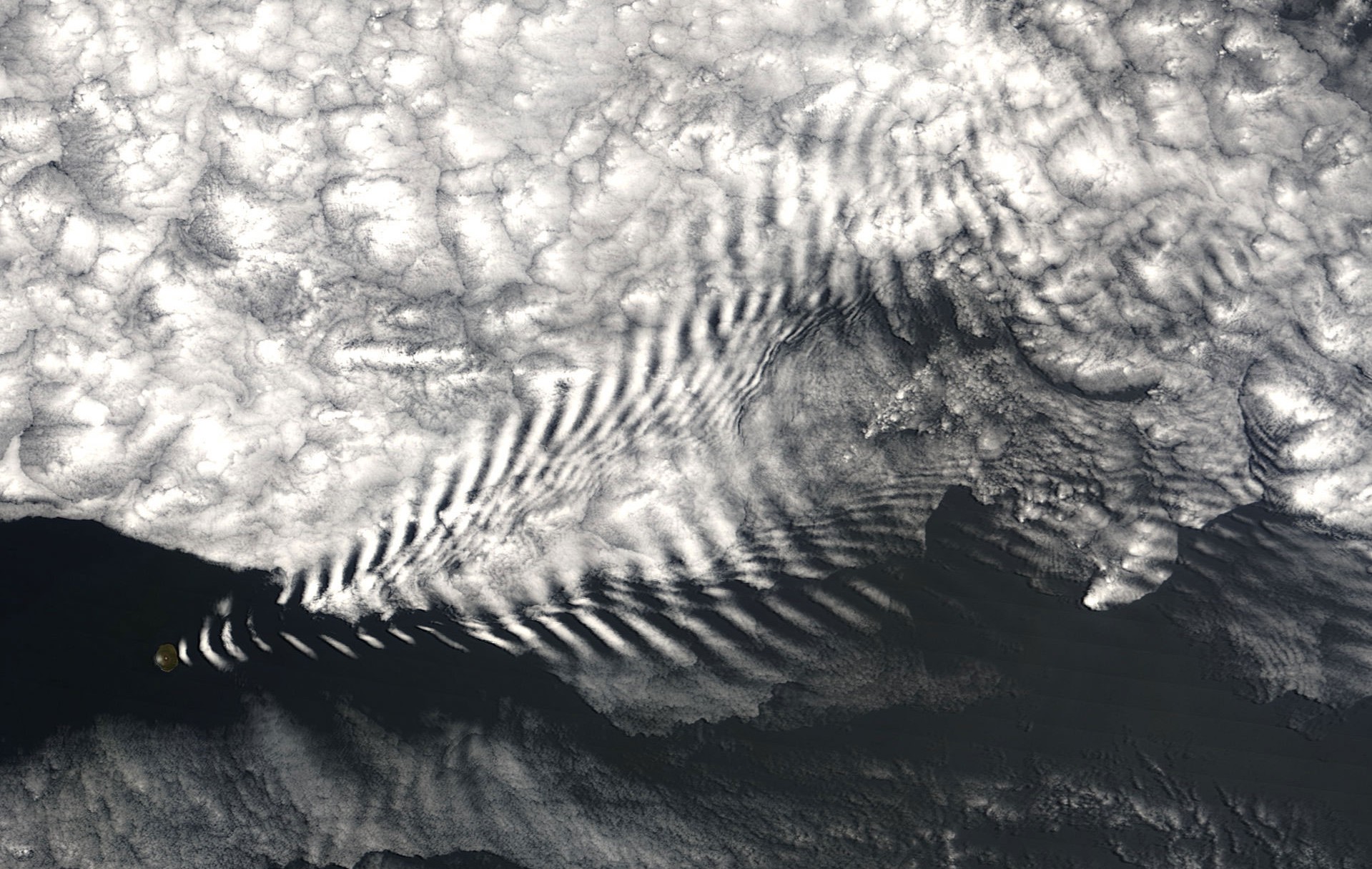
As kayakers, we are intimately familiar with waves on the surface of the water. But waves produced by the same basic physical mechanism—gravity waves—can form anywhere where a perturbation sets off oscillations in a density-stratified fluid. The surface of the water—an interface between two fluids of different densities, water and air—is just the most familiar location. But essentially similar waves, albeit now internal rather than surface waves, can form deep below in the water, and high above in the air.

Continue reading

The 2011 Hurricane Season in 4.5 Minutes

By Vladimir Brezina

Today, November 30, is the last day of this year’s hurricane season.

Hurricanes don’t know that it’s the last day of the season, of course, and in some years they’ve continued well past this date. The hurricane season of 2005, for example, lasted into January 2006; there were so many tropical cyclones that year—among them Katrina and Wilma, respectively the costliest and the most intense Atlantic hurricanes on record—that the prepared names were all used up and six Greek-letter names had to be used.

This year, we are only up to Tropical Storm Sean, so far. This time-lapse satellite-image video compresses the entire 2011 hurricane season into 4.5 minutes. Nothing really striking happens until half-way through the season when the impressive bulk of Hurricane Irene moves up the East Coast of the US… But the time-lapse format does give a powerful impression of the swirling of the weather systems and the recurved paths of the storms—the Coriolis force in action!

I Paddle Faster at Night

By Vladimir Brezina

Illusion of speed

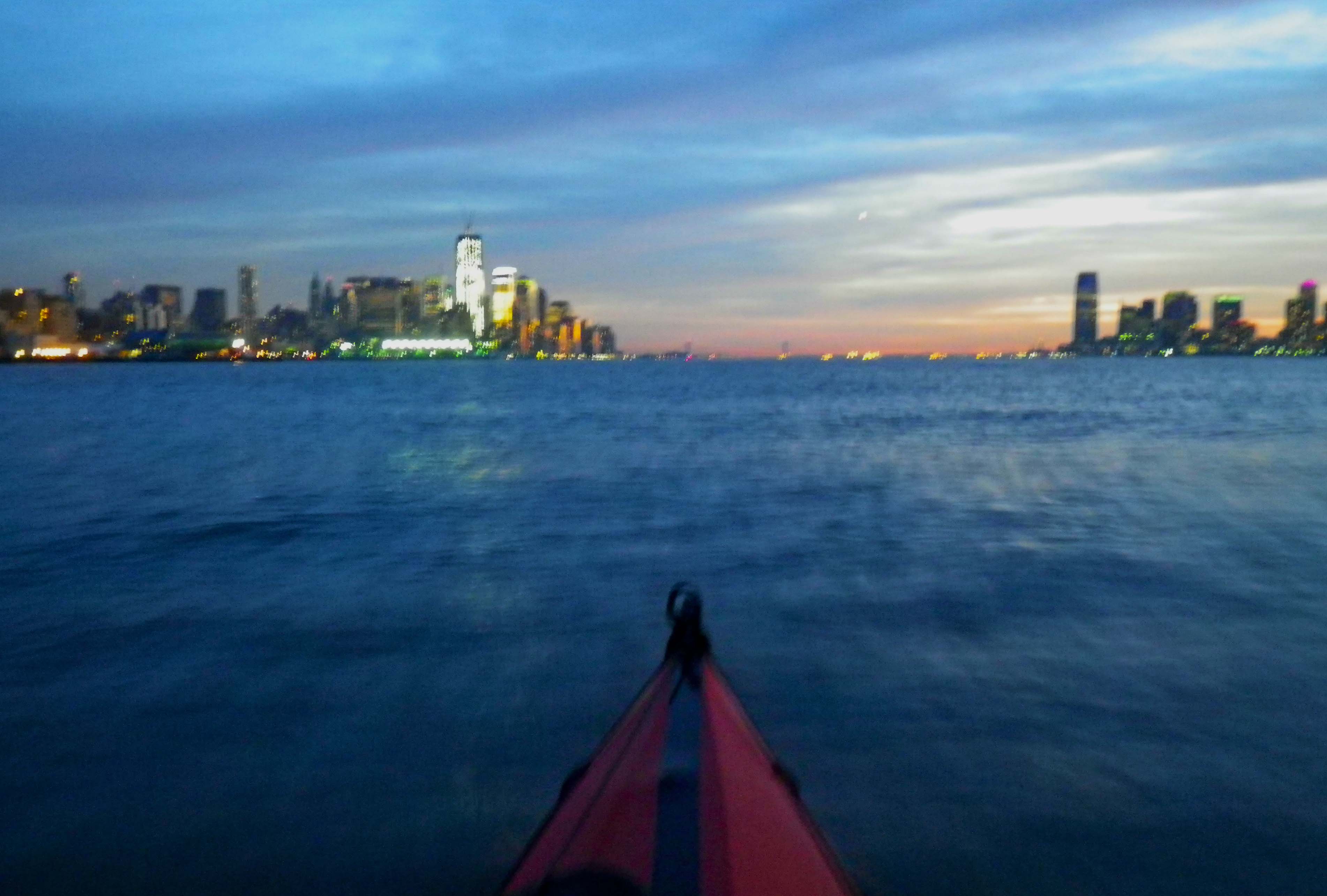
I love paddling at night. Not only for eminently practical reasons—to avoid the heat and humidity of New York’s summer days, for instance—but because of a remarkable visual illusion. As dusk falls, I feel myself paddling faster and faster, until I am simply flying over the water through the darkness. It’s an exhilarating feeling. If you paddle at night, no doubt you know exactly what I am talking about.

But when I look at my GPS, or for a moment emerge into the glare of shore lights, the illusion is shattered. I find that I am paddling at my usual daytime speed, if not slower.

I’ve often idly wondered what the basis of this illusion was. It seems that it’s by no means limited to paddling. According to this article, runners run faster at night, and cyclists ride their bikes faster at night. Even car drivers drive faster at night—although that might not be just an illusion :-).

The explanation given in the article is a relatively plausible one based on well-established neurological mechanisms. When we move through the world, we judge our speed by the speed of the optic flow, the coherent apparent motion of the objects in our visual field past us. But not all objects appear to move at the same speed. Nearby objects appear to move past faster than distant objects. (Indeed, this motion parallax helps us decide which objects are nearby and which are distant, a calculation that itself can generate some potent visual illusions.) Our brain balances the apparent fast movement of nearby objects and the slow movement of distant objects to determine our most likely true speed.

But at night this balance is disturbed. We see, dimly, only the fast-moving nearby objects—the waves around the kayak—and not the distant objects—the distant shoreline whose slow movement would in daytime provide a corrective balance.  At night, all the objects that we see are moving fast. Consequently, we conclude that we are moving fast through the world.

So that mystery is solved. Now I just have to worry about why time goes faster as you get older

Questionable Facelift for a Beauty

By Johna Till Johnson
(Additional material contributed by Vladimir Brezina)

Yesterday, I wrote about the Bayonne Bridge’s 80th birthday. The Bayonne Bridge is one of the loveliest—possibly even the loveliest—bridge in New York Harbor.

But I neglected to mention something in that post. Not because I’d forgotten, but because I don’t like to think about it: Current plans are for the Bayonne Bridge to undergo a structural makeover.

The roadbed of the bridge is being raised from 151 feet at high tide to 215 feet to accommodate the new generation of post-Panamax container ships.

Continue reading

Happy Birthday Bayonne Bridge!

By Johna Till Johnson
Photos by Vladimir Brezina

This past week marked the 80th birthday of the Bayonne Bridge, prompting me to muse about my lifelong love affair with bridges—some in particular.

I love bridges. I’m not entirely sure why. Partly it’s the look of them: They seem almost alive, taking off in a leap of concrete, stone, or steel,  somehow infinitely optimistic and everlastingly hopeful. Partly it’s their function: Bringing things together, connecting people and places that were previously divided. And of course, bridges often cross moving water—another of my favorite things.

But though I love them all, some bridges in particular hold a special place in my heart.

Continue reading

Dance Your Ph.D.

By Vladimir Brezina and Johna Till Johnson

It’s the question every science graduate student dreads:  “So, what’s your Ph.D. research about?” You take a deep breath and begin. People’s eyes glaze over…

The problem isn’t that your life’s work is uninteresting. It’s that the conventional way to explain it can be limiting:  Words can only get so far.  What if there were a better way to tell your story? Something like…  interpretive dance!

The first “Dance Your Ph.D.” contest was organized in 2008 by John Bohannon, the “Gonzo Scientist” of GonzoLabs and a contributing correspondent covering the intersection of science, culture, and art for Science magazine (“who, in true gonzo style, will participate in the events he covers”). Since then, the contest has become an annual event sponsored by Science. For the 2011 contest, 55 dances were submitted “covering everything from psychology to astrophysics,” and the winners have just been announced.

Continue reading

Container Dominoes

By Vladimir Brezina

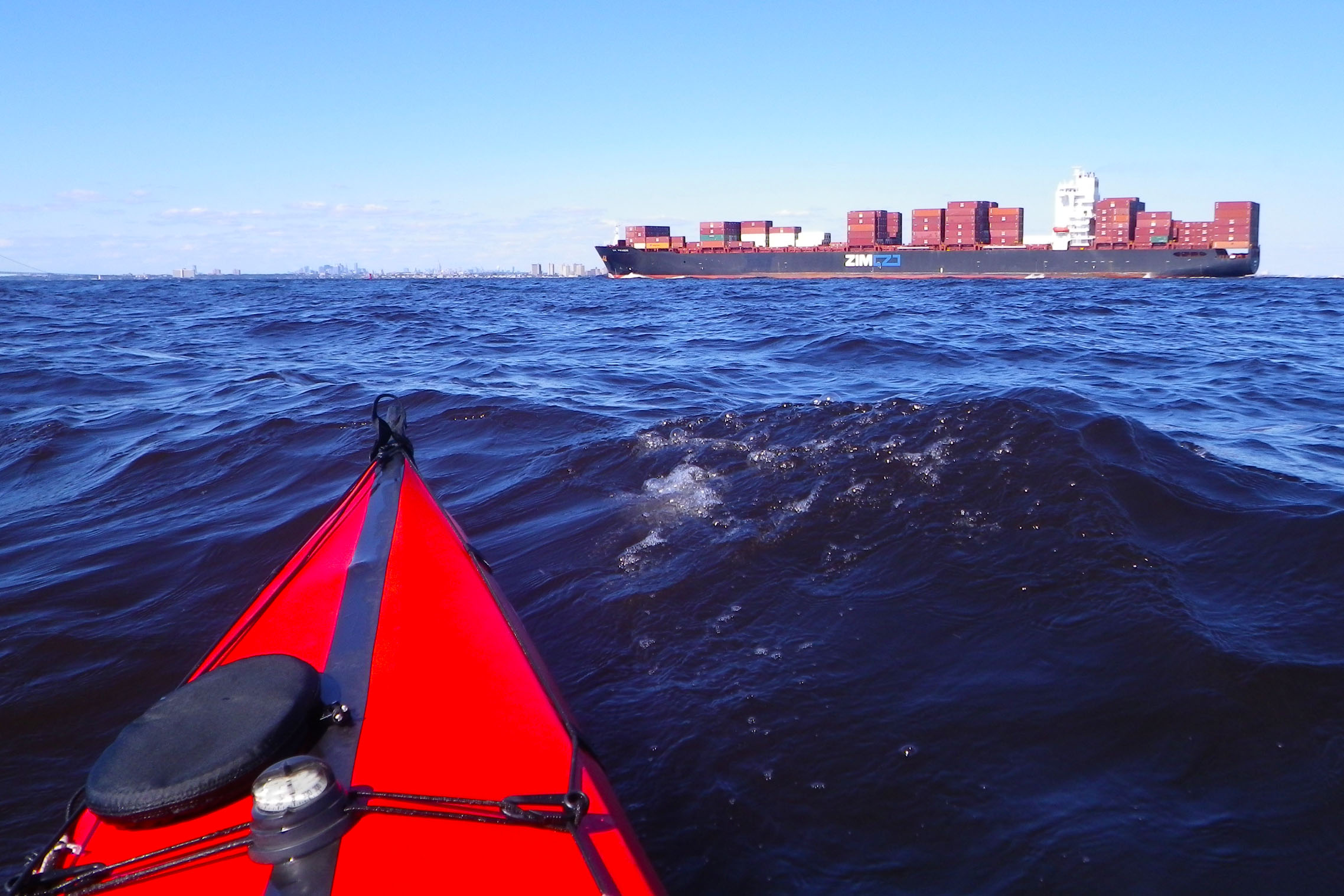
Johna’s recent post about Keith Tantlinger, the inventor of the Twistlock, the device  that has made modern container shipping possible, reminded me of the question that I always have when I see a loaded container ship in the harbor. How securely do all those containers, stacked so high on top of each other, remain stacked when the ship rolls and pitches in heavy weather? (Indeed, how stable is the ship itself when loaded so high, although that’s a different question.) Perhaps suggested by another of Johna’s posts, the image of falling dominoes comes to mind, or perhaps a house of cards…

Well, now there’s an answer.

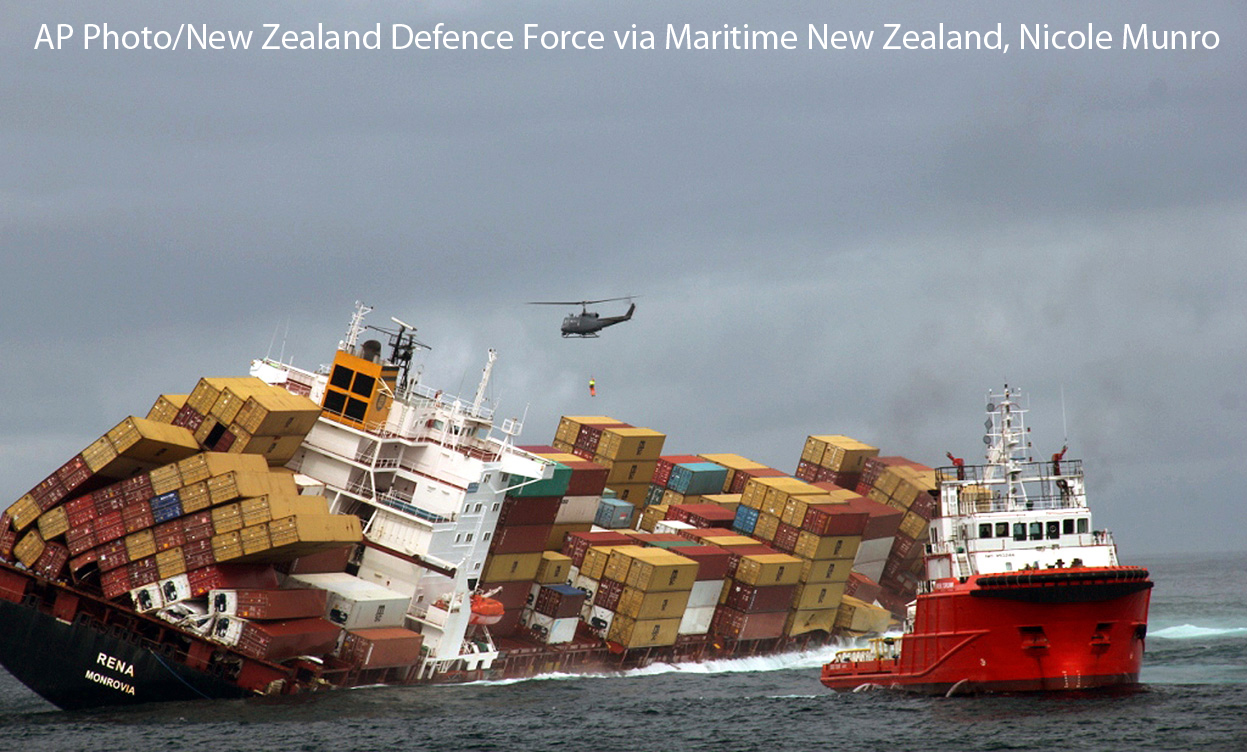
The Twistlock locking corners that anchor each container to the container below, and to the container above, hold up surprisingly well. In this photo of the Rena, the container ship that grounded a week ago on Astrolabe Reef off the northern coast of New Zealand, entire stacks of containers so anchored lean at a 45-degree angle without collapsing…

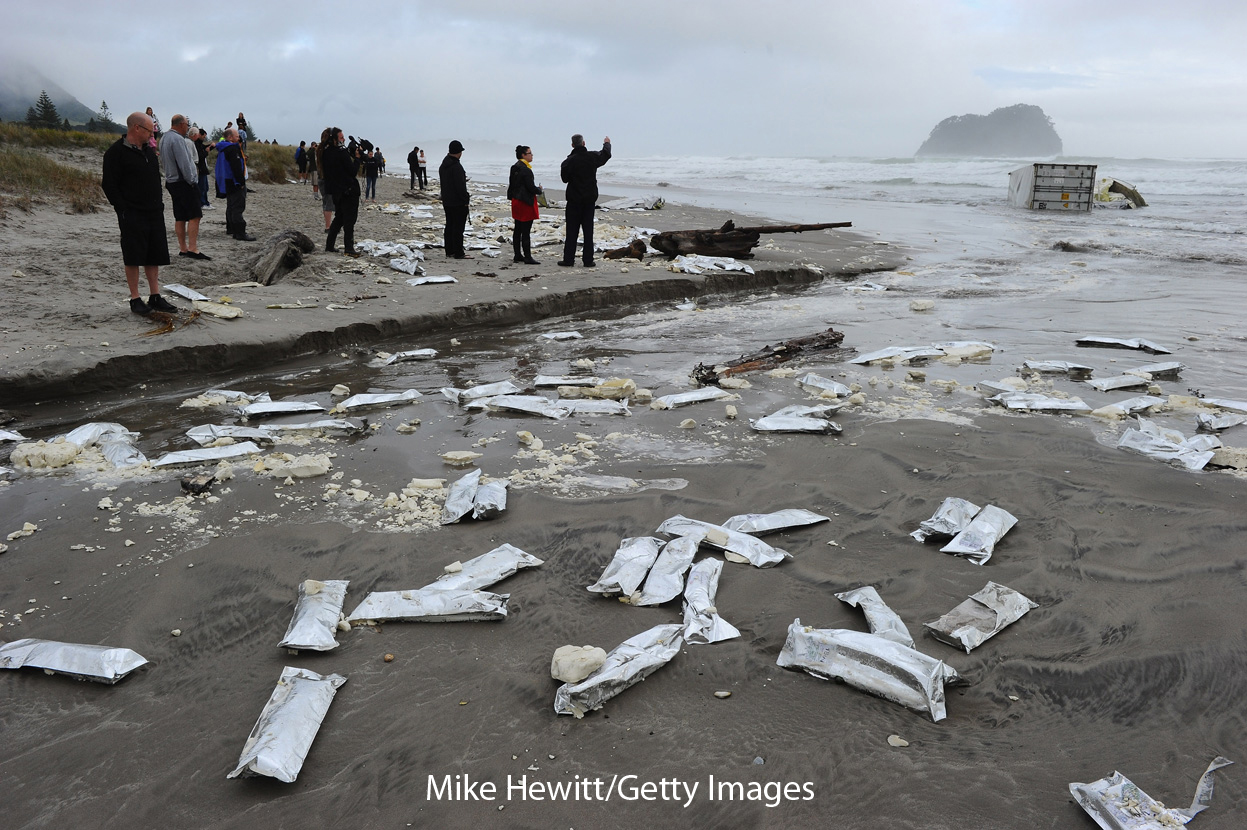
But, inevitably, some containers are falling into the sea and washing up on local beaches. Here, “local residents come to look at a washed up container with its cargo of packets of partly-cooked hamburgers littering the beach…”  (Usually, locals do more than just look…) Unfortunately, not just hamburgers, but large amounts of oil are now also washing up on the beach, and there is no end in sight.

The Atlantic has a series of 32 stunning photos of this, New Zealand’s worst environmental disaster. Take a look!